Déploiement de l'éco-production, des politiques et engagement à l'international, collaboration et partage d'expérience à travers les frontières, co-productions avec Alissa Aubenque, Directrice opérationnelle et de l’international d’Ecoprod et Marine Schenfele, Directrice RSE de CANAL+ Europe et Déléguée générale de la fondation Canal+ et Vice-Présidente Relations Internationales au sein d'Ecoprod.
Merci à Félix Brotte, Lucas Fernandes Mavré, Tristan Gaugué, William Ferrand de l’ESRA qui ont réalisé la prise de son et le montage.
Hébergé par Acast. Visitez acast.com/privacy pour plus d'informations.
Évolution, reconnaissance d'un nouveau métier... avec Ségolène Dupont, Déléguée générale, CPNEF de l’audiovisuel et Charles Jaeger, Coordinateur d’éco-production – Association ACCEPTE
Merci à Léo Buchet, Kérian Clément, Lucas Gaillard de l’ESRA qui ont réalisé la prise de son et le montage.
Hébergé par Acast. Visitez acast.com/privacy pour plus d'informations.
La Fondation 2100 alerte sur le déclin des compétences en mathématiques de la société française et les conséquences pour l’avenir de la nation: un sujet qui a fait l’objet de plusieurs rapports importants ces dernières années et sur lequel revient la fondation dans une note de 12 pages.
La Fondation 2100, en partenariat avec l'Institut d'Études Avancées de Paris, a conclu la deuxième édition du concours Positive Future. Ce concours vise à stimuler l'innovation et la créativité en invitant les participants à réfléchir au futur du travail influencé par l'intelligence artificielle. Les œuvres gagnantes ont été distinguées pour leur vision originale et leur capacité à mêler progrès technologique et problématiques quotidiennes. Découvrez les projets qui ont remporté les prix lors de cet événement marquant, et explorez les discussions enrichissantes qui ont eu lieu lors des webinaires de clôture.
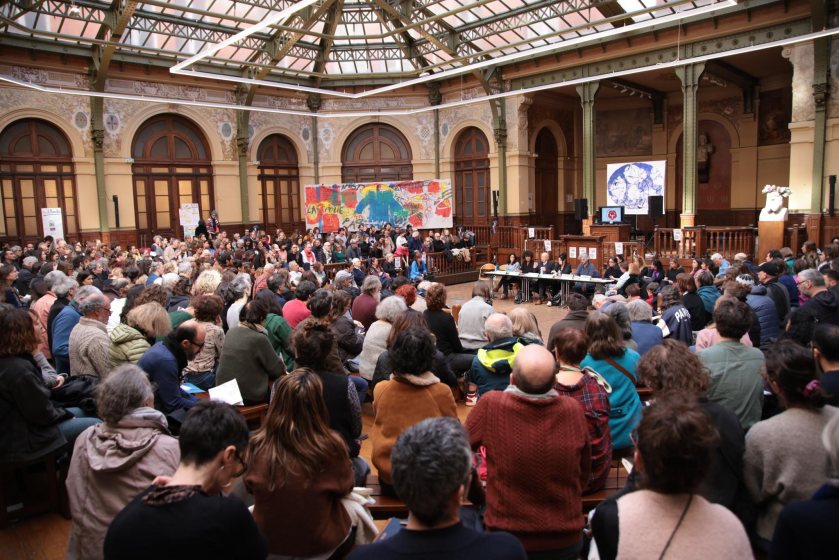
La fresque exposée pour l’occasion a été offerte au Printemps de la psychiatrie le 14 mars par la troupe du Spectacle Pro Bono Publico, qui en réalise une à chaque représentation. On y distingue à peine les dernières lettres peintes, La folie n’est pas une affaire personnelle.
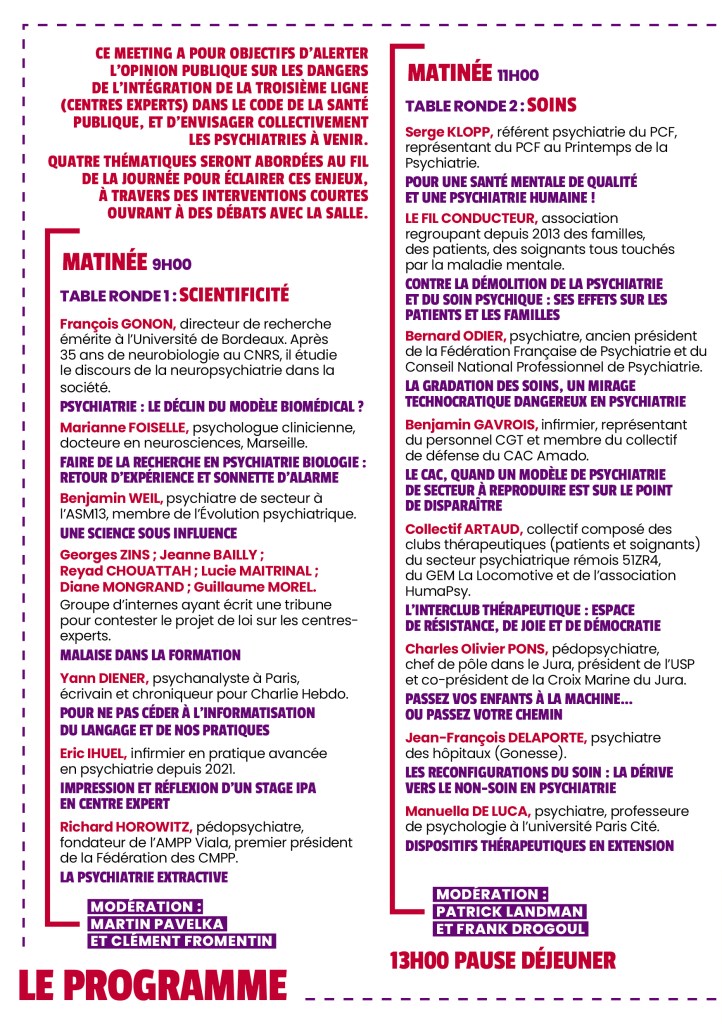
Vidéo de l’Ouverture et de la Table ronde 1 : #SCIENTIFICITÉ
Introduction de la Journée : Patrick Chemla, Delphine Glachant, Cécile Neffati
Argument de la première table ronde : En quoi les discours et promesses de la fondation Fondamental, revendiquant un appui sur la science, sont-ils illusoires et ne tiennent pas la route d’un discours critique et véritablement scientifique Modération : Martin Pavelka, membre de l‘API et du Groupe enfance du collectif des 39 et Clément Fromentin, psychiatre de l’ASM13 et membre de l’Evolution psychiatrique.
Introduction par les modérateurs, à 18 :00
à 20 : 20, François Gonon neurobiologiste et auteur, directeur de recherche émérite à l’Université de Bordeaux : « Psychiatrie : le déclin du modèle bio-médical »
à 28 : 35, Eric Ihuel, infirmier en pratiques avancées : « Impression et réflexion d’un stage IPA en Centre expert »
à 34 : 25, Yann Diener, psychanalyste, auteur et chroniqueur à Charlie Hebdo : « Pour ne pas céder à l’informatisation du langage et de nos pratiques »
à 40 : 33, Richard Horowitz, pédopsychiatre, premier président de la fédération des CMPP : « La psychiatrie extractive »
à 48 : 50, Benjamin Weil, psychiatre de secteur à l’ASM13, membre de l’Evolution psychiatrique : « Pour tout résoudre, cliquer ici »
Quelle idée restrictive et normative du soin est sous-jacente à cette proposition de loi, et quelles alternatives seraient désirables ? En quoi cette loi ne fait-elle qu’accentuer la crise de l’accès aux soins ? Modération : Patrick Landman et Frank Drogoul, psychiatres
à 01 : 02 Collectif Artaud, collectif composé des clubs thérapeutiques (patients et soignants) du secteur psychiatrique rémois 51ZR4, du GEM La Locomotive et de l’association HumaPsy : « L’interclub thérapeutique : espace de résistance, de joie et de démocratie »
à 08 : 21 Serge Klopp, référent psychiatrie du PCF, représentant du PCF au Printemps de la Psychiatrie : « Pour une Santé mentale de qualité et une psychiatrie humaine ! »
à 16 : 54 Le Fil conducteur Psy, association regroupant depuis 2013 des familles, des patients, et des soignants : « Contre la démolition de la psychiatrie et du soin psychique : ses effets sur les patients et les familles »
à 22 : 52 Bernard Odier, psychiatre, ancien président de la Fédération Française de Psychiatrie et du Conseil National Professionnel de Psychiatrie : « La gradation des soins, un mirage technocratique dangereux en psychiatrie »
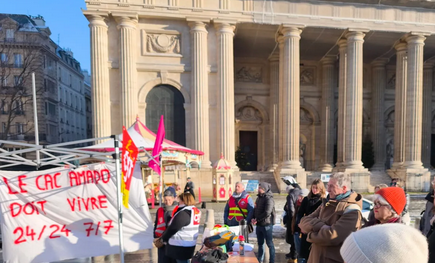
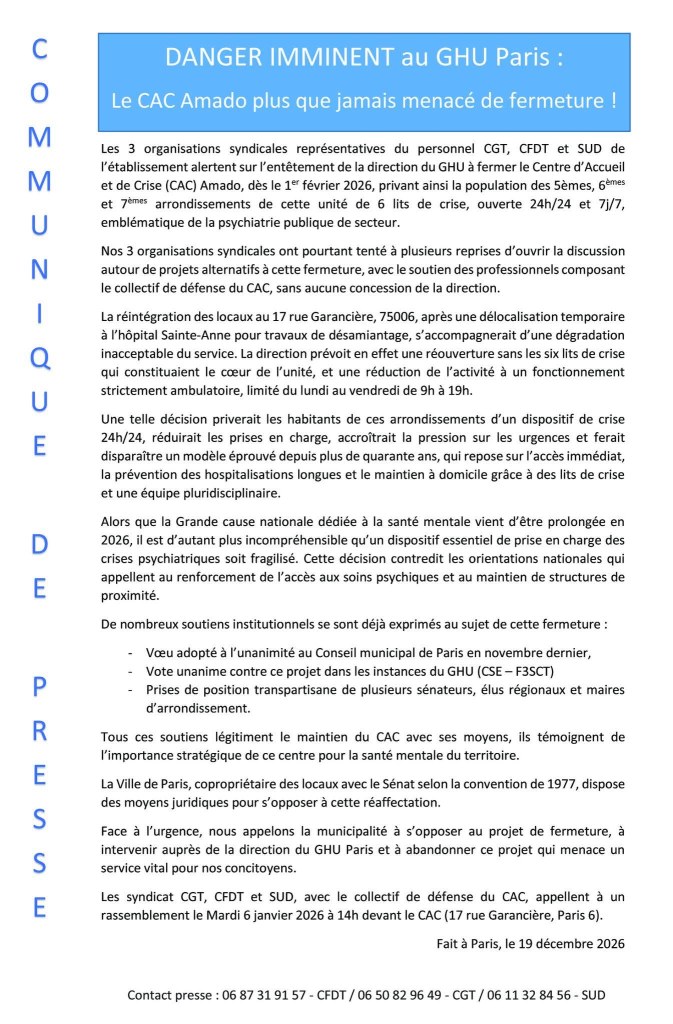
à 31 : 54 Benjamin Gavrois, infirmier, représentant du personnel CGT et membre du collectif de défense du CAC Amado : « Le CAC, quand un modèle de psychiatrie de secteur à reproduire est sur le point de disparaître »
à 38:05 Charles Olivier Pons, pédopsychiatre, chef de pôle dans le Jura, président de l’USP et co-président de la Croix Marine du Jura : « Passez vos enfants à la machine… ou passez votre chemin »
à 42 : 59 Jean-François Delaporte, psychiatre des hôpitaux, Gonesse : « Les reconfigurations du soin : la dérive vers le non-soin en psychiatrie »
à 52: 02 Manuella De Luca, psychiatre, professeure de psychologie à l’université Paris Cité : « Dispositifs thérapeutiques en extension »
Questions et interventions de la salle :
à 05 : 25 Soignantes de la Fondation Vallée
à 13 : 10 Millau cherche psychiatre !
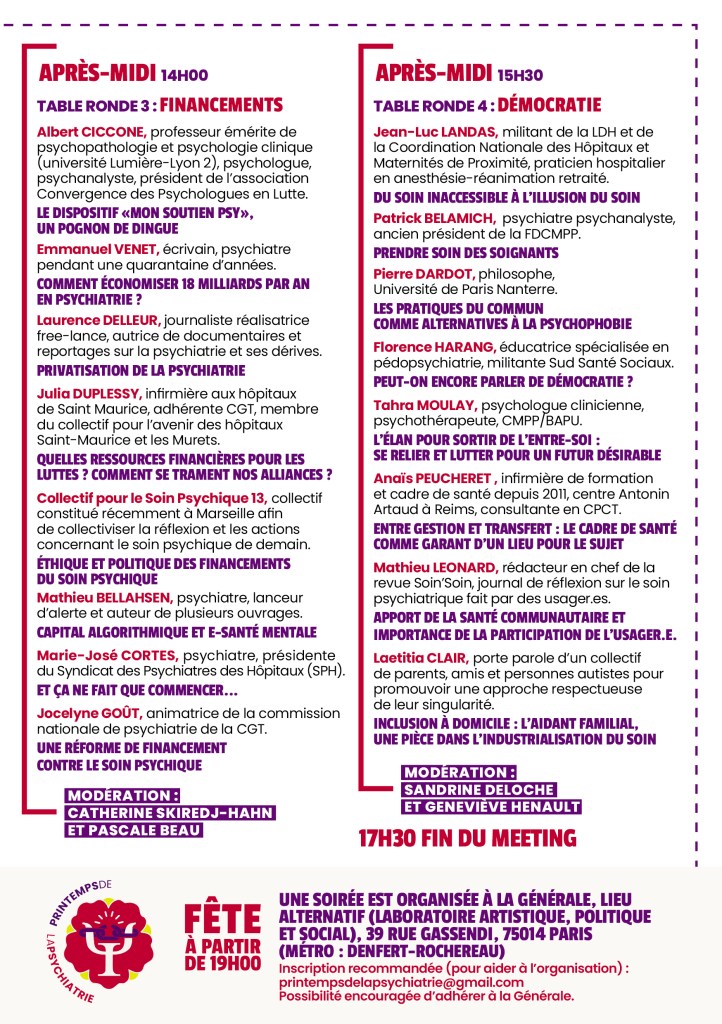
Vidéo de la Table ronde 3 : #FINANCEMENTS
En quoi cette proposition de loi, prétendument inscrite dans une démarche d’économie budgétaire, s’inscrit-elle dans une vision néolibérale largement compatible avec la privatisation lucrative de la psychiatrie ? Modération Catherine Skiredj-Hahn et Pascale Beau
à 0:50, Emmanuel Venet, écrivain, psychiatre : « Comment économiser 18 milliards par an en psychiatrie ? »
à 08:03 audio d’une journaliste, autrice et réalisatrice de documentaires et reportages sur la psychiatrie : « Privatisation de la psychiatrie »
à 14 : 47 Julia Duplessy, infirmière, adhérente CGT, membre du collectif pour l’avenir des hôpitaux de Saint-Maurice et les Murets : « Quelles ressources financières pour les luttes? Comment se trament nos alliances ? »
à 23: 02 Mathieu Bellahsen, psychiatre, lanceur d’alerte et auteur de plusieurs ouvrages : « Capital algorithmique et e-santé mentale »
à 34:50 Albert Ciccone, professeur émérite de psychopathologie et psychologie clinique (université Lumière-Lyon 2), psychologue, psychanalyste, président de l’association Convergence des Psychologues en Lutte : « Le dispositif « Mon soutien psy », un pognon de dingue »
à 42: 10 Jocelyne Goût, animatrice de la commission nationale de psychiatrie de la CGT : « Une réforme de financement contre le soin psychique » :
à 48:36 Collectif pour le Soin Psychique 13, collectif constitué récemment à Marseille afin de collectiviser la réflexion et les actions concernant le soin psychique de demain. : « Éthique et politique des financements du soin psychique »
à 56:21 Marie-José Cortes, psychiatre, présidente du Syndicat des Psychiatres des Hôpitaux (SPH) : « Et ça ne fait que commencer… »
Questions et interventions de la salle :
Vidéo de la Table ronde 4 : #DEMOCRATIE
En quoi la démarche même des centres experts vient attaquer la démocratie et le service public, au bénéfice du marché financier et algorithmique ? En quoi cette proposition de loi ne fait-elle que démontrer l’absence de pilotage de la psychiatrie, résultant en un abandon des patients et des familles ? Modération : Sandrine Deloche, pédopsychiatre et psychanalyste, et Geneviève Henault, psychiatre à l’hôpital public.
à 2:13 Jean-Luc Landas, militant de la LDH et de la Coordination Nationale des Comités de défense des Hôpitaux et Maternités de Proximité, praticien hospitalier en anesthésie-réanimation retraité : « Du soin inaccessible à l’illusion du soin »
à 8:58 Lætitia Clair, porte parole d’un collectif de parents, amis et personnes autistes pour promouvoir une approche respectueuse de leur singularité : « Inclusion à domicile : l’aidant familial, une pièce dans l’industrialisation du soin »
à 15 : 57 Florence Harang, éducatrice spécialisée en pédopsychiatrie, militante Sud Santé Sociaux : « Peut-on encore parler de démocratie ? »
à 22 : 12 Patrick Belamich, psychiatre psychanalyste, ancien président de la Fédération des CMPP : « Prendre soin des soignants »
à 29 : 13 Anaïs Peucheret, infirmière de formation et cadre de santé depuis 2011, centre Antonin Artaud à Reims, consultante en CPCT : « Entre gestion et transfert : le cadre de santé comme garant d’un lieu pour le sujet »
à 34:41 Pierre Dardot, philosophe, Université de Paris Nanterre : « Les pratiques du commun comme alternatives à la psychophobie »
à 41:51, texte de Mathieu Leonard, rédacteur en chef de la revue Soin’Soin, journal de réflexion sur le soin psychiatrique fait par des usager.es.( lu par Marianne Foiselle) : « Apport de la santé communautaire et importance de la participation de l’usager.e. »
à 46:27 Tahra Moulay, psychologue clinicienne, psychothérapeute, CMPP/BAPU : « L’élan pour sortir de l’entre-soi : se relier et lutter pour un futur désirable »
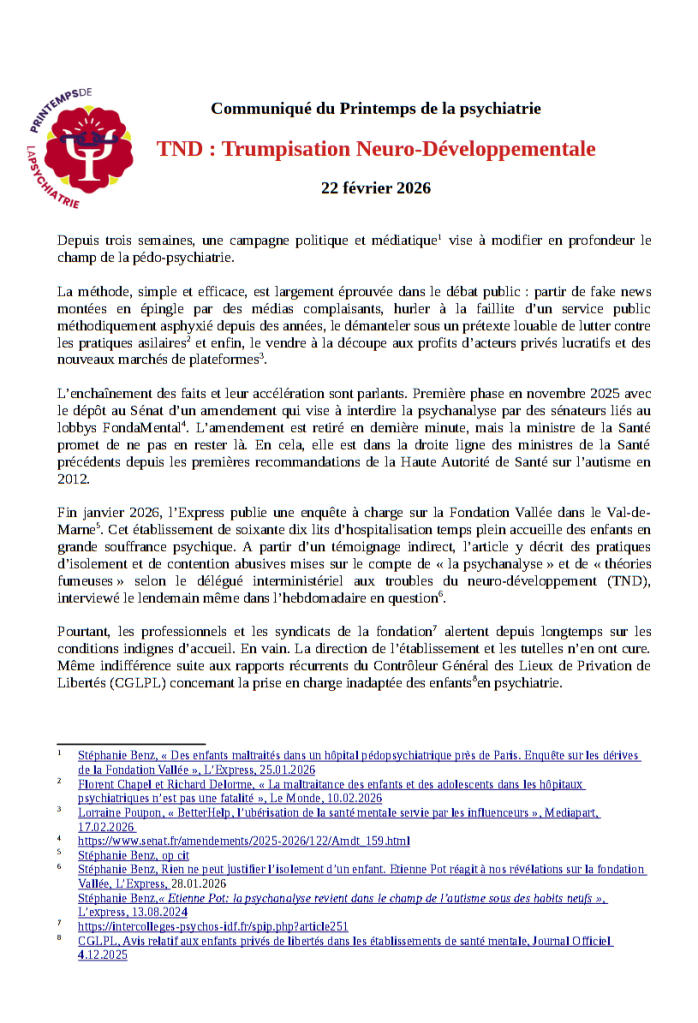
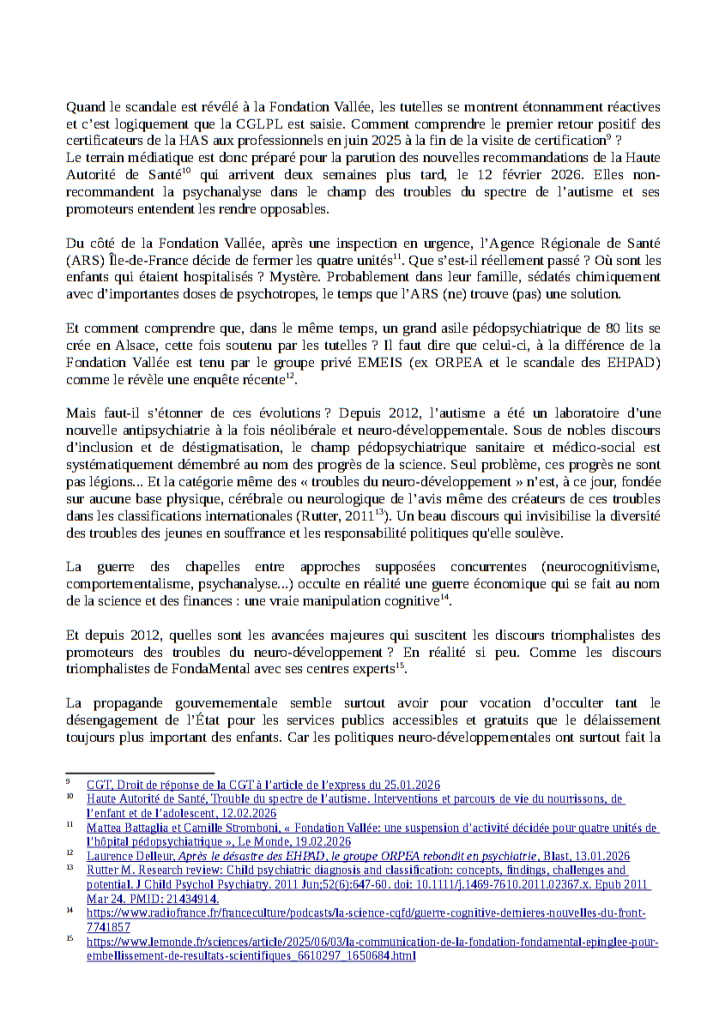
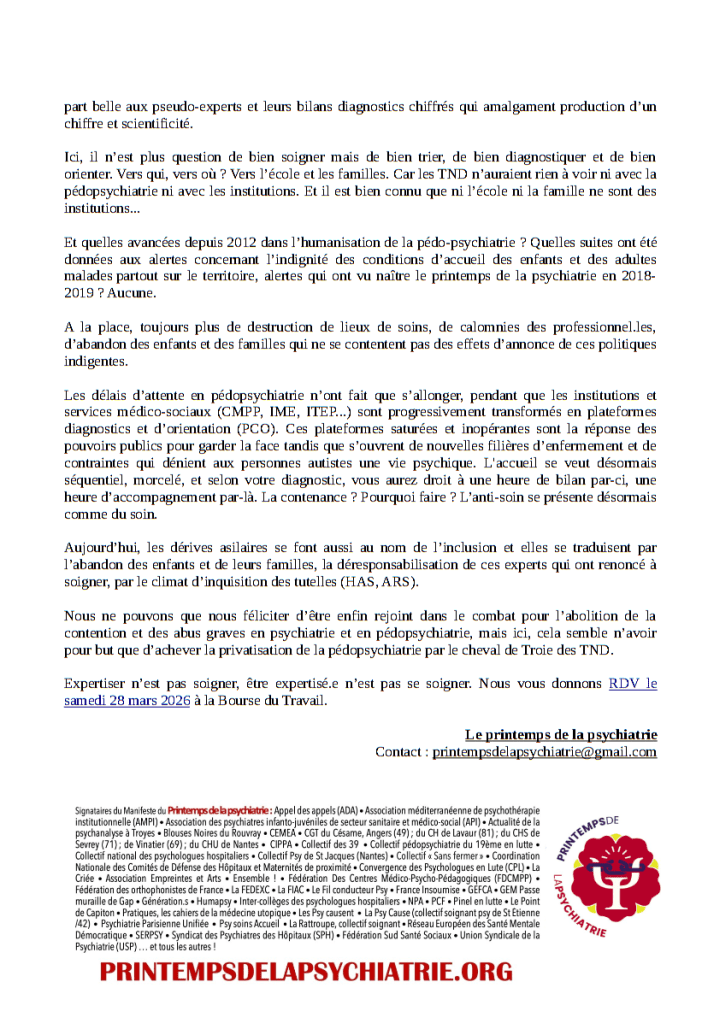
Dans sa lettre ouverte du 17 avril 20261, la Haute Autorité de Santé tenait à rappeler quelques principes face aux pressions de certains industriels. Tout d’abord son « rôle précis », à savoir « évaluer, en toute indépendance […] à partir des données disponibles ». Nous pourrions nous en réjouir, mais nous en sommes surtout étonnés. Dans le champ de la psychiatrie et de la pédopsychiatrie, l’impartialité revendiquée semble écartée. Toutes les données disponibles ne semblent pas avoir été étudiées, ou alors différemment. Comment sont examinés les dossiers ? A partir de quelles études scientifiques et avec quelles vérifications ? Rappelons à ce titre le guide de pratique clinique sur le diagnostic et le traitement des troubles déficitaires de l’attention avec ou sans hyperactivité (TDAH) chez les enfants et les adolescents2, dont les biais et le manque d’objectivité ont été soulignés dans un article de la revue « Prescrire »3. Dans cet article, ces recommandations constituent un « guide à écarter ».
Une absence d’ouverture et un refus de la contradiction
Plus loin dans sa lettre, le collège de la HAS précise : « les usagers sont membres de toutes nos commissions et contribuent aux évaluations ». Nous serions très intéressé.es de connaître ces usagers et leurs nominations dans les commissions, quand nous connaissons les nominations de certains membres décisionnaires dont les conflits d’intérêts ont été maintes fois soulevés.
Plus loin encore, il nous est expliqué le fonctionnement de la HAS : « Collégialement, nous analysons, nous débattons, nous entendons les points de vue dissonants, toujours guidés par l’exigence scientifique. Une fois publiés, nos avis peuvent légitimement être discutés. C’est le propre de la science. »
Là encore, nous nous étonnons de cette revendication de la HAS qui ne semble pas s’appliquer cette « recommandation de bonnes pratiques » dans tous ses champs d’exercice, et notamment pas en psychiatrie et pédopsychiatrie. Des décisions sont prises en lieu et place des professionnel.les qui se voient dépossédé.es de leurs compétences, avec maintenant le risque d’une opposabilité des RBPP, en complète contradiction avec leur code de déontologie professionnelle. La HAS déclare entendre les points dissonants, mais quand a-t-elle entendu l’appel récurrent d’une grande partie des professionnel.les sur la question de l’autisme, des troubles de l’attention et de l’hyperactivité et des « troubles neuro-développementaux » ?
Ce problème du manque de contradictoire est clairement relevé dans le rapport annuel 20254 du déontologue de la HAS, M. Robert Gelli. Celui-ci pense en effet « utile de mettre en place un groupe de travail interne pour essayer de définir une doctrine » sur les potentiels liens intellectuels des experts auxquels la HAS fait appel. Il estime que le lien intellectuel « peut être susceptible de constituer un conflit d’intérêts lorsqu’il est de nature, par son intensité, sa rigidité ou son lien précis des travaux à compromettre l’impartialité réelle de la personne ».
Une neutralité poreuse aux intérêts idéologiques et financiers
La HAS récolte ce qu’elle sème: des lobbyings. En se voulant à toutes les places, elle ne peut qu’attiser les convoitises marchandes et perd sa place de tiers, son autonomie de pensée.
Dans notre secteur du soin psychique, ellepêche par son médico-centrisme, finalement loin des directives de l’OMS qui prônent la prise en compte de contexte de vie des populations dans les questions de santé publique. Même en santé somatique, les professionnel.les soignent des patient.es et non une maladie. Les médecins le savent bien, il y a des personnes dont le traitement ne pourra être que médical, et pour d’autres il ne sera que chirurgical, d’où la nécessité de leur autonomie, de leur liberté de prescrire. La HAS l’a elle-même écrit5 : « Les recommandations de bonne pratique sont des synthèses rigoureuses de l’état de l’art et des données de la science à un temps donné. Elles ne sauraient dispenser le professionnel de santé de faire preuve de discernement dans sa prise en charge du patient qui doit être celle qu’il estime la plus appropriée, en fonction de ses propres constatations. » Et le Conseil d’État dans une décision du 7 juillet 2021 (438712)6 rappelle : « une recommandation de bonne pratique […] ne dispense [pas] le professionnel de santé de rechercher pour chaque patient la prise en charge qui lui parait la plus appropriée ».
Comment alors ces recommandations, rédigées pour aider le praticien à exercer son art, tendent-elles à la création d’un modèle unique, qui serait le seul reconnu par les autorités de contrôle et de tarification ?
Parce que la HAS, organe de l’État, fait surtout des choix politiques, et non des choix scientifiques. Elle le dit elle-même dans sa lettre ouverte : « L’impartialité de la HAS permet de concilier le « mieux soigner » et le « mieux dépenser », avec le souci permanent d’assurer la pérennité de notre système de santé ». Le « mieux dépenser » n’a rien à voir avec la science. En revanche le « mieux dépenser » pourrait clairement être contrôlé par les ARS à travers des recommandations devenues « opposables ».
Peu à peu, la HAS cherche à étendre son influence : après avoir récupéré les missions de l’ANESM, elle s’invente juriste avec l’opposabilité de ses recommandations, et voudrait maintenant récupérer les missions de formation « scientifique » des professionnels de santé7. Nous dénonçons cette centralisation des pouvoirs qui détruit la richesse du soin et va à l’encontre de pratiques éthiques.
Une éthique flexible
Pour rappel, la HAS écrit elle-même dans ses recommandations8 que la réflexion éthique est une « réflexion collective associant une pluralité de points de vue […] déclenchée pas des situations concrètes singulières ». « C’est un processus de va-et-vient du singulier au général […] qui requiert du temps », « implique l’ouverture » et « nécessite la recherche d’apports extérieurs ». Elle précise même : « La réflexion éthique ne dispense pas les professionnels de leur responsabilité. Les décisions en situation appartiennent aux acteurs de terrain, qui ont intégré les questions et conclusions de l’instance éthique dans leur réflexion ». Et pourtant elle s’obstine à vouloir imposer des protocoles uniformes et généralisés dans les établissements de soin !Alors que les RBPP, faut-il le rappeler, se font sur « l’état actuel des connaissances scientifiques » qui par définition évoluent constamment.
La HAS, via ses recommandations éthiques, alerte sur un risque d’infantilisation de l’autre (« c’est pour son bien ») et un risque d’indifférence à son égard (« c’est son choix ») concernant les usagers. Qu’en est-il pour les professionnels de terrain qu’elle ne cesse de mépriser?
La psyché humaine est tellement complexe qu’elle n’obéit à aucune causalité, simple et univoque, et se moque des réductions idéologiques. Toute approche privilégiant une réponse unidimensionnelle est nécessairement à côté. La psychiatrie de précision, c’est la psychiatrie du singulier dans un environnement familial, social et sur un territoire donné ! Seul l’empirisme des praticiens détermine la validité des pratiques.
Nous dénonçons les positions doctrinales de la HAS qui, derrière un discours de neutralité et d’ouverture, a en réalité perdu son obligation de démocratie, son éthique et son exigence de pluralisme dans l’orientation des pratiques.
Suite à l’intervention dans le Meeting du 28 mars de Benjamin Gravois, infirmier, membre du collectif de défense du CAC Amado, le Printemps de la psychiatrie appelle à signer et faire signer la pétition :
Continuons à signer et faire signer la pétition contre la Proposition de Loi (adoptée par le Sénat en décembre 2025) ! Elle comptabilise aujourd’hui plus de 27 000 signatures :
Ce document de « 6 pages » s’imprime sur une feuille A/4 recto verso (format paysage ou horizontal) puis le plier en 3 en repliant le dernier volet sous le premier. Le PDF en téléchargement :
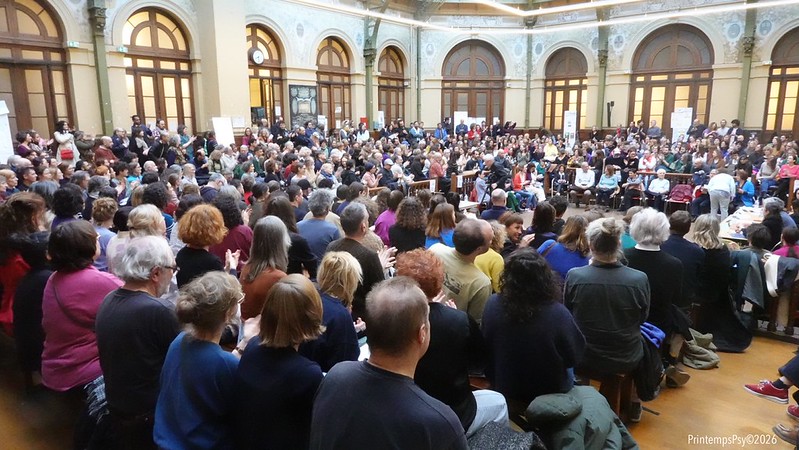
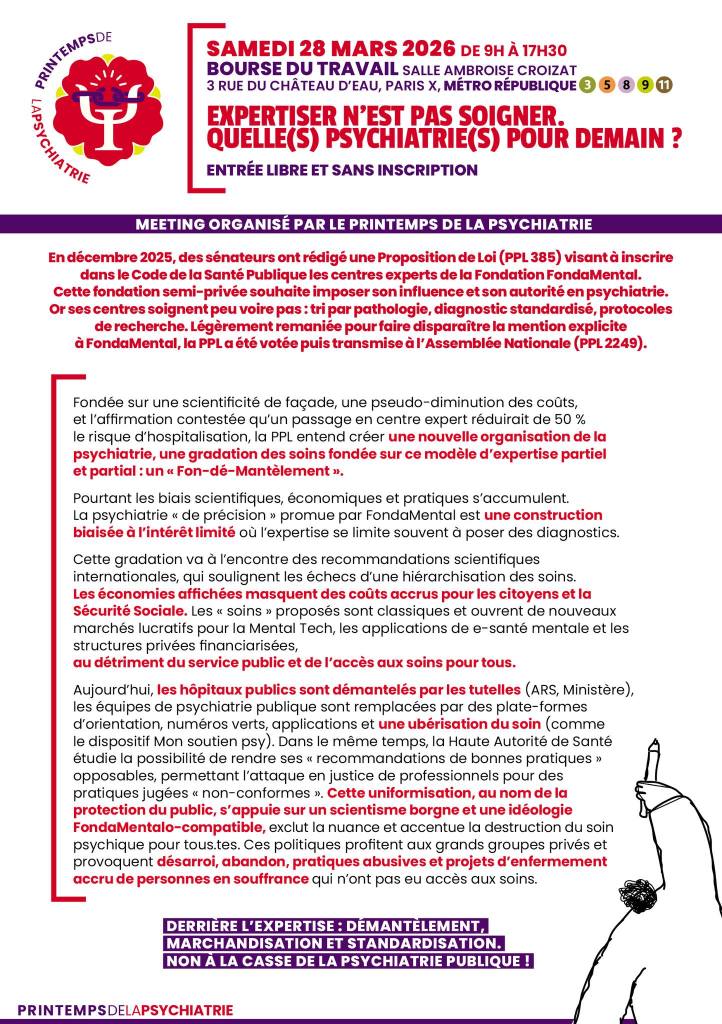
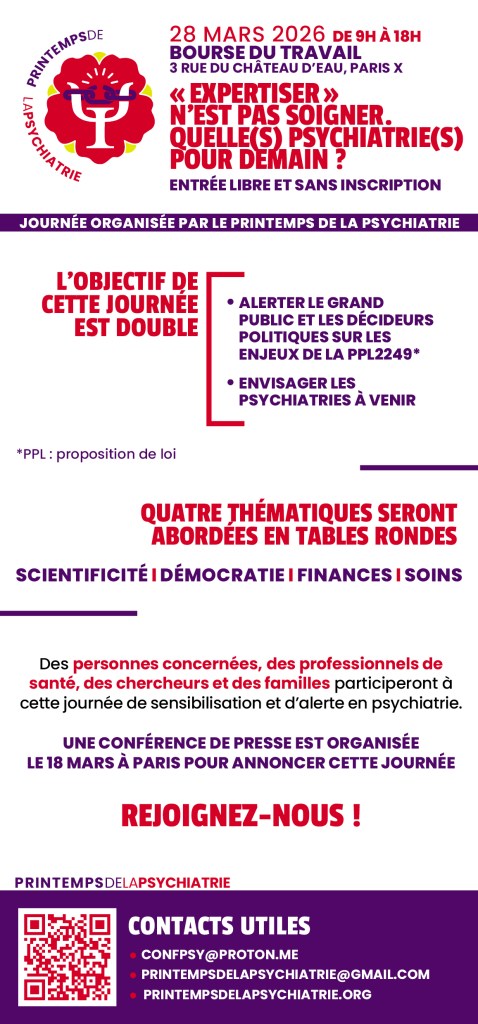
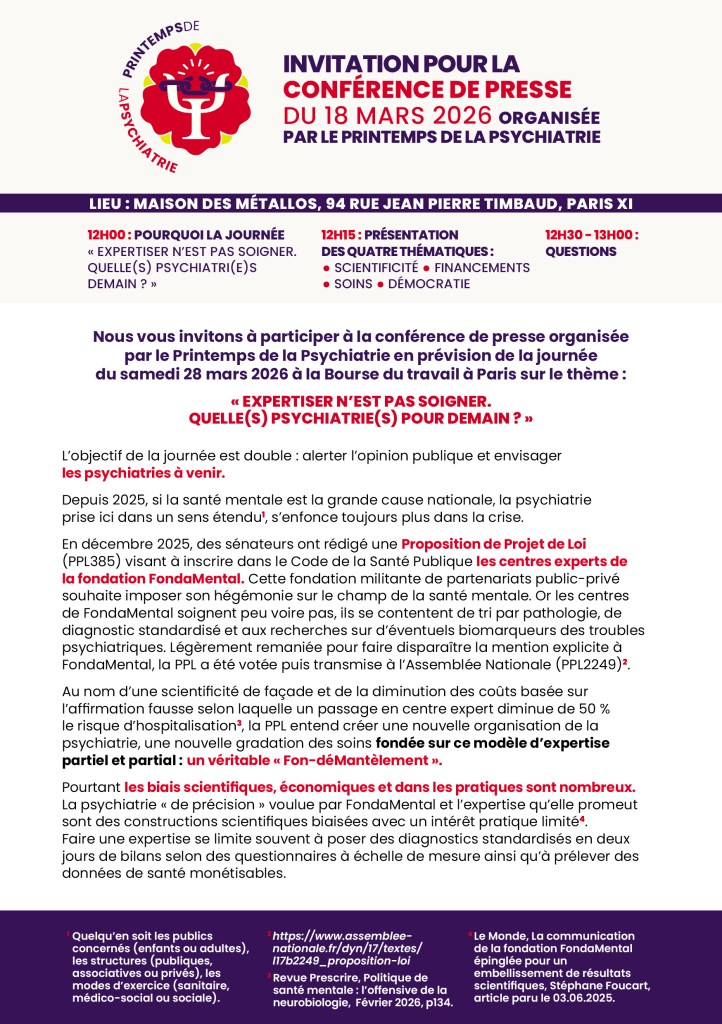
Le Printemps de la psychiatrie organise un meeting le samedi 28 mars 2026 sous le titre : « Expertiser » n’est pas soigner – Quelle(s) psychiatrie(s) pour demain ? afin de mobiliser contre le vote de la Proposition de Loi N° 2249, déjà passée au Sénat.
Il se tiendra à la Bourse du travail de Paris, en accès libre. Save the date !
Le meeting a été annoncé hier aux députés, avec le message suivant :
« Mesdames et messieurs les députés,
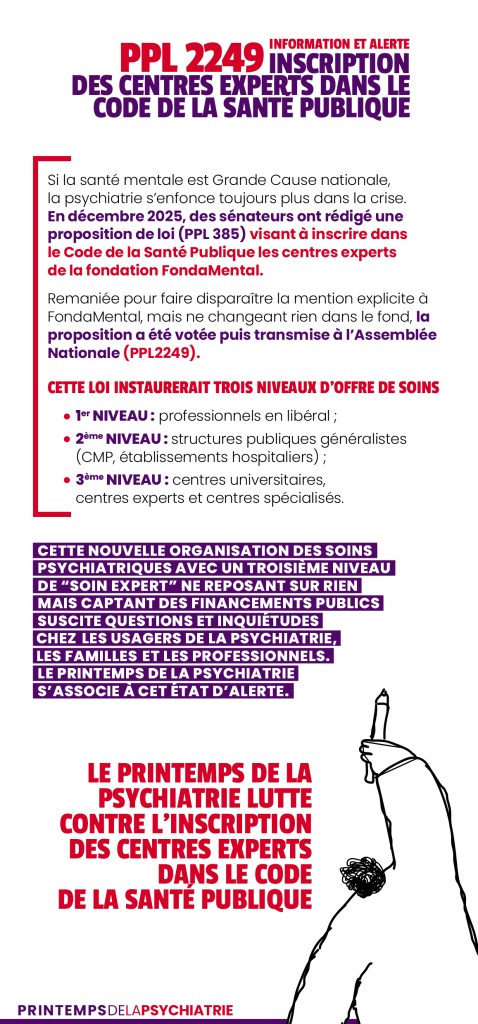
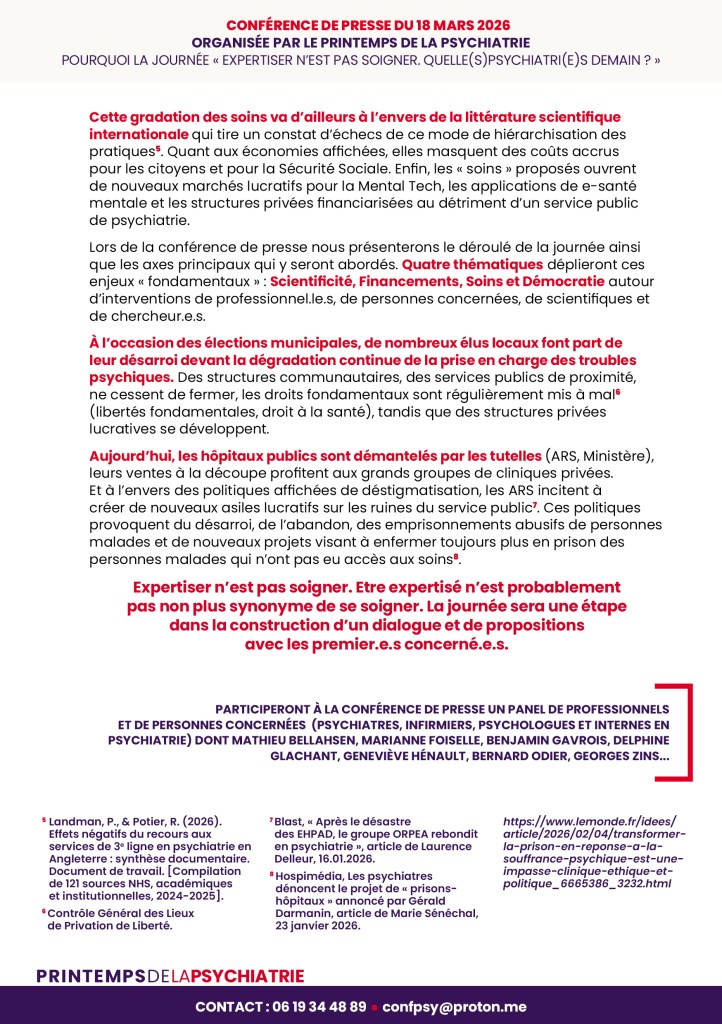
En décembre 2025, la proposition de loi N°385 visant à intégrer les centres experts dans le code de la santé publique a été votée au sénat. Elle est maintenant en attente de débats à la commission des affaires sociales de l’assemblée nationale, sous le N°2249.
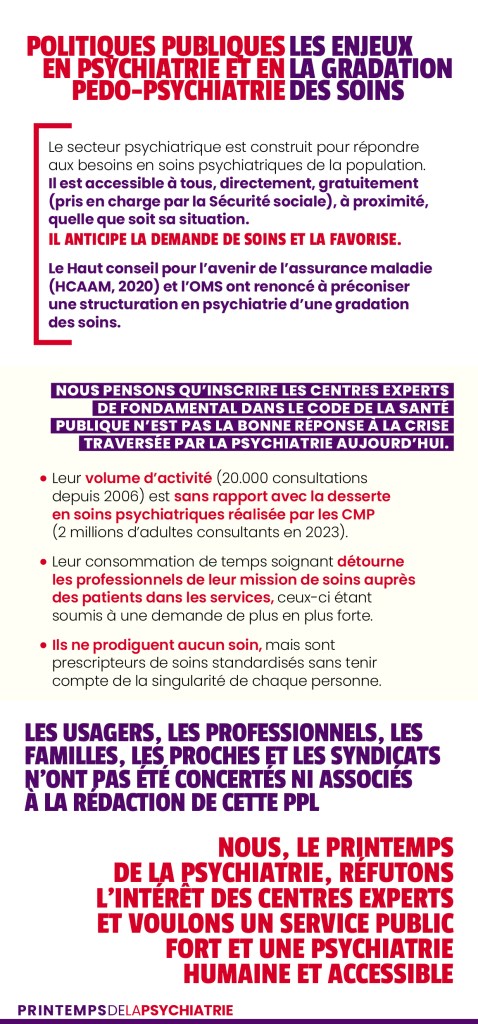
Cette PPL, si elle devait être votée à l’assemblée nationale, entraînerait d’importants remaniements dans l’organisation des soins psychiatriques.
Elle instaure notamment trois niveaux d’accès aux soins.
Un premier niveau avec les médecins généralistes, les psychiatres, psychologues et infirmiers libéraux ; un deuxième niveau avec les structures publiques généralistes (Centres médico-psychologiques, hôpitaux de jour, centres d’accueil et de crise) ; un troisième niveau avec les centres universitaires, les centres experts et centres spécialisés (traumatisme par exemple).
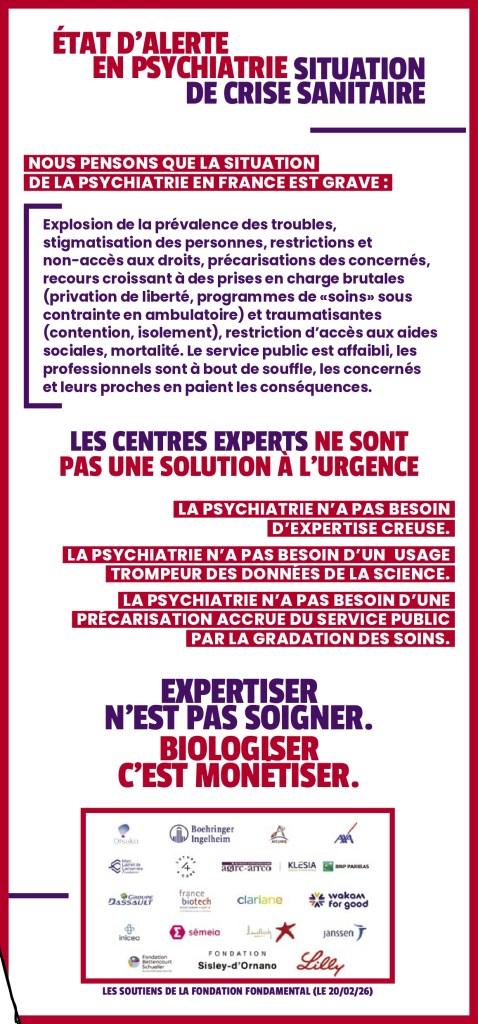
Cette nouvelle organisation des soins psychiatriques suscite un certain nombre de questions et d’inquiétudes auprès des professionnels du soin psychique et de plus en plus de personnes concernées, patients et familles.
Le Printemps de la psychiatrie organise une journée d’échanges et de débats à ce sujet le samedi 28 mars 2026 à la bourse du travail, 3 rue du château d’eau, Paris 10e, de 9h à 17h.
Nous comptons vivement sur votre présence afin de vous sensibiliser aux questions que pose cette proposition de loi et afin d’échanger avec vous qui allez voter prochainement pour ou contre cette PPL.
Delphine Glachant, pour Le Printemps de la psychiatrie »
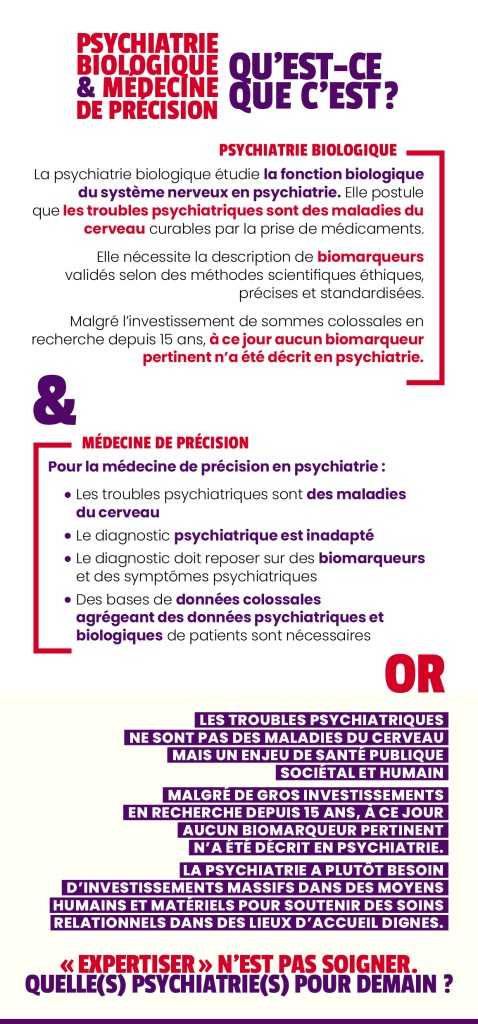
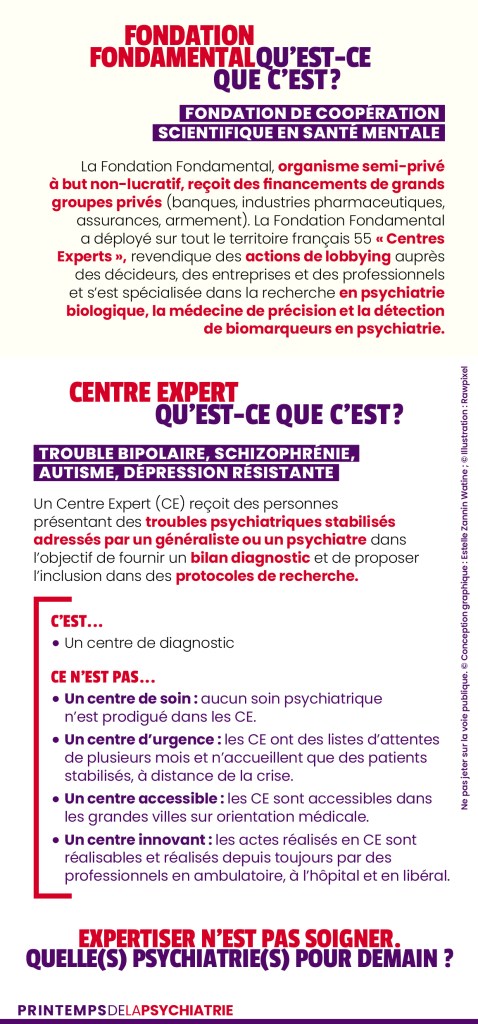
Plusieurs tables rondes seront au programme (encore en cours d’élaboration), autour des thématiques « Scientificité », « Soins », « Financement » et « Démocratie ».
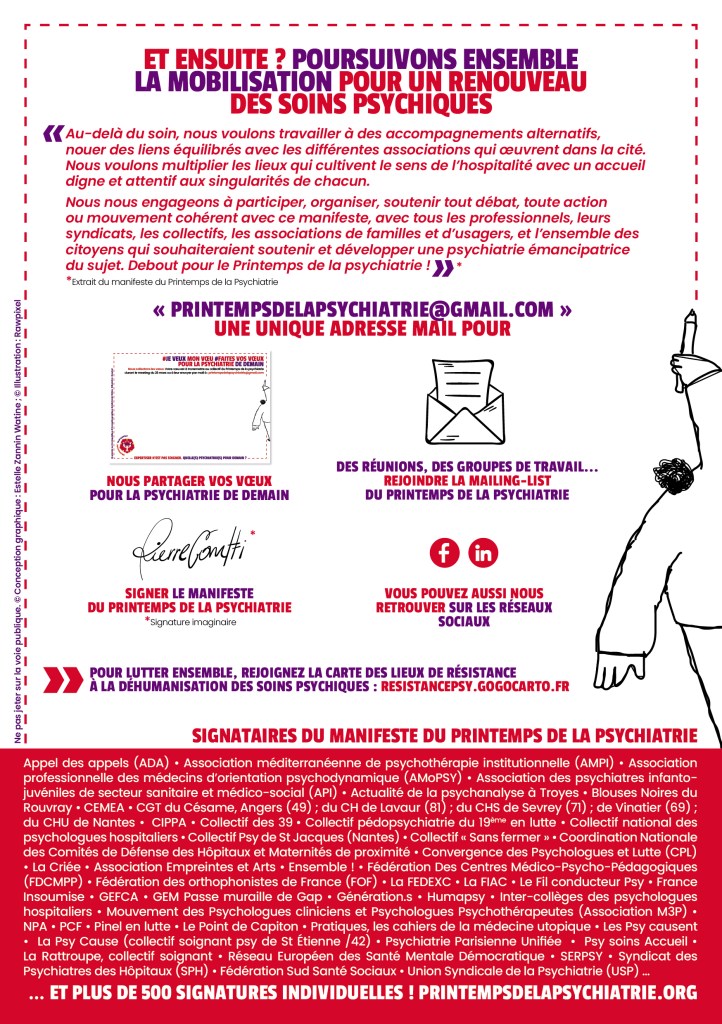
Pour avoir le choix du visuel dans vos partages, voici une deuxième version de L’INVITATION !
In the symbiotic foundation for the Symbiocene, ghehds become the replacement for rights. I proposed:
Instead of a hierarchy of competing rights, assuming autonomous individuals or entities in a contested domain, ghehds respect entitlements of coalescence, vagility, passage, movement and flow within organically and symbiotically unified wholes. Rights assume division, competition and exclusion; ghehds assume unity, cooperation and inclusion.
The emphasis in this definition is on conceptual and material protection or defense of the passage or vagility of life (the biocomunen) within and between the coalitions of life forms and the assessment of the way different life forms manage to symbiotically coalesce and form larger overlapping entities.
Ghehds are the equivalent of a ‘lore’ or a body of culturally mediated knowledge that helps humans determine ‘the good thing to do’ with respect to the human-nature relationship. They help us distinguish between associative and dissociative ways of living.
A rejection of rights-based jurisprudence and governance would be a good first step in the creative application of foundational ghehds for governance and law at continental and global scale. Starting afresh with ghehds will certainly get rid of the ongoing toxic colonial legacy of rights, sovereignty, borders, the crown, nations, and nationalism, etc., that currently rule the Earth. On all colonized places on Earth, such a conceptual metamorphosis is urgently needed.
At the same time, damaged places on Earth require active and urgent repair and human ‘investment’ (to clothe) in seeing the biocomunen restored to full health. Where the damage has already seen the extinction of life, human creativity and work to put into place emergent, hybrid symbioments will cumulatively re-establish planetary-scale interconnections in life, but from the microbiome up.
The idea of ghehds also encourages fresh approaches to issues of injustice where, for example, indigenous land was seized and then must be fought to be returned in Western legal systems based on rival claims about land ‘rights.’ Decolonization and a restoration of indigenous people to a living, symbiotic bond to their own land is potentially ghehds-based radical justice.
Along with rights, other colonialist terms such as “sovereignty” need to be expunged from our dictionaries. Sovereignty, from “soverain,” comes from the Vulgar Latin superānus and Latin “super,” which means to be above all others. As we have seen with symbiosis, there is no higher or lower, no ruled and ruler, and no house and tenant.
We are all denizens (within) of a united nisedom (nested layers of life). It is beyond time we got rid of terms that relate to a mistaken, externalized worldview. A good Indigenous motto is “The land does not belong to us; we belong to the land.” The same logic of the commons applies to the ghehds of the seas, rivers, the atmosphere, and the cryosphere.
Material from my new book: The Symbiocene: Our Only Future (CUP 2027)
Along with the material collapse of life and its vitality, there is also the collapse of what we once would have called a spiritual dimension. As each shared intersection in the ghedeist of life is extinguished, as each holobiont biocomunen is wiped out, we experience a diminishment in our personal and collective identity. As the sixth great extinction proceeds, we sense that we are getting closer to the seventh great extinction … ourselves. I feel this loss in my integrity when the last West African Black Rhinoceros is shot for its horn, or when the body of a little boy, Alan Kurdi, a refugee, washes up alone on the shores of the Mediterranean Sea. The ghedeist connects us all.
Organized religion has never had a mortgage on spirituality but it has been a powerful broker of its meaning in the past. Belatedly, as many forms of non-human life disappear from the face of the Earth, the leaders of many faiths have called for greater efforts to conserve and protect what we have left of ‘creation’. Pope Francis (was) a great leader of the Catholic Church in this respect.
However, in my view, spirituality, as the human search for meaning, has already left the big tree, the big church and the ‘big man’ view of life. It has returned to where it all started … collaboration and association among the smallest possible units of life. That life can grow and evolve from such ‘humble’ beginnings, to now have its human form discover how it all happened, is itself … spiritual. It gives generously of meaning as to how humans ought to live.
The symbiotic turn in our thinking takes us out of formal religion, out of reductionism, out of patriarchy, out of economic liberalism, out of autopoiesis and out of the idea of the autonomous individual. Finally, we are liberated from the dominant ideas that have cajoled us into thinking that we are separate, or must separate from, the rest of individual life forms. We can no longer excuse or justify that separation. Life is a cooperative enterprise held together by associations of diverse life forms that have co-evolved over millions of years. Humans are simply a recent example of large-scale symbiosis in action, as we walk this Earth, courtesy of our gut bacteria.
To have spirituality without religion might come as a relief to many. I feel it is long overdue, as doctrinal spirit in the realm of the other-worldly has now been replaced by the ghedeist within this world … in every nook and cranny. The ghedeist is in every living thing and, if you are open to it, you can feel it everywhere and within yourself. It is about time we loved what and who we are.
Given that the world’s population is now well over 8 billion, it seems absurd to think that we could create a more intensive form of face-to-face democracy to give expression to the multitude of human voices competing for a hearing in the public arena. Town Hall meetings might have worked as an inclusive form of democratic decision-making in some parts of the world in the 1950s, but in the 2020s, such an idea seems arcadian. It is also utopian to think that well-meaning human ‘representatives’ could collect non-human voices and then present them to contemporary parliamentary decision-making bodies.
Despite these obviously formidable logistical difficulties, what must be challenged is the notion that humans can be or act as autonomous individuals, the bearers of individual or corporate rights, wielding power over others in the public domain while at the same time destroying what remains of the once symbiotically united global commons.
In the light of the contemporary science of symbiosis and the philosophy of sumbioism, a new starting point to achieve the major aims or goals of a symbiotically animated society must change from an alienating digital model of lifeless algorithms driving parasiticism of past knowledge – to life-affirming decision-making that drives the conservation of extant life and the creation of knowledge required for successful living in the Symbiocene.
The closest we might get to such a biological model of decision-making in social life is by the use of autoinducer signaling relationships, simbiorithms, simbiotic intelligence (SI) and the holistic information needed to create the Symbiocene. The ‘sim’ in simbiorithms comes from ‘simulation’ (from Latin simulāre to copy, from similis like, and, the Spanish and Italian spelling of symbiosis as simbiosis).
The incorporation of biological models of autoinduction into the silicon-based digital world that will use biofeedback loops, homeostasis, threshold limits, autorepair, monitoring, and biostatic regulation can all be re-imagined using the conceptual tool of simbiorithms. Cybernetics (from the Greek “kubernētēs,” steersman, from “kubernan,” to steer, control) then becomes a biogovernance model based on simbiorithms, simulating homeostatic control within human societies.
The use of simbiorithms entails the retaking of responsibility and control over the digital world and our lives in dead digital spaces. It also means challenging the technological hegemony of the oligarchs and oligopolies who currently own and control those spaces. If all these conditions are met, it is possible that connections between SI, its simbiorithms, and holistic communication processes will help us enter the Symbiocene.
* Draft material in preparation for my new book: The Symbiocene: Our Only Future.
On a foundation of Symbiocene life law based on ghehds, we need to develop a replacement concept for economics, one immersed in symbiosis. As was argued in chapter 4, the term ‘economy’ is based on ‘oikos,’ or the Greek word for the household. The general meaning relates to the (male) management of the household. The new term, ‘sumbonomy’ (sum-bon-o-mee), in addition to the ‘sumbios’ (living together) and ‘nomia’ (to manage), has echoes of the ‘summum bonum,’ a Latin expression for the highest or ultimate good. The French word ‘bon’ also means good. The ‘economy’ of the Anthropocene is replaced by the sumbonomy of the Symbiocene.
As such a social structure does not yet exist, I can only offer speculative thoughts on what form it might take. The sumbonomy is the highest form of practical living humans can undertake for a good life. The sumbonomy is the material foundation for humans living in nature, and we can now create the new conceptual domain of sumbonomics. It has a transdisciplinary partner in sumbiology, or the study of humans living together with each other and other forms of life.
Contrary to the degrowth movement, this conceptual domain can align human enterprise with the symbiotically generated growth that can be found in life. To generate this type of growth, we will need new, creative forms of design and technology based on symbioactive production and benign symbiomimicry. It is from the microcosm—the fungi, algae, bacteria, and archaea, the building blocks of complex life—that the human sumbonomy can be created.
The sumbonomy will be the result of sumbiocentric thinking and, because of the potential for mersis in the Anthropocene, will require the most intense period of genuine growth since the Industrial Revolution. I wish to see the pro-parasitic or terraphthoric (earth destroying) ‘economy’ of the Anthropocene totally replaced by the terranascient (earth-creating) ‘sumbonomy’ of the Symbiocene.
Fossil fuels are finite reserves of energy that can be used only once and are not able to be regenerated in meaningful geological time frames, and similar considerations apply to an insane economy that becomes dependent on “rare” earth elements and compounds. Fossil fuels, because of their finitude, can be owned and traded for wealth maximization. Rare earths are like diamonds. While the current technologies we use to generate renewable energy can be privately owned, the source of that energy, the sun, cannot.[i]
In switching from private property ownership and extraction rights to symbiotically produced resources respectful of the ghehds (intersecting life interests) of free-living microorganisms, we metamorphose from the Anthropocene to the Symbiocene. In doing this, we give microorganisms the space and resources to do what they would want to do anyway, such as reproduce and grow. That is how we shift from the scarcity of fossil fuel energy and materials to the abundance of life forms powered by the sun, plants, and microorganisms, from morbid dead carbon to vital living carbon.
[i] Ralph Nader is supposed to have said “The use of solar energy has not been opened up because the oil industry does not own the sun.” The other way of putting this quote would be to argue that if the oil industry owned the sun, we would have had sun powered renewable energy for everything by now. The good news is that nobody can own the sun as it is an inviolable common with an inviolable ghehd that is more powerful by quantum leaps than all the corporations and despots of the world combined.
*Draft material from The Symbiocene: Our Only Future (2027), Cornell University Press.
AI generated image of a solar shrine where humans once again pay homage to our energy common, the Sun.
While many see the current growth in renewable energy as a long-term bonus for humanity in the fight against climate warming, I see the current technologies based on wind and solar as emergency, temporary, and risky fixes for the urgent climate problem. Importantly, they reduce CO₂ emissions but are still based on symbiocide, toxic extraction, and gross exploitation of people and places. The use of rare earth elements is necessary in renewable energy systems, particularly in the magnets of wind turbine generators and the electric motors of hybrid and fully electric vehicles. There is improved efficiency, but because they are rare and difficult to mine, such ‘expensive’ minerals are highly sought after the world over.
The current system of extraction for rare earth elements, limited minerals, and botanical resources for green energy can be highly damaging. The damage also includes human exploitation, particularly affecting the miners who extract rare earths and elements from their geological locations. Extracting cobalt by artisanal mining, for example, currently involves the exploitation of children in the Congo. Lithium mining for battery production involves similar-scale sacrifice zones as those proliferated by mining for coal or bauxite. Converting British Columbia’s old-growth forests into wood pellets for a British power station (Drax) will soon be phased out; however, forest wood pellets continue to be used as biomass for power.
In Earth Emotions (2019) I made my limited support for the current forms of ‘renewable energy’ abundantly clear:
Critics of renewable energy are quick to point out that solar panels, wind turbines, and lithium-ion batteries are produced using fossil fuels, massive pollution, ecosystem disruption and human exploitation. They are, however, a transition to something far better … Despite how evacuated solar tubes, solar panels and lithium-ion batteries are made, there is absolutely no doubt that, once up and running, they use freely available, non-polluting and safe forms of usable energy. However, if they are merely being used to expand growth within the old parasitic industrial system, the Earth will still be subject to major desolation; it will just take that bit longer than it would have if we stayed using fossil fuel as the foundation of that economy.
The ongoing desolation highlighted above is exacerbated by the trend towards mega-industrial wind turbine complexes, which are proposed and permitted to be built in areas that are located on or near highly biodiverse remnant rainforests in the high country of Eastern Australia. Reasonable questions must be raised about the point of renewable energy if the rare and endangered species you hope to save from climate warming, are the very species now being threatened by industrial wind projects. Such consideration is especially pertinent when species, under the pressure of a heating world, are moving higher in landscapes to remain within their symbio-evolutionary preferences for habitat and extantion.
Massive wind turbine installation in over-the-horizon deep ocean locations solves some of the land-based problems with wind; however, impacts on seabirds and whales continue to make wind power less desirable than large-scale solar power located in places such as ex-mining land that has been irreversibly sterilized of endemic flora and fauna by gross symbiocide …
The urgency of global warming as an existential threat to all life on Earth means that we must use renewable, zero-carbon forms of energy production to counter the immediate threat. But that does not mean current modes of renewable energy are viable into the future. As a first step to symbio-compatible energy, we need to avoid placing industrial scale energy ‘farms’ in hugely sensitive locations. Putting them on ex-open cut mining land would be a good start since it has been sterilized for any other purpose.
A sound second step would be to make wind and solar as bioactive as is possible. The replacement of finite (rare), non-recyclable, and polluting components in wind turbines and solar panels with biologically produced replacements is compelling. Starting with the wind farm towers, laminated wood is now being used as a substitute for steel, and it has a carbon-neutral rating.Turbine blades are now fully recyclable, and those at the leading edge are also made out of laminated timber, which is non-toxic and fully recyclable. The next step is to make whole blades from plant-based material, and the National Renewable Energy Laboratory in the USA has created a new substance for wind turbine blade construction that “is made from inedible sugar extracted from wood, plant remains, used cooking oil and agricultural waste.”
New ways of using ‘life-tech’ to bioactively store energy are also no longer science fiction. Bacteria infused in concrete are helping to store “living energy” for later use. As summarized by Petersen et al.:
A research team at Aarhus University has demonstrated how the world’s most widely used building material can be transformed into a living energy device. By embedding energy-producing bacteria in cement, they have created a biohybrid supercapacitor with surprisingly high performance and a remarkable ability to regenerate itself over time.
The next step toward truly symbiotic energy will be to generate electricity directly from biologically active sources. The use of microalgae within bioreactors to produce biofuel is certainly a lot better than burning forest biomass for energy, as was mentioned with the Drax case. However, the ultimate aim of burning biomass, despite potential carbon neutrality, is polluting in other ways because the combustion process emits particulate matter (PM 2.5 or less), nitrogen oxides (NOx), carbon monoxide (CO), sulfur dioxide (SO₂), lead, mercury, and other hazardous air pollutants (HAPs).
Bioelectrochemical systems are a more desirable source of power for the Symbiocene because they allow living, symbiotically unified organisms to produce harmless renewable energy simply by living their normal life cycle. Microbial-based fuel cells can produce electricity and clean water from human urine. Indeed, having domestic-scale microbial fuel cells allows contemporary humans to re-engage with life processes where, for example, urinating into a fuel cell powered by algae or bacteria can contribute to the energy needs of a house. This new form of domestic symbiosis between humans and algae I call “sumbalere,” or actively nurturing our life-support systems.
Sumbalere is more than caring for, for example, pets; it instils care for all life because it enables humans of all ages to directly participate in the vitality and the cycles of life. In the Symbiocene, instead of ignorant button-pushing to send our bodily “wastes” away, humans perform daily bodily ceremonies to re-energize their houses, produce fertilizer for their gardens, and keep the lights on. Composting toilets convert our excretion into humus that can then be used to grow nutritious food in organic gardens.These are ways to reanimate our current lifeless lifestyles. In the Symbiocene, non-indigenous humans bring their lives closer to those of Indigenous humans who still hold traditional animistic beliefs. Symbolic animism is supported by symbiotic animism.
In Earth Emotions, I made the suggestion that in a future Symbiocene, new forms of energy and light could come from biological sources such as bioluminescence. I suggested that our “lights will shine like fireflies”; however, since I wrote those words, experimental and artistic efforts have been made to bring bioluminescence into greater prominence. A light source that is self-generating from life with zero pollution is an area that deserves greater research support, and in 2022, Rambouillet, a town in France, used this method of lighting in an artistic way.
The use of AI also needs consideration in energy analysis. As it currently stands, AI uses enormous amounts of energy, usually fossil fuel-based, to run and cool the data centers and power networks needed for information storage, computation, and dissemination. AI can be used for calculating energy efficiency, hence generating a reduction of energy waste in systems; however, decentralization of multi-scale biologically based energy sources and more efficient use of energy, e.g., switching from AC to DC current plus advances in QuEra neutral atom quantum computing, will lead to significantly less energy consumption than the conventional servers.
The scale of energy production and use can even be reduced to that of the human body and its own ability to produce and dissipate energy. Zou et al. summarize the potential of harvesting human body-generated bioelectricity for practical purposes:
Finally, the concept of a self-powered closed-loop bioelectronic system (SCBS) is put forward for the first time, which organically combines portable electronic devices, implantable electronic medical devices, energy harvesting devices, and the human body. The prospect of symbiosis between the SCBS and the human body is provided.
The use of our own bodies to ‘power’ symbioactive technologies is no longer science fiction. There is a space opening in biotechnology that just might meet some of the scientifically sound definitions of symbiosis. If we can think of mitochondria as the power stations of the cell, imagining the whole human body as an organic power station that drives nano-symbiotechnology is an exciting possibility for the Symbiocene.
However, as with Elon Musk’s claim that there can be symbiosis between humans and technology (see chapter 4), due caution on the veracity and ethics of these claims for new domains of symbiosis needs to be carefully evaluated. Bioenergy innovation is in its infancy and, like other symbioactive technologies, will need research, innovation, ethics, and public subsidies to put such technology into the Symbiocene.
* Draft material from my book The Symbiocene: Our Only Future. (CUP 2027 in publication).