Vue normale

Il y a de nouveaux articles disponibles, cliquez pour rafraîchir la page.
À partir d’avant-hierFlux principal

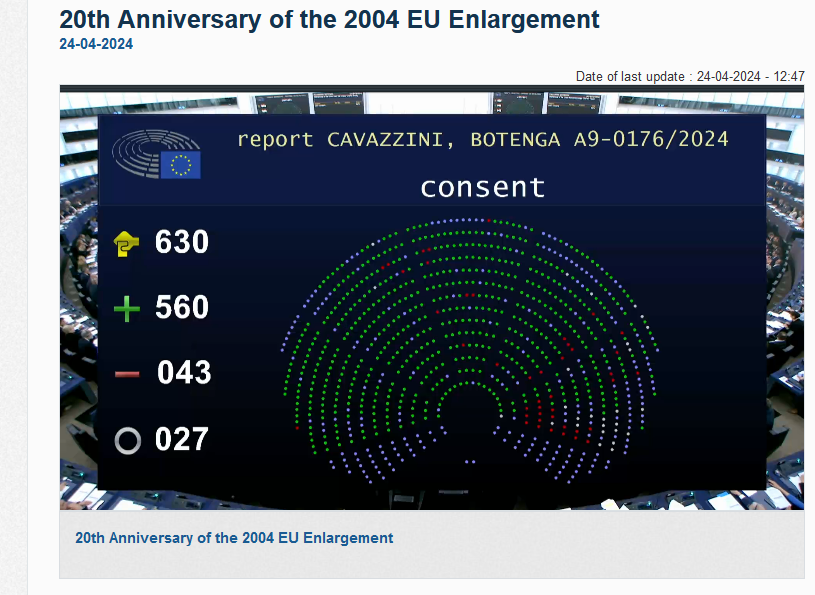
The European Parliament votes in favor of the EU's withdrawal from the Energy Charter Treaty (ECT).

24 avril 2024 à 13:08

The European Parliament has adopted by a large majority the proposal from the European Commission for the EU and Euratom to withdraw from the Energy Charter Treaty. This withdrawal can be officially notified after the final adoption of the proposal by the Council, in the coming weeks. And it will still take another year for it to become effective.

This decision marks a significant new step following the wave of withdrawal announcements from EU member states (Poland, Spain, the Netherlands, France, Slovenia, Germany, Luxembourg, Denmark, and Portugal) and the United Kingdom.

In practical terms, exiting the treaty means that new investments made in the energy sector (especially fossil fuels) will no longer be protected, which is excellent news. For investments made before the withdrawal date, which remain protected for 20 years, the EU is already planning to adopt an intra-european instrument to clarify that the Energy Charter Treaty (ECT) cannot apply to intra-European disputes. However, it should also prepare a parallel agreement with third countries leaving the ECT to neutralize the ECT's 20-year survival clause and thereby mitigate the risks of disputes.

Notes:

(1) Among these countries, 5 have officially notified their withdrawal. This withdrawal became effective for France, Germany, and Poland in December 2023. This will also be the case for Luxembourg in June 2024, for Slovenia in October 2024, and for Portugal in February 2025.

(2) The British government announced in February 2024 its upcoming withdrawal from the ECT after the failure of modernization efforts to align the agreement with a carbon neutrality trajectory. The Swiss government also indicated in November 2023 that it would consider withdrawal if modernization could not take place or if many EU member states left the ECT.

EU pesticides export ban: what could be the consequences?

18 avril 2024 à 09:00

The report focuses on how a ban would affect EU employment, as well as the impacts on human health and the environment in importing countries. It concludes that stopping the export of EU-banned pesticides would neither endanger employment nor burden the EU economy. At the same time, a ban would positively impact people's health and the environment in importing countries.

While pesticides are banned in Europe because they are too hazardous for humans and/or the environment, European companies are still allowed to manufacture and export them in other parts of the world. This EU double standard poses a threat to human health and the ecosystems in importing countries, mainly Low- and Middle-Income Countries (LMIC). At the same time, the EU imports food grown using these substances, leading to exposure of EU consumers via residues in imported foods and also putting EU farmers in an unfair competition.

After committing to ban the export of these pesticides in 2020, the EU has been stalling, and even backtracking, under pressure from the industry, which fiercely opposes the adoption of an EU-wide export ban. The main argument used by the industry is that an export ban would harm the EU economy and create a massive job loss for pesticide producers while having no beneficial impacts for the protection of human health and the environment in importing countries. The thorough investigation presented in this report gives a completely different picture :

  • A negligible economic cost for the EU. The total number of jobs potentially at risk as a result of a hypothetical EU export ban would be as low as 173 jobs in 2022. Based on the experience with the partial French export ban, the authors conclude that the total potential loss of employment would have accounted for 25 jobs in 2022 for the entire EU. In the end, no jobs might be lost at all as staff may be relocated or given different tasks.
  • Positive impacts for importing countries. To this day, the EU remains the world's leading exporter of pesticides. Consequently, stricter rules on pesticide exports will have positive effects on chemical pollution globally. Halting exports of pesticides banned by the EU would reduce exposure and all associated risks for the health of agricultural workers, local populations, and the environment.

Based on these findings, the coalition of civil society organizations urges EU policymakers to act without further delay.

Alternatives for a fair and sustainable partnership between the EU and Mercosur: scenarios and guidelines

17 avril 2024 à 18:09

On 28 June 2019, the EU and Mercosur reached a political agreement towards a free trade agreement between the two regions, after 20 years of negotiations. In the ensuing period, the path to ratification has been fraught with internal and external challenges. The agreement was highly criticised for its potential environmental and social impacts.

Indeed, the EU-Mercosur agreement promotes trade flows of goods incompatible with the objectives set by the Paris Agreement, the European Green Deal, and the Farm to Fork Strategy. It poses significant risks for Mercosur countries, as it locks them into a role as agro-exporters, and worsens deforestation in the Amazon. Its implementation would also negatively affect EU countries, notably from a health perspective, as it would facilitate the entry of products produced using practices prohibited in the EU.

These obstacles prompt a critical examination of the viability and plausibility of ratifying the current agreement in its present state – from an environmental, social and democratic perspective, but also regarding the discrepancy in production standards between the two blocs, in the context of farmers' protests across Europe.

The report, authored by Veblen Institute, CISDL, E3G, FTAO and IEEP, coordinated under the Green Trade Network, and commissioned by the Greens/EFA group in the European Parliament, explores 4 scenarios for a fair and sustainable partnership between the EU and the Mercosur region :

  • Alternative 1. Renegotiation of the deal : with key elements to consider such as, making tariff preferences conditional on effective compliance with sustainability criteria for all the most sensitive products from a climate and biodiversity point of view, compliance with environmental and climate commitments as well as core ILO conventions as an essential element of the EU-Mercosur Agreement, specific and measurable commitments in the TSD chapter, etc.
  • Alternative 2. A bilateral partnership on sustainability issues without access to market (high level of cooperation, low level of market integration)
  • Alternative 3. Targeted cooperation and integration: a bilateral partnership on sustainability with targeted market access
  • Alternative 4. Targeted Bilateral Strategic Partnership(s) (on critical raw materials)

The Report also contains policy recommendations for decision-makers and negotiators on both sides to build future relations between the EU and Mercosur :

1. Any agreement or political partnership with Mercosur countries (as a bloc or individually) should be compatible with the Paris agreement and the Kunming Montreal framework in compliance with international human rights law, ILO Standards, WTO law and Public International Law.

2. Future cooperation vehicles between the two blocs should be based on dynamic assessments of the impacts of any market access measures on both ecosystems and local communities. They should include tailored roadmaps for addressing key environmental and social issues, combined with review and adjustment clauses.

3. Any EU-Mercosur partnership should be supported by a financial package that facilitates compliance with EU market access requirements and contributes meaningfully and sustainably to the Mercosur region's clean and circular economy transition, further linking the EU's trade policy with specific programmes such as the Global Gateway.

4. The future partnership should provide a series of assistance measures to ensure sustainable management of resources and a fair allocation of value as well as to raise the capacity of local actors to comply with the EU's environmental and labour regulations.

5. Parties should refrain from seeking to increase trade between the two blocs as a goal in itself, but primarily seek to improve commercial partnerships of products that are produced sustainably and are not easily available in the other bloc.

6. Market-opening provisions of such a partnership should focus on trade in sustainable products produced by companies abiding by the CSDDD and similar laws, favouring local and domestic products when possible. This shall also mean stopping the export of harmful substances that are banned in the EU (pesticides).

7. Any initiative for dialogue on standards should be aimed at increasing the level of protection for workers, consumers and the environment and not at facilitating trade (which may be an indirect benefit but should never be a condition for it).

💾

Veblen Institute's submission to the UNFCCC Sharm el Sheikh dialogue

31 mars 2024 à 09:57

The UNFCCC launched a call for submission in the framework of the Sharm el-Sheikh dialogue on topics to be discussed in upcoming workshops on the scope of Article 2.1(c) of the Paris Agreement (1). Based on submissions received, the chairs of the dialogue will decide which topics to address in the following four workshops over 2024-2025.

The Veblen Institute's contribution focuses on ending fossil fuel investments protection to bring financial flows in line with Article 2.1(c) of the Paris Agreement. The contribution points out that current international investment agreements and the investor-state dispute settlement mechanism are significant obstacles to climate change mitigation and adaptation. One of the measures needed to achieve the objective of Article 2.1 (c) is to remove fossil fuel investments from the list of activities covered by investment protection as soon as possible. This is why this key issue should be addressed as part of the UNFCCC dialogue in Sharm el-Sheikh.

Note
(1) Paris Agreement, Article 2.1(c) : "This Agreement, in enhancing the implementation of the Convention, including its objective, aims to strengthen the global response to the threat of climate change, in the context of sustainable development and efforts to eradicate poverty, including by: (...) (c) Making finance flows consistent with a pathway towards low greenhouse gas emissions and climate-resilient development".

❌
❌