Vue lecture

Il y a de nouveaux articles disponibles, cliquez pour rafraîchir la page.
🔲 ☆

Yes, the Olympic ceremony parodied The Last Supper. And it would be nice if the media admitted that.

I briefly return to my last essay on the opening ceremony of the Olympic Games, particularly to the parody of Da Vinci’s Last Supper. As you know, quite a few people found that parody blasphemous and perverse, an open manifestation of the decadence of globalist institutions. I revisit it here to draw attention to the mainstream reaction to the uproar. I find that reaction particularly interesting and typical.

Mattias Desmet is a reader-supported publication. To receive new posts and support my work, consider becoming a free or paid subscriber.

Here’s how it went: the mainstream media believed they could instantly dismiss the outrage over the alleged blasphemy. They made a quick call to the artistic director of the ceremony, who immediately revealed The Truth: the theater in question during the opening ceremony had nothing to do with The Last Supper. It represented a pagan Feast of the Gods. They were done. The fake news spreaders on X and other conspiracy theory sites were debunked once again.

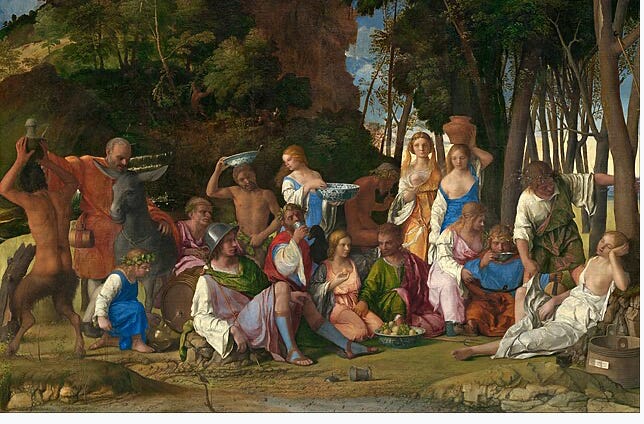
The army of fact-checkers, digital first responders, and other zealous supporters of the globalist ideology sprang into action. They posted references to the artistic director’s words under claims about The Last Supper and even added Bellini’s painting, The Feast of the Gods, here and there. This way, everyone could see with their own eyes which painting it was actually about. The only slightly odd thing – which surely the great Ambassadors of Truth of globalism also noticed – was that Bellini’s painting didn’t really resemble the grotesque theater staged in Paris. But who cares, the artistic director had spoken, oracle of Truth, no more reason to doubt: the entire outrage was based on delusion and illusion.

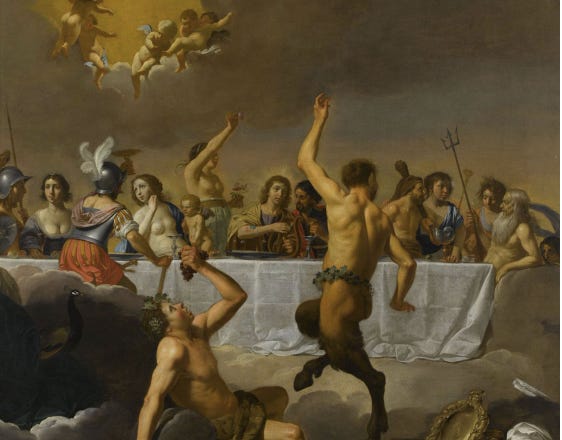
Firstly: the painting alluded to was not Bellini’s The Feast of the Gods, but rather The Feast of the Olympian Gods by Jan van Bijlert. That painting does align in composition with the staging at the Paris ceremony. One might say: what’s the fuss, does it matter which painting it was? It wasn’t about The Last Supper, so the theater isn’t mocking Christianity.

Of course, it matters. Simply because: Jan van Bijlert painted his Feast of the Olympian Gods around 1635, about a hundred and fifty years after Da Vinci painted The Last Supper. And Van Bijlert’s painting is clearly a pagan variant of Da Vinci’s painting. In other words: whether the opening ceremony of the Olympic Games directly mocked Da Vinci’s Last Supper or did so through a parodic imitation of Van Bijlert’s painting, it doesn’t matter, what happened at the opening ceremony was indeed mocking The Last Supper, and thus ethical and religious principles, particularly Christianity. Period.

The most remarkable thing, above all, is that the fact-checkers and woke enthusiasts indeed did not see that it was about the Last Supper. They even mocked those who did see it, claiming they were lost in illusions and delusions. The more someone is gripped by totalitarian thinking, the more he accuses those who think differently of madness. In itself, it remains one of the most remarkable effects of the phenomenon of mass formation: the enormous narrowing of perspective accompanied by a radical blindness to anything that does not align with one's own fanatical beliefs (and the aggressive attack of it).

It is not that the representatives of the dominant narrative are the only ones who fall prey to this. Fanatical conspiracy thinking essentially suffers from a similar problem. Those who break free from the grip of the dominant narrative, in a sense, wander unprotected in the world of the Real and often seek refuge in another illusion, or at the very least, another narrative that irresponsibly reduces reality to a simplistic story.

And I repeat: it’s not about whether there should be no sexual freedom in society or whether it should be forbidden to mock religious tenets, beliefs, or views. Every person has the right to a space where they can work through the peculiarities of their sexuality on their own authority and responsibility, if they so wish. And although I personally find mocking something that another person holds sacred tasteless, I do not think it should be forbidden.

What it is about, however, is that globalist institutions use symbolism, as seen at the opening ceremony of the Olympics and the Eurovision Song Contest, to situate their essence in mockery and perversion. That is precisely the function of a ceremony of a major social event: it represents what the essence of a society is, it represents the principles that support the social system. And that is certainly a good reason to protest and refuse to participate in the globalist ideology. More so: those who fail to protest, neglect an ethical duty.

Back to the mainstream reaction and the legion of globalist foot soldiers. They missed the mark completely. We can conclude that from the above argument. And we can add the reaction of the producers of the opening ceremony. They confirmed in an official statement, contradicting the artistic director’s claims, that the particular part of the ceremony indeed parodied The Last Supper. I would say: we can come to a conclusion on this matter. When it looks like a duck, swims like a duck, and quacks like a duck, then it is probably a duck.

For now, the mainstream remains silent. That’s notable: their inability to admit mistakes. That is, in itself, human, but it is quite pronounced among representatives of the dominant narrative (an inability typical of totalitarian systems). The corona crisis stands out in this regard. Every crucial aspect of the dominant narrative has now proven to be wrong: the origin of the virus, the mortality of the virus, the effectiveness of the measures, the effectiveness of the vaccines, the (supposedly non-existent) side effects of the vaccines, and so on, name it and the dominant narrative got it radically wrong.

No one can really doubt that anymore. But how many fact-checkers and mainstream journalists have you heard admitting that they have radically suppressed the Truth in the name of Truth? How many have you heard apologize for degrading people to second-class citizens based on pseudoscience and fake news? We can only conclude: those who crown themselves as Ambassadors of Truth and profile themselves lavishly as fighters against fake news and disinformation suppress the truth with a stream of fake news and disinformation.

The lack of interest in facts in totalitarian systems is extraordinarily fascinating from a psychological perspective. In Germany, a whistleblower from the Koch Institute revealed the extent of the government and experts’ deception. The revelations left little to the imagination: the entire German corona policy was based on cynical disregard for facts and science and was one big coup to give a technocratic turn to society. And there is hardly any reason to assume that the policy in other countries was fundamentally different from Germany’s.

In Germany, this was briefly big news in the mainstream media. That, in itself, is a good thing. But outside of Germany, there was hardly any reporting. Let this sink in: the narrative behind the most significant societal crisis of modernity proves to be as leaky as a bucket, and it hardly sparks interest in the media that drove society economically, psychologically, physically, and ethically to ruin with this story. Indeed: ‘Not love, not hate, but the passion for ignorance is the most fundamental passion of man.’

Finally: I hear people indignantly shouting here and there that they should try to stage such a parody about the prophet Mohammed at the Olympic Games. Why is it always the Christians who have to endure mockery? It is true in itself: the brave woke adherents, the heroes of the masses, will think twice before directing their extraordinary heroism at Islam. And yet I must say: let this not be an opportunity to sow division between religions and worldviews, between Jews, Christians, Muslims, Humanists, or Agnostics, or Atheists who try to stay connected with principles of humanity.

What it really is about is that there is an ideology that mocks ethical awareness and profiles itself as a representative of an anti-ethical force. It is against that which we have a duty to speak out. Everything else means slowly becoming the monster one fights.

Mattias Desmet is a reader-supported publication. To receive new posts and support my work, consider becoming a free or paid subscriber.

🔲 ☆

The opening ceremony of the Olympic Games - A tribute to William Blake.

My pen refuses to rest this summer. This time, it is the opening ceremony of the Olympic Games that I find difficult to let pass without making some remarks.

This morning, I saw clips from the opening ceremony of the Olympic Games. The imagery was, let's say, mind-boggling. It presented, among other things, a grotesque parody of Da Vinci's Last Supper. In the place of Christ sat a stout woman with half-exposed breasts; the apostles were replaced by a motley crew of transgenders and other figures from the cabinet of sexual curiosities. Among this group, there was also a young girl – a sign of childlike innocence and purity.

Mattias Desmet is a reader-supported publication. To receive new posts and support my work, consider becoming a free or paid subscriber.
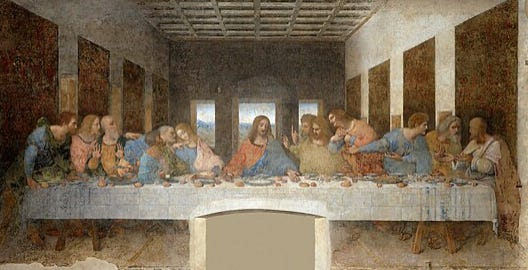
There was some debate about the interpretation of the hotly discussed scene. Was it indeed a parody of The Last Supper? The artistic director explained that the spectacle represented Dionysus at a pagan feast. That Dionysus was represented – no doubt about that. But that the formal presentation of the group evoked direct associations with Da Vinci's composition, an artistic director’s explanation doesn't change much about that. And the fact that the Paris 2024 producers contradicted the artistic director explicitly and confirmed that the scene was inspired by the last supper, also doesn’t add to the credibility of the director’s claims (see Link).

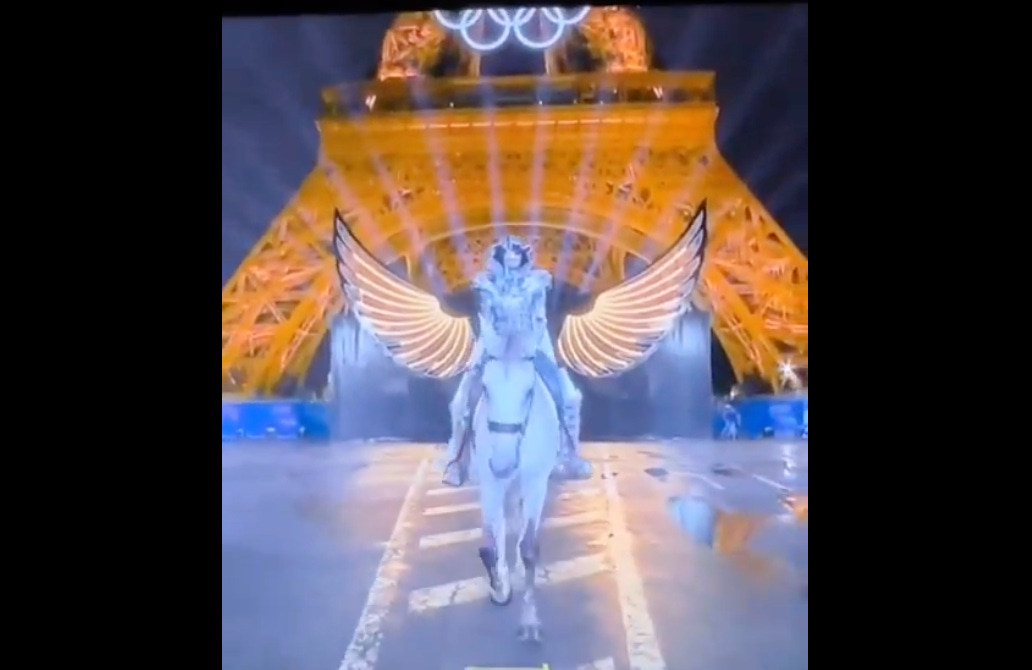
The parody of The Last Supper was certainly not the only striking element in the ceremony. Among other things, a cloaked rider on a white horse was brought forward, which was interpreted by quite a few critical observers as the fourth rider of the apocalypse – Death on a pale horse. Here, too, it was difficult to be certain. Was it truly an apocalyptic figure? Or did the winged horse rather represent Pegasus, a symbol of strength and courage?

One can debate the interpretation of the symbolic language used, but the style of the ceremony had a deeply macabre and decadent undertone that cannot be denied. The ceremony was brimming with heavy symbolism, the connection of which to the Olympic Games – a sporting event – was hard to see. The question was difficult to suppress: what message is that heavy symbolism pregnant with?

A large part of the population found the ceremony impressive – the pinnacle of spectacle, a celebration of freedom, triumph of humanism, inclusivity, and 'equity.' At least, that's what mainstream reporting suggests. They see it as a good thing: no more prejudices against people with a sexuality that doesn't follow the norm. And that mockery of Christianity – can't Christians handle it perhaps? Are they becoming as sensitive as Muslims? Is there no longer any place for Charlie Hebdo in our culture for them either? Anyone who criticizes the woke culture is easily labeled as a new kind of extremist who falls back on ultra-conservative values in difficult cultural times.

It shows cultural maturity when there is openness and room for peculiarities regarding sexuality, a space where a person can realize themselves as a singular sexual being. But the woke spectacle we saw at the opening ceremony has little to do with that. In its intrusive display and anchorless drifting into increasingly grotesque forms of sexuality, it does not show the merging of sexual drive with love and tenderness that is the hallmark of human and cultural maturity; in its fanaticism, it is no longer a liberator, but a tyrant, a militant and extremist ideology that leads sexuality not to its pinnacle but to its complete decline.

It thrives on the illusion of a malleable human, the person who does not submit to God or commandment, who creates and realizes themselves, who tries to erase the task of being a man or a woman that our body imposes on us with surgery and hormone treatments from the text of their life.

The opening ceremony also had nothing to do with cultural maturity that can relativize itself on all levels – including religiously. The opening ceremony of the Olympic Games is not a discourse presented in a satirical newspaper like Charlie Hebdo. An opening ceremony is a ritual, in this case, the ritual of the largest and most significant event of our globalist new world order. And even more: such a ceremony shows what a society identifies with, such a ceremony represents the essence of the societal model that organises it. What is problematic, in other words, is not that a society is tolerant towards exotic and in some cases perverse types of sexuality and morality; what is problematic is that this kind of morality represents is essence. That is why the displayed bad taste is not something to simply turn a blind eye to and shrug off; it is indeed something significant.

What we saw was nothing less than a ritualized mockery of the sacred and the ethical, something that, from an ethical-religious perspective, is a ritual of evil. Our culture is tending toward an end. Let us briefly return to a beginning.

***

A good two hundred years ago, humanity wiped the religious worldview that had turned into hypocrisy and dogma off the societal table. The Enlightenment had arrived – the ideology of Reason took the helm. Humanity began to navigate by the compass of rationality. They would observe the world and things with their own eyes and precisely determine and mathematically describe the relationships between them. And based on this rational description, they would control and manipulate nature; humans would ultimately perform the miracles they had long fruitlessly expected from God. Think of Harari’s Homo Deus: humans themselves will become God. I have written about this elsewhere (see this link).

The Enlightenment tradition marked the historical moment when humanity changed compass and direction. The religious worldview proposed ethical principles: humans must first and foremost, with every step they take in the earthly realm, ask whether they are walking towards Good or Evil. Some took the ethical principles more seriously than others; for some, the ethical discourse became purely a tool of hypocrisy and perversion. But the story on which the culture was based, in any case, placed the ethical level first.

The Enlightenment tradition swept the whole idea of ethics as a guiding principle off the table. From now on, humanity would follow reason. No more religious illusions. From now on, humanity would go by what they observe with their eyes and understand with their minds. And there it immediately fell prey to … an illusion. Our supposedly objectively observing eyes are directed by forces that lie entirely outside the field of rationality. For example: whether one sees in nature a system where the strong eliminate weaker life forms via survival of the fittest and promote the stronger, or a system where the stronger care for the weaker in the most loving and sensitive way, is determined by factors that have nothing to do with rationality.

The 19th-century imperialist saw survival of the fittest everywhere. And he was remarkably blind to the flood of examples showing that nature is at least governed by many other principles. The imperialist saw nature that way because he, from his narcissism and egocentrism, liked to see nature that way. What the imperialist really claimed through his theory of survival of the fittest was that the imperialist, who was at that moment the strongest due to certain historical circumstances, not only had the right to ruthlessly oppress and subject the weaker in his colonies but that he, while doing so, was also the best and most noble that nature had ever produced.

Let narcissism give way to Love for a moment, let the Soul take the helm from the Ego. You see another Nature arise. You see, for example, a nature where strong trees support weaker trees by providing them with nutrients through their root systems; you see a nature where an elephant mother mourns her dead young for months; you see the strong human who recognizes himself in the weak and gently places a hand on their shoulder.

And even if you believe that the strong should triumph over the weak, it is far from certain that this actually happens in ‘nature.’ Nietzsche glorified the striving for power, but he was one of the few who was skeptical from the start about the so-called survival of the fittest: the strongest and most noble people usually lose out in nature, he believed. The weak often band together and are usually able to bring down the strong, who walk through life overconfidently alone. For Nietzsche, the 19th-century imperialist was far from considered the crown of evolutionary creation; he was rather a distasteful creature of an Apollo who no longer recognized Dionysus as his equal.

To return to the core of the matter: the Enlightenment belief placed rationality at the center and considered the whole range of Good and Evil as completely irrelevant and even non-existent. It faded into the background; people no longer paid attention to it. And in the background, something typical happened. Evil took the helm. Doing Good requires a certain level of alertness and effort from humans; one must devote some attention and energy to it; one must always overcome some resistance to do Good. If that alertness and investment of strength and energy to do Good are not there, then the ship of life silently turns and sails towards dark waters.

You can also see in a very direct way that the rise of the rationalist worldview dealt a death blow to Goodness. Rationalism taught us that the highest goal of the human being was the struggle to survive (as previously mentioned). And that immediately implied that doing Good was foolish and backward. Doing Good weakens oneself and strengthens the Other. Or so it seems at first. The rationalist human could only draw the conclusion from his ideology somewhere and conclude: you should not be good, you should be smart, cunning, and ruthless.

In this way, a kind of destructive drive crept into the Enlightenment culture from the beginning. Rationalism not only tried to understand but also to control, manipulate, subjugate, and destroy. That death or destructive drive is very clearly verifiable. The triumphantly proclaimed reign of Reason was accompanied by the pollution of nature with microplastics and toxic chemicals, with industrial fishing methods and forestry and agricultural practices that ruthlessly exploit nature, with the deadliest wars in history, and with the industrial destruction of populations and races that did not fit into rationalist ideologies. William Blake devoted his entire oeuvre to this in the earliest stage of rationalization and mechanization of the world, during the French Revolution, the historical event that represents the moment when the rationalist worldview seized control. He saw it as a manifestation and unleashing of the forces of Evil and testified to this view in his entire oeuvre.

The entire UN ideology with its Sustainable Development Goals claims to halt the destructive drive, but it is essentially a continuation of the rationalist ideology, which, through its ecomodernist program, aims for the ultimate subjugation of nature (think of projects to influence the climate) and with its woke humanism tries to install a radically dehumanizing transhumanist technocracy.

Remarkably, the idealization of Reason also cost Truth its head. The duty to speak honestly was thrown overboard within the rationalist worldview. The reasoning was quickly made. Speaking the Truth is always risky; those who speak the Truth weaken themselves; they have fewer chances in the struggle to survive; only a fool speaks the Truth.

Humans have always been deceptive and lying beings who often confuse Appearance with Reality, but the rise of the Enlightenment tradition was accompanied by the reign of a new kind of lie, a lie that is theoretically founded (based on scientific theories about mass psychology), ideologically justified, and industrially produced: propaganda. The contemporary (globalist) order stands and imposes itself through propaganda – the art of manipulating the human being; the practice of depriving the human being of spiritual freedom.

Under the pseudo-rational surface of our Enlightenment culture, therefore, a destructive, deceitful, and dehumanizing force steadily grew. It grew in the unseen, but like any spiritual Greatness, it wants to manifest itself and be publicly recognized. Our culture has reached a point where that force increasingly shows its face openly. Witness the grotesque theater of the most recent Eurovision Song Contest and the dark symbolism of the Olympic opening ceremony.

Our culture is approaching its apotheosis, the moment when the masks are taken off and the forces that determine it reveal themselves. The moment also when humans see their true condition. The rationalist human is not about to become God. They are also not about to conquer their absolute freedom, sexually and otherwise. On the contrary, they are on the verge of being completely enslaved. And the Olympic opening ceremony shows us more clearly than ever who their Master will be

.

Mattias Desmet is a reader-supported publication. To receive new posts and support my work, consider becoming a free or paid subscriber.
🔲 ☆

The Trump assassination attempt - The limits of the Propaganda Model.

Normally, I let my pen rest during the summer months, but for some things, you set aside your habits. What has been happening in the context of the U.S. presidential elections over the past few weeks is, to say the least, remarkable. We are witnessing a social system that – to use a term from complex dynamic systems theory – is heading toward a catastrophe. And the essence of the tipping point we are approaching is this: the propaganda model is beginning to fail.

***

Mattias Desmet is a reader-supported publication. To receive new posts and support my work, consider becoming a free or paid subscriber.
It started a few weeks ago like this: Trump, the presidential candidate who must not win, is up against Biden, the presidential candidate who must win. After the first debate, it was immediately clear: Trump will win against Biden. The big problem: Biden and Jill are about the only ones who don't realize this.

The media then turned against Biden. That, in itself, is a revolution. They had praised President Biden to the skies for four years, turning a blind eye to the fact that the man either seemed hardly aware of what he was saying or was giving speeches that could only be described as having the characteristics of a fascist’s discourse.

I'm thinking, among other things, of the 2022 midterm speech in which he, against a bombastic-dramatic backdrop and flanked by two soldiers with machine guns, more or less directly called for violence against the Maga followers. Not to mention the shameless prosecution and imprisonment of political opponents and the intimidation and excommunication of hundreds of journalists (carefully kept out of the media by journalists who sided with the regime).

Huxley would not be surprised that Biden claims in almost every speech that he had to save democracy, including his most recent speech. I've shared the quote of Huxley below before, but it doesn't hurt to read it a second time:

‘By means of ever more effective methods of mind-manipulation, the democracies will change their nature; the quaint old forms — elections, parliaments, Supreme Courts and all the rest — will remain. The underlying substance will be a new kind of non-violent totalitarianism. All the traditional names, all the hallowed slogans will remain exactly what they were in the good old days. Democracy and freedom will be the theme of every broadcast and editorial — but democracy and freedom in a strictly Pickwickian sense. Meanwhile the ruling oligarchy and its highly trained elite of soldiers, policemen, thought-manufacturers and mind-manipulators will quietly run the show as they see fit.’ (Huxley, Brave New World Revisited).

In any case, the media’s love for Biden was suddenly over when it became clear that he could not possibly win the election, even not with a little help from the media. If you want to know how that 'little help' worked in 2020, look at one of the most important interviews of the past year, where Mike Benz – former director of the cyber portfolio of the U.S. government – explains to Tucker Carlson in detail how information flows on the internet were manipulated during the 2020 elections (and the COVID crisis). The guy eventually got disgusted from what he was doing and now runs a project striving for online freedom of speech.  I would recommend everyone to spend an hour watching that interview. Such an explanation is what we need: calm, expert, nuanced, and extraordinarily revealing.

After the first debate, the media realized that even they could not help Biden win the election. They changed their approach. Biden was quickly stripped of his saintly status. The Veil of Appearances was pulled away, and he suddenly stood naked and vulnerable in the eye of the mainstream – a man in the autumn of his life, mentally confused, addicted to power, and arrogant. Some journalists even started attributing traits of the Great Narcissistic Monster Trump to him.

But even media pressure couldn’t make Biden change his mind. He was so far gone that he did not see the hopelessness of his situation. That did not change when the Democratic elite turned their backs on him. Barak, Hillary, Nancy – it didn't matter, the presidential candidate who couldn't win kept stumbling in a lost race.

Then things took another turn, a turn so predictable that one is astonished that it actually happened. An overaged teenager calmly climbed onto a roof with a sniper rifle, under the watchful eyes of the security services, and nearly shot Trump in the head. The security services, which initially did not respond for minutes when people tried to draw attention to the overaged teenager with an assault rifle, suddenly reacted decisively: they shot the overaged teenager dead seconds after the assassination attempt.

What happened there? There are many reasons to have reservations about Trump, but one thing we cannot help but say: if Trump becomes president, the war in Ukraine will be over. Anyone who does not attribute any weight to that should subject themselves to a conscience examination. And no, Trump will not have to give half of Europe to Putin for that. My cautious estimate, for what it's worth: It will suffice for NATO to stop and partially reverse its eastward expansion, for Russia to retain access to the Black Sea via Crimea (something everyone with historical awareness knows that denying would mean the death blow to Russia as a great power and thus a direct declaration of war), and for the population of the Russian-speaking part of Ukraine to choose in a referendum whether to belong to Russia or Ukraine.

One of the biggest and most dangerous media lies of this time is that Putin started an 'unprovoked war' in Ukraine. I recommend a second interview by Tucker Carlson here (undoubtedly one of the most important contemporary journalists, one of the few who still fulfill the original societal function of journalism). The interview with professor and former top diplomat Jeffrey Sachs also has everything a good interview should have: given with great expertise, calm, and nuanced. Anyone who still believes that the war in Ukraine was 'unprovoked' after listening to it is kindly invited to explain themselves in the comments section of this article.

So, I repeat my point: with Trump, the provocation of Russia stops, and the war in Ukraine ends. Presidents who threaten to end wars are sometimes shot at by lone gunmen. And those lone gunmen are, in turn, shot dead. And the archives about that remarkable act of lone gunmen sometimes remain sealed for a remarkably long time, much longer than they usually do.

The media ultimately covered this historical event of the Trump assassination attempt surprisingly lightly. No journalist to be found pointing a finger at Biden because he had more or less literally called to 'target' Trump a few months earlier. Let alone the media admitting that they created the unspoken support in the population for this political violence. Neither did I find journalists who were greatly concerned that the overaged teenager was linked to Antifa – nothing wrong with Antifa according to them. I can imagine that the moral appreciation would have been different if an overaged teenager linked to the Maga movement had nearly taken down President Biden.

Anyway, we are not surprised. That reaction was predictable. We are used to the media. Some journalists even suggested that Trump had been shot with a paintball, others thought the most accurate way to report was that someone 'wounded Trump on the ear'.

In any case, after the assassination attempt, the situation became even more dire for the mainstream: the presidential candidate who must not win is now even more popular, and his victory in a race with Biden is almost inevitable.

Then the next chapter begins. Biden suddenly changes his mind: he has come to his senses and drops out of the race. He announces this - of all things - in a letter with a signature that, even for his shaky condition, looked quite clumsy. Then he stayed out of the public eye for a few days. We are curious about what exactly happened there.

But the media are compliant again. Biden has now been sanctified again. Just like Kamala Harris, of course. They are already mentioning polls showing she will beat Trump. With a little help from the media, of course. Curious how this will continue, but I would be surprised if the rest of the campaign will be a walk in the park. Trump is not safe after the first attempt, that's for sure. And to Kamala Harris, I say this: when totalitarian systems go into a chaotic phase, they become monsters that devour their own children.

****

It is hard to ignore: the indoctrination and propaganda model is creaking and groaning at all its seams. The Veil of Appearances that is meant to hide all dirty laundry from the public eye is tearing left and right. And that's why the step toward terror is increasingly being taken. One can see something frightening in it, but it also heralds the beginning of the end of the propaganda model. No one knows exactly how long the endgame will last, but it is certain that the system is in deep crisis. From the fact that the Democrats ran with someone like Biden and then had to force him out in this amateurish and transparent manner, we can only conclude one thing with certainty: the desperation must be enormous.

What we are witnessing is nothing less than the failure of the greatest propaganda apparatus in history. And at that point, we also see a fact that people absorbed by conspiracy thinking make: they overestimate the perceived enemy not only as too evil but also (much) too powerful. In this way, one can only feel smaller and feel more and more powerlessness, anger and hate, exactly the sentiments that will prove deadly in the coming years.

The general reduction of everything that happens to a conspiracy, not seeing a Reality behind the manipulation and illusions created, is itself a symptom of this time. Conspiracies exist. No one needs to convince me of that. And one problem of this time is that most people who identify with the mainstream discourse have a remarkable ability to deny that. And they have an equally great ability to ignore that they themselves eagerly produce conspiracy theories when it comes to Putin or Saddam Hussein or 'extreme right'.

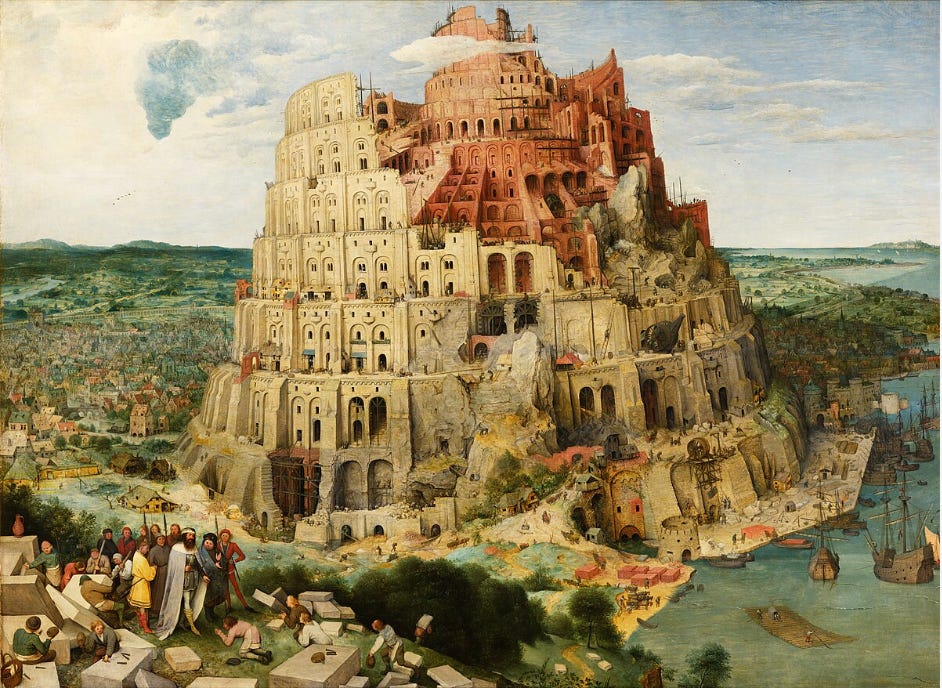
Conspiracy theories sometimes correctly relate to facts, and sometimes incorrectly. However, they do not provide a comprehensive explanation for global events. They do not touch the essence of the problem. The essence of the problem lies in rationalism and the associated human arrogance. And this hubris is certainly not the privilege of 'the elite.' It is even typical of conspiracy thinking itself, which ultimately attempts to capture the essence of social dynamics through a rationalistic construction. And precisely because of this, conspiracy thinking, just like the dominant discourse, falls prey to a Babylonian confusion. Like the dominant discourse, they fail to bring true peace regarding the Real that increasingly imposes itself from behind the Veil of Appearances in this historical era.

In times when America is dangerously heading towards a civil war, the golden advice is: do not be tempted by the possibility of violence. Stay calm and composed. And continue to speak. Totalitarianism dehumanizes; the only remedy against totalitarianism is to always recognize a human being in the Other. Also in the Totalitarian Other. What is happening is historical. Stand on the right side of history. This is not the side of the Democrats or the side of the Republicans, it is not the side of Trump or the side of Harris; it is the side of humanity, it is the side of those who are not so convinced of their own words that they can no longer find any space for the words of the Other to exist.

Mattias Desmet is a reader-supported publication. To receive new posts and support my work, consider becoming a free or paid subscriber.
🔲 ☆

The paradise of the mother's voice.

What is Truth? This question is timeless and essentially unanswerable. And yet we must never stop asking it. Contrary to what postmodernists believed, truth does indeed exist. Moreover, it is our only guiding light in the dark land of totalitarianism.

Mattias Desmet is a reader-supported publication. To receive new posts and support my work, consider becoming a free or paid subscriber.
First and foremost, we are going to listen to a newborn child, a child that has not yet been grasped by the world of illusion and the Ego. A child in that period is a being that – just like the mystic, the mescaline user, the seminal scientist, and the schizophrenic – exists in the land of Truth and the Real. That land was declared forbidden territory by the rationalist Enlightenment tradition; it is precisely that land we need to explore to understand the ailments and crises of our Enlightenment culture.

****

A child already floats on the waves of the mother's voice in the womb. It registers the tempo, rhythm, and other sound properties somewhere in the fabric of its flesh. Immediately after birth, it will recognize the mother's voice from all other voices. Place headphones on the child's head during its first breaths; let it hear the mother's voice while sucking on the left breast and someone else's voice while sucking on the right breast; after a short time, it will suck much more on the left breast than on the right. And it can already somewhat reproduce the mother's voice. Its earliest cries and screams already show melodical similarities to the mother's voice. There is no other conclusion possible: it has learned the mother tongue in the womb.

After birth, the learning process continues. The child imitates the mother's facial expressions and mimics her sounds. While lying in its cradle, it sees a procession of maternal symbols at its zenith – facial expressions, body postures, and sounds. In its desire for union with the mother, it participates in that primordial symbolism. It observes her facial expressions with intense attention and makes rudimentary attempts to imitate them, it mimicks the mother's sounds in its earliest cries and cooing, and it experiences the deepest pleasure when it notices the mother responding by imitating the child in turn.

As the child creatively adopts the mother's language of forms and sounds, it simultaneously adopts something else: her state of Being. The child imitating the melancholy sound of the mother's voice feels her sadness; the child imitating the mother's smiling face feels her joy. In this way, it’s being merges with the being of the mother.

Language thus becomes a medium for union with the maternal being. Literally. Through the imitation of forms and sounds, the child feels one with her. This must be interpreted radically. The young child observing another child falling becomes that child. The observing child will mimic the painful grimaces of the fallen child and thereby feel its pain and often start crying itself.

Adults also still possess this ability. Watch someone hit their finger with a hammer, and you will often spontaneously pull back your hand and feel your face contort into a grimace. However, in adults, this empathic response is much more limited than in a young child. The reason is that adults, unlike children, are limited in their union with the Other by a veil of illusion that envelops them and separates them from the Other. This veil of illusion is called the Ego – more on that in a subsequent essay.

The young child has no Ego yet and, for instance, cannot yet assign meaning to words, but this does not mean that, in terms of language, it only negatively differs from adults, as a being that merely lacks something. In some respects, a child can do more than an adult. It has a learning and absorbing ability that an adult can only dream of. For example, in the earliest months of its existence, a child has an astounding ability to distinguish sounds from each other. In two weeks, it can learn to distinguish all the phonemes of all the languages in the world from each other. In comparison, an adult could not achieve this in years.

And the most interesting part is this: this rapid learning process only occurs when the child listens to a physically present Other. It will not occur when the child listens to audio or video recordings. Under those circumstances, the linguistic sounds do not seem to really interest the child. The reason why a child directs its attention and interest so much to language is that it sees a gateway to the body of the Other in the sounds. It wants to connect to that body. Imitating its sounds is a way to achieve that. In a sense, the child uses language for the same purpose as football supporters when they sing together: to experience the pleasure of resonant connectedness. This shows us (again): language is originally a medium used to connect animated bodies with each other.

Here we see a radical difference from the transhumanist view of language. Transhumanists see language merely as a means to convey information in a rational way. ‘Humans became the most powerful animals on earth because they could exchange information more efficiently through language’ (see Harari).

And through merging with technology, humans can optimize that ability. With a Neuralink in the brain, humans will communicate perfectly. No more eternally incorrect human language, no more endless sources of half-understanding and complete misunderstandings. No more stuttering and stammering of people with limited verbal capacities, no more gossiping of fishwives and jealous neighbors.

And no more poetry and endless chatter of lovers. That pathetic happiness will no longer be necessary. Implanted hormone pumps will be able to manipulate the state of the blood 24/7 – Homo Deus will spend his life in a state of constant, biochemically induced happiness. Want to experience the intoxication of love, the ecstasy of gazing at vast mountains, the tenderness of a young mother nursing her child – it is merely a matter of pressing the right button, and the right pump will be activated.

Transhumanism, in its ideological fanaticism, overlooks something. It even overlooks the essence of language. Information exchange is not the primordial function of language. In the beginning, language carries no meaning at all and refers to nothing. In the beginning, language is the bearer of the Soul. It is pleasure and love. It is primarily a sonic phenomenon that creates connection through resonance. In the mother's voice, the music of paradise sounds. The door to paradise opens by singing along with the mother's song.

And the mistake of transhumanism goes beyond that. Transhumanism sees all life, every form of exchange of an 'organism' with its environment actually as a form of  ‘information exchange’ or 'data exchange.' The phenomenon of 'life' is seen as an algorithmic process in biological hardware. An organism that eats actually exchanges information or data with its environment. The organism transforms the food according to a certain algorithm.

Harari coined the term ‘dataism’ for this ideology. Every organism, including human beings, is a kind of processor that performs algorithmic transformations on its environment. And that processor can be reprogrammed; humans are 'hackable animals.' Just wait a little longer, and we will have fully mapped out the laws of the data stream of life and will surpass ourselves by reprogramming ourselves – much better than nature programmed us.

The experiential world of the young child shows us a completely different universe, a universe that is not an electronic crackling of data streams between processors, but a universe that is a gently undulating sea of love and connectedness between singularities that are one with the All. And the destiny of humans is not to become a sort of hyper-efficient, information-exchanging cyborg, but a being that resonates with the mystical form language nature, a being that relates more or less harmoniously to the All from which it originated.

****

Back to the child who can learn to distinguish phonemes from one another at an astounding rate. Where does this spectacular learning ability of a young child come from? Simply put: the child learns to distinguish sounds so quickly because it does not yet have an Ego. The Ego is only born between six and nine months, at a very precise moment that we will discuss when exploring the world of Appearances.

It is this Ego-less state that allows the child to subtly and directly let the strings of its body vibrate with the sounds made by the Other. An adult can hardly imagine this Ego-less state of the child, except in a few specific states. One of these states was masterfully described by Aldous Huxley in his book 'The Doors of Perception' (after which the sixties group The Doors was named).

Mescaline is a substance derived from the root of the peyote cactus. The Indians of Mexico and the Southwestern United States have used the root since time immemorial and revered it as a deity because it led them to a state in which they recognized both their origin and their destination. Those who use the root experience a state of deep union with the soul of all objects around them. One no longer looks at light; one becomes a light particle. One no longer observes other people; one becomes the other person. And so on.

This great Union is paradisiacal in nature. The Soul is completely absorbed by the shapes and colors of certain objects. The folds in velvet, the deep blue of lapis lazuli – Huxley noted that one would certainly die of hunger if the mescaline trance did not stop. The endlessly wide calm and unfathomably deep satisfaction that the Soul experiences in its contemplation are such that no one would be able to turn away to, say, look for food.

Huxley broadly equated the mescaline experience with the mystical experience. The great mystics like Meister Eckhart, St. John of the Cross, and Hildegard von Bingen described the essence of the mystical experience in the same way: one becomes one with the All, one with the universal Soul. It is from the experience of Unity among all singularities that the great religious principles self-evidently emerge. 'Love your neighbor as yourself' – you are the other; what you do to another, you do to yourself.  

To the series of experiences described by Huxley, we can add another: the near-death experience. The term itself had not yet been coined when Huxley wrote his 'The Doors of Perception', but every description found of it fits seamlessly into the series of experiences Huxley mentions.

Whether one wants to consider this experience purely materialistically as a kind of biochemical convulsion of the brain or as a mystical experience of a Real state of being is irrelevant here: here too one finds the paradisiacal experience of unity with the All; here too one finds the experience of unfathomable beauty of colors and sounds; here too the Soul is absorbed by the things it perceives, and so on.

Just like the young child, a person in a near-death experience has remarkable knowledge that transcends any form of rational insight. An engineer friend who had a near-death experience after an accident described to me that he saw the world below him and all the algorithmic laws of nature became crystal clear to him. He 'saw' them with the greatest obviousness and could only marvel that he had not always seen them. When he descended back into his pain-scorched body and the mind was sucked back into the force field of the Ego, he had to admit that, as before, the eyes of his mind were too cloudy to discern the crystalline structure of reality.

In the mescaline experience, the mystical experience, and the near-death experience, we encounter a state in which knowledge is revealed directly through a form of feeling one with reality: “In the final stage of egolessness there is an 'obscure knowledge' that All is in all—that All is actually each. This is as near, I take it, as a finite mind can ever come to 'perceiving everything that is happening everywhere in the universe'.” (Huxley, The Doors of Perception).

It is also relevant to mention Einstein's reflections on the origin of scientific knowledge. Einstein aptly referred to a 'cosmic religious feeling' as the ultimate source of science. In a preface to a book by Max Planck, he stated that people mistakenly believe that scientific insights flow from rational thinking. According to him, they flow from intuition and an ability to 'einfühlen', a German term that literally translates to 'feeling one' or 'empathy':

'Thus the supreme task of the physicist is the discovery of the most general elementary laws from which the world picture can be deduced logically. But there is no logical way to the discovery of these elementary laws. There is only the way of intuition, which is helped by a feeling for the order lying behind the appearance, and this einfuhlung is developed by experience' (Einstein in 'Where is science going?', p. 12).

****

In 'The Doors of Perception', Huxley thus explores the counterpart of the totalitarian paradise he described in his iconic novel 'Brave New World'. Totalitarianism always fanatically believes it will create a paradise for humanity. Hitler believed so much in the paradise of his racially pure Aryan society that he deemed it justifiable to make millions of victims; Stalin thought millions had to be sacrificed to realize the 'rule of the proletariat'. The hallmark of the totalitarian paradise is always that humanity believes it can realize it itself, particularly through the ruthless application of a rationalist ideology. In the case of Hitler, it was a eugenic theory; in the case of Stalin, it was Marx's historical materialism.

Today, Harari presents us with this totalitarian paradise. This time, it is the transhumanist ideology that provides the plan for it. Humanity will enter it by merging with technology. And it will be centrally coordinated – even the cyborg needs a state. Someone must coordinate and direct. Preferably not a human. A central computer, constantly getting smarter through Artificial Intelligence, will monitor and optimize the psychological and physical state of the citizen via nanoparticles in the blood.

Freud thought that governing is one of the impossible professions, but the Great AI statesman will change that. The society – that writhing, chaotic heap of bodies – will become a flawlessly functioning 'internet of bodies' through the triumph of reason. No more depression and anxiety attacks. Anxiety and stress hormones, serotonin and oxytocin will be kept at the perfect level by hormone pumps in the vein walls. Also, no more crime – criminal neural patterns will be detected and neutralized at an early stage. And if necessary, the bionic joints of cyborg beings with hard-to-manage blood values can still be remotely locked.

The cyborg human will finally transcend its existence tormented by irrationality. It will flawlessly register reality through cameras that replace the always cloudy lens of the eye and microphones that are not bothered by selective deafness and tinnitus. The hyper-accurate data stream thus provided will be stored in its hard-drive-augmented memory and communicated perfectly rationally and without bias to other cyborg humans via an embedded brain chip.

This paradise will be eternal. If a part of the cyborg human wears out, it is simply replaced. And the human mind and soul, meaningless by-products of the biological hardware of its brain, are stored on a hard drive and, if really necessary, uploaded into a new, laboratory-grown cyborg body. Hannah Arendt already pointed out: the only problem with that totalitarian paradise is that it looks so suspiciously like hell.

It is striking: the paradise Huxley explores in The Doors of Perception is in most respects precisely opposed to the totalitarian paradise. The totalitarian paradise is the result of rational thinking. It arises when rational understanding is complete, and the ability to control and manipulate reality is maximal.

The paradisiacal experience Huxley explores, on the other hand, befalls humanity when it leaves its rational thinking behind, transcends its Ego, and abandons any urge to control and manipulate 'reality'. The person merges with Being, to the extent that any attempt to know rationally can only detract from the awareness of it. The knowledge that humanity receives in this paradise is not rational knowledge; it is an empathetic knowing that essentially arises from a direct experience of the Being of things.

What is experienced thereis the Real ground of things that great painters like Vermeer and Braque captured on canvas; it is the mystical essence to which Blake devoted his oeuvre. 'Things without pretensions, satisfied to be merely themselves, sufficient in their Suchness, not acting a part, not trying, insanely, to go it alone, in isolation from the Dharma-Body, in Luciferian defiance of the grace of God' (Huxley, The Doors of Perception, p. ).

Crucial in the context of this series of articles on the act of speaking: language has a completely different status in Huxley's paradise than in the totalitarian paradise. In the totalitarian paradise, language is purely an exchange of information. In the experiences described by Huxley, the exact opposite applies. He describes it vividly: in the mescaline experience and in the mystical experience, one does not care about the meaning of words and symbols.

That does not mean that language in that state becomes indifferent. On the contrary. Another dimension of language comes to the forefront. Words come in directly, they do not need to first go through a mentally laborious process to gain meaning and be linked to perceptions: "To be shaken out of the ruts of ordinary perception, to be shown for a few timeless hours, the outer and inner world, not as they appear to an animal obsessed with survival or to a human being obsessed with words and notions, but as they are apprehended directly and unconditionally by Mind at Large—this is an experience of inestimable value to everyone and especially to the intellectual.” (Huxley, The Doors of Perception).

In a certain sense, consider the way poetry speaks: the less you think and the more you let the poem come in directly, the more intense the poetic experience. Just as a young child can learn to distinguish phonemes extraordinarily quickly, an adult under the influence of mescaline becomes extraordinarily sensitive to minute differences in (colors and) sounds: “All colors are intensified to a pitch far beyond anything seen in the normal state, and at the same time the mind’s capacity for recognizing fine distinctions of tone and hue is notably heightened.” (Huxley, The Doors of Perception).

In the Ego-less state, language is thus not so much a system for exchanging information; it speaks rather through its sound-musical dimension, through its formal characteristics. In this state, language is stripped of all meaning; it wells up directly from what lives in the animated body; it testifies in its rhythm, sound, bouncing, and stuttering to the Soul, as it slumbers in the tensions of the fibers of the speaker's animated body. The child listening to the mother and receiving her sounds feels the mother in its body, pulling her Soul inward through the sounds. And the child who speaks itself transports its own Soul to the Other through the sounds it makes. This pure, emotional dimension of language largely disappears as soon as words begin to carry meaning and refer to objects.

From this exploration, we derive a core characteristic of sincere speaking: in a sense, sincere speaking takes us back to the core of our Being, before it was covered by social conventions and meaning. Sincere speaking is done primarily from the feeling, animated body; much less from the head; it is an emotional speaking rather than a thinking-rational speaking. One who speaks before thinking is more sincere than one who first surrenders too much to considerations about what is right to say, about what must, may, and can be said.

Practicing the art of Sincere Speaking largely comes down to this: connect with what slumbers and vibrates in the fibers of your animated body, let it form words and speak those words before they are distorted by thoughts and censored by social conventions. You certainly cannot follow this rule everywhere and always, and it is certainly not enough to define 'truth,' but it does touch on a core aspect of it.

It is this kind of speaking that penetrates through the Veil of Appearance and literally perforates holes in the Ego through which resonating connections between animated bodies are established; it is this kind of speaking that realizes a true human bond; it is this kind of speaking that increases the intuitive sense of the human being.

Mattias Desmet is a reader-supported publication. To receive new posts and support my work, consider becoming a free or paid subscriber.

🔲 ☆

The de-souling of the world

I was walking through an airport in Lithuania in mid-April and stood in line at a coffee bar. When the line in front of me finally cleared and I reached the cashier, I looked into the eyes of a young woman, about 17 years old, I estimate. Those eyes stared back at me, motionlessly waiting for my order.

I hesitated for a moment but then broke the inscrutable surface of those eyes with my words. "A chai latte, please, preferably with oat milk and cinnamon, if you have it." She typed on her computer keyboard with outstretched fingers, then looked up and met my gaze again for a few moments. Since I had nothing more to say, she tapped her keyboard a few more times, neither quickly nor slowly, and handed me the receipt. "Can I pay with cash?" "No." She slid a small payment terminal towards me - I scanned and entered my code. "Thank you." And she directed her motionless eyes like the lenses of a surveillance camera to the next person in line.

Mattias Desmet is a reader-supported publication. To receive new posts and support my work, consider becoming a free or paid subscriber.
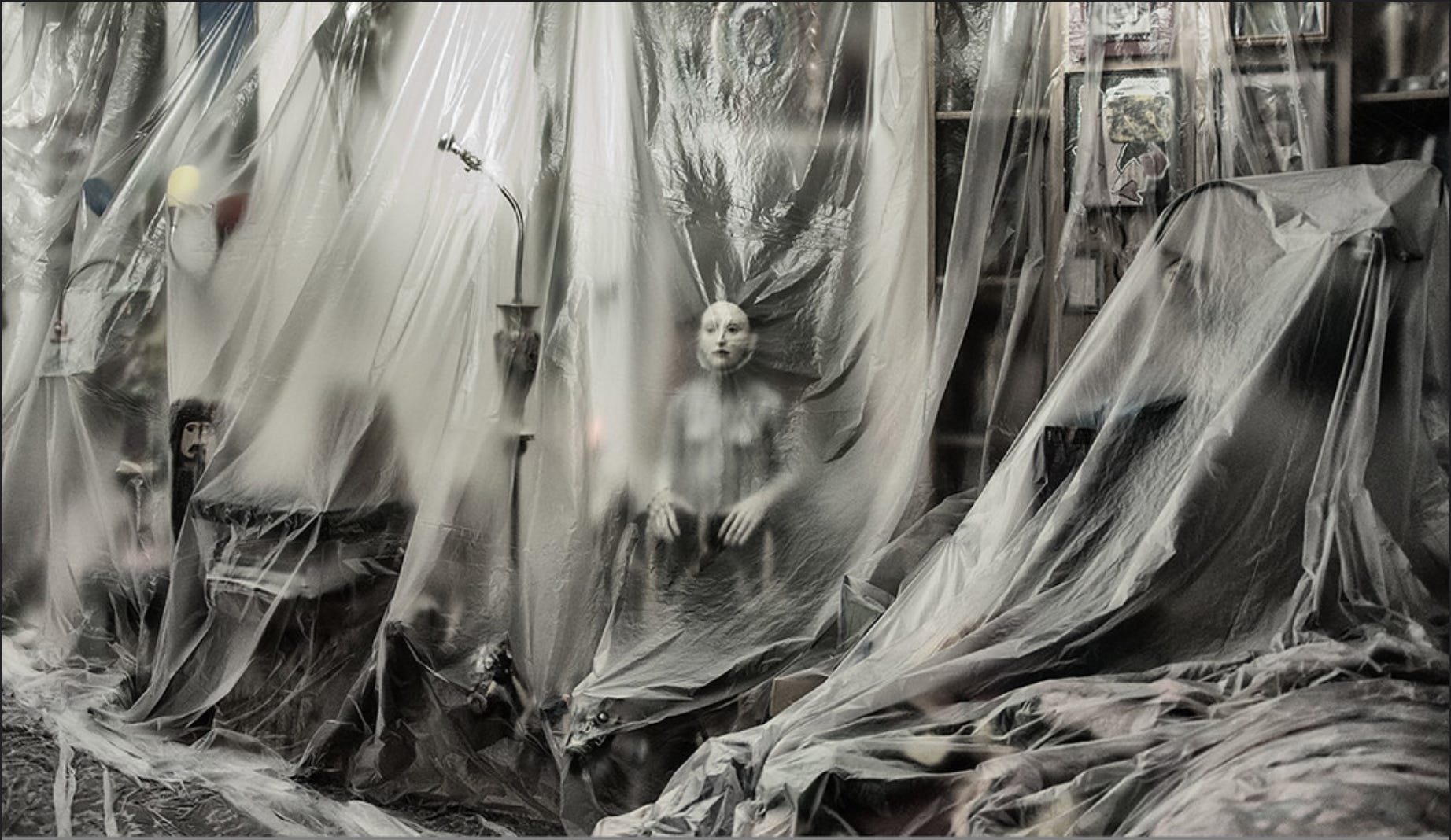
At the table where I waited until the red neon numbers on the sign above the desk announced that my chai latte was ready, I lapsed into contemplation. That young woman – she was neither polite nor impolite, neither trying to stand out nor hide, neither rude nor friendly, neither fast nor slow. But what was she? Neutral perhaps? Technical and dry? She moved and acted like a machine; her soul had withdrawn into the unfathomable depths of her cells. De-souled! – that was the word that sought birth in my thoughts.

And with that word came from the fog of my memory a whole series of figures that had all made the same impression on me in recent times: beings glued to their smartphone screens on trams and trains, people answering my spontaneous greeting on the street with nothing more than a hollow gaze, beings for whom both joke and seriousness are too burdensome, beings who offer a foundation for neither anger nor love.

*****

The soul is withdrawing from the world. And that phenomenon is related to our rationalistic worldview. In recent centuries, we have come to view humans as "organisms" without a soul, and now they are increasingly behaving that way. "The universe is a machine - a collection of elementary particles that follow the laws of mechanics without any room for protest or frivolity. And humans are small machines caught in the big machine. They have neither soul nor spirit; their consciousness is a meaningless byproduct of the bio-electrical processes in their brains."

Yuval Noah Harari is perhaps the best-known literary prophet of the mechanistic view of humanity today. In his mega-bestseller Homo Deus, he takes this thinking to its extreme consequences. Humans are robots; every physical and mental behavior is the result of mechanical processes; they have no free will, make no choices, and consequently cannot bear any responsibility:

"In the nineteenth century, Homo sapiens was like a mysterious black box, whose inner workings were beyond our grasp. Hence, when scholars asked why a man drew a knife and stabbed another to death, an acceptable answer said: 'Because he chose to. He used his free will to choose murder, which is why he is fully responsible for his crime.' Over the last century, as scientists opened up the Sapiens black box, they discovered neither soul, nor free will, nor 'self' – but only genes, hormones, and neurons that obey the same physical and chemical laws governing the rest of reality. Today, when scholars ask why a man drew a knife and stabbed someone to death, answering 'Because he chose to' doesn't cut the mustard. Instead, geneticists and brain scientists provide a much more detailed answer: 'He did it due to such-and-such electrochemical processes in the brain, which were shaped by a particular genetic make-up, which in turn reflect ancient evolutionary pressures coupled with chance mutations.’" (Homo Deus, pp. 328-329).

Within mechanistic thinking, it is not considered a bad thing to view the universe as a machine. The big machine of the universe can be fully understood, predicted, and manipulated rationally (see, for example, Laplace). Humans can take control of their own lives through reason. They will print food in laboratories and leave the burden of pregnancy to artificial wombs; they will go to Mars and control sunshine and rain. And they can perfect themselves, definitively eliminating the flaws and shortcomings of the human condition.

The moment when humans will perfect themselves is imminent – Harari feels it approaching:

"Experiments performed on Homo sapiens indicate that like rats, humans too can be manipulated, and that it is possible to create or annihilate even complex feelings such as love, anger, fear, and depression by stimulating the right spots in the human brain. The US military has recently initiated experiments on implanting computer chips in people's brains, hoping to use this method to treat soldiers suffering from post-traumatic stress disorder. In Hadassah Hospital in Jerusalem, doctors have pioneered a novel treatment for patients suffering from acute depression. They implant electrodes into the patient's brain and wire them to a minuscule computer implanted in the patient's chest. On receiving a command from the computer, the electrodes transmit weak electric currents that paralyze the brain area responsible for the depression. The treatment does not always succeed, but in some cases, patients reported that the feeling of dark emptiness that tormented them throughout their lives disappeared as if by magic" (Homo Deus, p.334).

If we understand the human-machine well enough, the engineer-doctor will be able to eliminate any malfunction – this is roughly the message of transhumanism. Disease and suffering will belong to the past. And ultimately, even death will yield to the light of Reason. Yuval Noah Harari puts it unequivocally:

"In reality, humans don't die because a figure in a black cloak taps them on the shoulder, or because God decreed it, or because mortality is an essential part of some great cosmic plan: Humans always die due to some technical glitch" (Harari, Homo Deus, p.25). "And every technical problem has a technical solution. We don't have to wait for the second coming to overcome death" (Harari, Homo Deus, p.26).

The ambitions of rationalism reach high – to the heavens. The rationalist declared God's throne empty and then sat on it himself. When the rational understanding of the universe-machine and the human-machine is advanced enough, humans can make themselves superhuman – humans can become God.

"In the twenty-first century, the third big project will be for us to create divine powers of creation and destruction and upgrade Homo sapiens into Homo Deus" (Harari, p.53).

Homo Deus is on the horizon, the human who, through merging with technology, can become God. Artificial eyes, ears, and noses will provide humans with information that is much more accurate and extensive than that obtained through natural senses. They will be able to smell like a dog, literally have eyes in the back of their heads, and hear what is said kilometers away.

And don't think that this transhumanist ideology is limited to the realm of fantasies and grand ideological plans of writers and philosophers. Over the last seventy years, governments have developed concrete projects to bring this ideology to reality. From projects like Elon Musk’s Neuralink to DARPA’s ‘Neurowarfare’ programs – they are feverishly trying to realize the great transhumanist dream (see this link).

****

Rationalism promises to bring humanity to paradise, but so far, that has not been very successful. The air of the 21st century is constantly saturated with a sense of crisis. The war on terror, the banking crisis, the climate crisis, the MeToo crisis, the corona crisis, the Ukraine crisis – the thundering echo of one crisis still resonates when the lightning bolt of the next crisis strikes the fragile structure of society again.

In a way, the major social crises of the 21st century all reflect a problem in the relationships in which humans are caught: they all stem from problematic and failing relationships between humans and institutions (banking crisis), between humans and fellow humans (war on terror), between men and women (MeToo crisis), between humans and nature (climate crisis).

Initially, rationalism itself tries to provide the solution to the problems it causes. The proposed solution for problematic sexual identity is a mechanistic-surgical adjustment of the body; the solution for the threat of terrorism is the surveillance state; the solution for the detrimental impact of humans on nature is digitized "five-minute cities" where humans live in small housing units and never go more than a few kilometers from their homes, hyper-technological electric cars that can be switched on and off by the state at will, a forest of wind turbines, and plains of solar panels. And if that doesn't work – everyone knows, by the way, that it won't work – we will move on to exploding nitrate bombs in the atmosphere and installing manipulable mirrors between Earth and the Sun.

The more the rationalist vision fails, the more desperately it claims the truth. With every new crisis, the representatives of the dominant narrative – the mainstream media, national governments, global institutions – respond with more censorship. Armies of fact-checkers and "digital first responders" scour the internet looking for any dissenting voice; algorithms slow the spread of any dissenting voice on social media; millions of posts, even from people who recently gained worldwide fame by winning prestigious scientific awards, are removed from the internet.

These "ambassadors of Truth" remain remarkably unmoved when it later turns out that the story they defended uncritically was wrong. The corona crisis abundantly demonstrated this. Almost everything about the mainstream narrative turned out to be wrong: the virus was bred in a lab rather than arising from zoonosis; the mortality of the virus was at least ten times lower than stated; the vaccine did not prevent the spread of the virus and had many more side effects than suggested, and so on.

The reaction of the population when the lies are revealed is especially astonishing. Hannah Arendt put it this way: "The totalitarian mass leaders based their propaganda on the correct psychological assumption that, under such conditions, one could make people believe the most fantastic statements one day and trust that if the next day they were given irrefutable proof of their falsehood, they would take refuge in cynicism; instead of deserting the leaders who had lied to them, they would protest that they had known all along that the statement was a lie and would admire the leaders for their superior tactical cleverness" (The Origins of Totalitarianism p. 382).

This is something remarkable: The zealous pursuit of "correct information" and "science-based policy" leads to the opposite: a society that falls into increasing absurdities. Within the group which follows the dominant narrative, people start to believe that the Earth is tipping over because we are pumping too much water and that there is no biological (and psychological) difference between a man and a woman.

And at the other opposite end of the socio-psychological spectrum, in the group of people who resists the mainstream narrative, more and more people believe that the Earth is flat and that a reptilian chest is hidden under the white shirts of the elite. The whole world problem is increasingly viewed in a one-sided and simplistic way as the problem of a malicious, satanic elite.

At both polar extremes, the same psychological processes are ultimately at work: a tired and lonely person, whose life feels increasingly empty and meaningless, tries to gain control over his sentiments and affects by pinpointing the cause of all fear and problems to one small point. The "mainstream" side projects all evil onto the anti-vaxxers and conspiracy theorists; the "counter-movement" locates all evil in the "malicious elite."

A constant on both sides is that the evil is primarily projected outside oneself. And to that extent, one cannot help but fall into aggression and powerlessness. The way out of this powerlessness is not in dimming sunlight with technologically controllable mirrors in space or exploding nitrate bombs in the stratosphere; our fear of terrorist attacks will not go away by introducing a surveillance state, racial hatred will not disappear by rewriting history books, sexual drive will not become less problematic through the woke ideology, and diseases will not be prevented by mRNA vaccines and nanotechnology in the blood.

And the way out of powerlessness is not in a violent uprising against the elite either. The elite is a mirror of the population. They are part of the same overarching organism. As long as the view of humanity and the world does not change, the population will repeatedly create the same elite. The main conclusion is this: the rationalistic worldview has had its time.

****

A few hundred years ago, people began to believe that rational thinking would lead to Truth. But on that path, deception mostly prevailed. In a sense, this is simply a consequence of our rationalist-mechanist view on man and the world. "Man is a machine caught in the great machine of the universe; his highest goal is to prevail in the struggle to survive. Why would such a survival machine try to speak the Truth? The ancient Greeks already knew: speaking the Truth is always risky. It reduces your chances of success in the survival game. For the rationalistic person, the conclusion is quickly drawn: Only idiots speak the Truth."

Thus, the fanatical belief in "rationality" strangled the Truth. In the population. And in the elite. The entire pursuit of rationality led to what I call "the veil of appearance" becoming increasingly thicker and more impenetrable in our society. The veil of appearance has always existed, but it has grown excessively in the past few centuries. It becomes thicker than ever before. We live in the age of propaganda and large-scale manipulation. Search engines like Google were initially funded by the American state. And that could cost enormous sums of money. Why is a search engine so interesting to the state? Because of its enormous usefulness as a propaganda instrument.

Propaganda tries to steer mental processes. It ensures that attention is focused on one thing and not another. That is what Google does. Every time you search your way through your mental life and give Google a search query, the search engine steers you in one direction according to an algorithm set by the state and keeps you away from another direction. Many of the well-known applications on the internet are camouflaged propaganda instruments.

And it goes further than that. To give one example: in 2020, the United Nations recruited no fewer than 110,000 so-called "digital first responders." These people have one mission: to discredit anyone who supposedly spreads "fake news." And that fake news is defined as "anything that goes against the UN ideology." And not only the UN recruits such collaborators. Almost every major global institution does. Every day, hundreds of thousands of people are busy on the internet trying to influence your opinion by artificially presenting certain opinions as popular and "right" and others as reprehensible and wrong.

The propaganda techniques of the 21st century are downright astonishing in their scope. They range from artificially hiring a virtual or real crowd ("rent a crowd," a form of "astroturfing") to give preferred opinions an attractive aura of popularity to doing the exact opposite by slowing down likes on social media ("shadowbanning") to make unwanted opinions appear unpopular and thus unattractive.

The question of what is real and what is appearance becomes even more blurred by the spectacular rise of Artificial Intelligence. Fake profiles on the internet, chatbots that are barely distinguishable from real people during conversations, artificial photos, and deep fake videos – the world of appearance is becoming harder and harder to distinguish from the real world. Thus, the 21st-century human disappears into a digital hall of mirrors where the real and the virtual image are barely distinguishable from each other. And he moves in that hall like a puppet on the algorithmic strings of masters whose eyes he never sees. This is the big question for the near future: who is The Master in this hall? And how does a person find the way out? This question boils down to this: What is Truth?

Where is the weak point in the armor of the moloch that has the human condition in its grip? The way out of the captivity in appearance lies – entirely logically when viewed from a certain perspective – in the revaluation of an act that humans could perform around the campfires of prehistoric times: the act of speaking the truth. This act is both the solution to the individual crisis and the collective crisis in which society finds itself.

We must focus our attention on this: The art of good speaking forms the logical remedy for a society sick with that new kind of lie that we call propaganda. We are going through a metaphysical revolution, comparable to the metaphysical revolution that led to the Enlightenment. This revolution essentially boils down to this: a society led by a propagandized mass is replaced by a society led by a group of people connected through sincere speaking.

In a sense, this revolution also transforms the imbalances created by rationalism; it turns them back into relationships. Sincere speaking is resonant speaking – it connects the Soul of man with the outside world; it restores the connection with fellow humans, one's own body, one's own drives, society, and nature. It is an important question in this era: what is the psychology of the act of good speaking? What are the different ways in which a person can use words, and which form of speaking can penetrate the veil of appearance and inspire people in times when they are suffocating under manipulation and appearance? How can we master the art of Good Speech?

Mattias Desmet is a reader-supported publication. To receive new posts and support my work, consider becoming a free or paid subscriber.
🔲 ☆

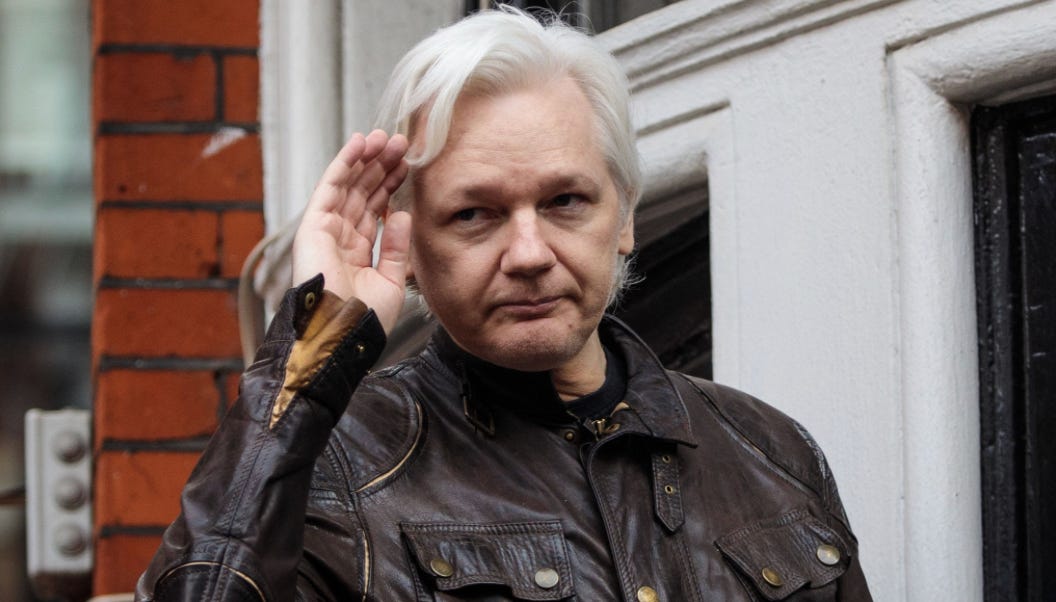
Freedom - Julian Assange

Dear friends,

A few musings emerge in the still air of the summer evening. It was a historic day. Julian Assange is once again a free man.

Or is he really? What does freedom mean if one must pay for it with a coerced confession of guilt? This is what I read in the twilight of this sun-drenched day: Julian Assange and humanity will only truly be free when cowardly attempts to make him a criminal are abandoned and he is honored for what he is: someone who spoke and broke through the façade, even when he knew he would lose everything.

Mattias

Mattias Desmet is a reader-supported publication. To receive new posts and support my work, consider becoming a free or paid subscriber.
🔲 ☆

Nietzsche in Israel

Dear friends,

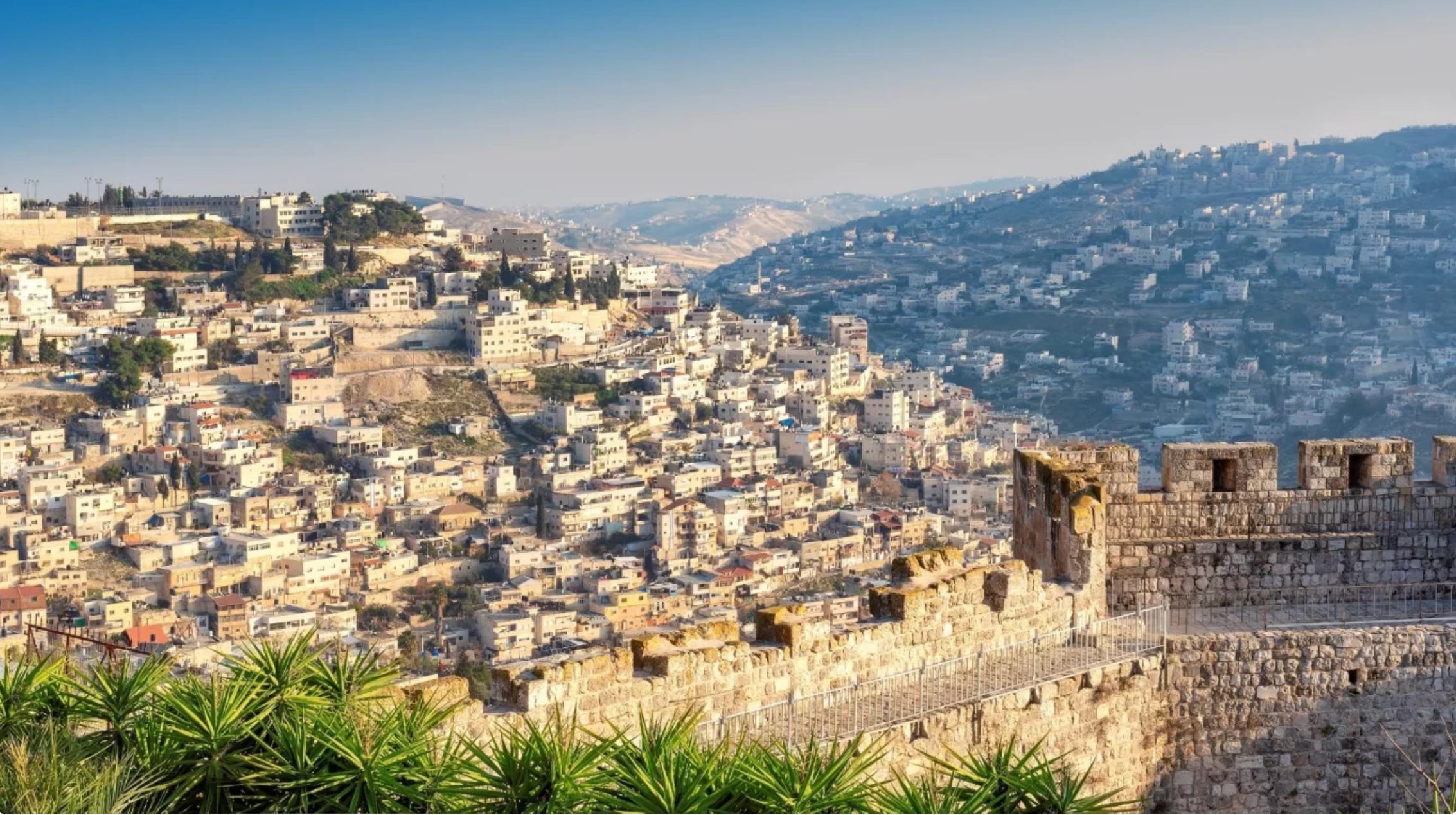
Several people have asked me over the past few months to speak out about the ‘Israel-Palestine conflict.’ I can say that I am writing an essay on it. However, I am not in a hurry to publish it. If I write something about it today, it is because Ghent University has decided to end its cooperation with Israeli universities. I want to start by making something clear: I do not support this boycott.

Mattias Desmet is a reader-supported publication. To receive new posts and support my work, consider becoming a free or paid subscriber.

When it comes to this conflict, I see and hear quite a few superficial sentiments and strong convictions in the public sphere, but little genuine desire for evenings of love and laughter between Jews and Palestinians. I suggest, to begin with: better leave aside the strong convictions and certainties.

When we talk about ‘Israel,’ who are we talking about? Are we talking about the Jewish people are seeking a place on earth where they are not bombarded with rockets every day? Are we talking about Israel in so far as it tries to be an orderly democracy where Arab and Jewish Israeli citizens live on an equal footing? Are we talking about the Israeli state as a crucial pawn of a globalist and technocratic New World Order, which briefly surfaced during the corona crisis? You cannot simply be ‘pro-Israel.’ There are many different kinds of ‘Israel.’

And when you talk about ‘the Palestinians,’ what are you talking about? Are you talking about the group of people displaced by the series of events in the British Mandate of Palestine over the last century and a half? Are you talking about the victims of an Israeli war machine that at times is the grim manifestation of ultranationalist sentiments? Or are you talking about a Hamas mass that is the spearhead of a Jew-hatred that thrives in much of the Arab world and that, no matter what Israel does or does not, wants to eliminate the last Jew?

If you keep in mind the Jewish person who does not get lost in ultranationalist feelings of superiority and the Arab fellow human who does not fall prey to Jew-hatred, you see that what is happening there is a classic human drama. And that human drama is not unique. It arises, like most human dramas, because people lose themselves in petty sentiments and ultimately fail to recognize the humanity in their fellow human beings.

That is why I do not participate in the increasingly fashionable ‘pro-Palestine’ demonstrations: with a few exceptions, I feel mainly a lot of fanaticism and little genuine concern for the fate of anyone. If you take to the streets when violence is done to one party, you must do the same when the other party faces the same. Otherwise, your activism does not testify to humanity but to unacknowledged hatred.

We can casually ask the pertinent question: why so disproportionately more attention to this drama? There are so many conflicts worldwide, so many armies causing large numbers of civilian casualties; there are so many refugees mourning the land and house where they were born. What makes the world’s eye so drawn to this conflict? What is the relation of the disproportionate attention to the qualification of Jewish people as God’s chosen people? I leave that question open for now, but that question also has a right to exist.

It is good to cherish our questions and be cautious with our answers. If you speak about the founding of the state of Israel, you are talking about something both humanly necessary and problematic. How can the Jewish people give themselves a (deserved) homeland without making it an ultranationalist ‘Jewish state’? Where does nationalism turn into ultranationalism? Can there be mass migration to a country without threatening the integrity and way of life of the people already living there (a pertinent question in Israel and beyond)? These are difficult questions. Great minds like Albert Einstein and Hannah Arendt have pondered them and never gave a definitive answer. Ultimately, the only answer that will be satisfying comes from the world of the soul and the heart, not from reason.

And the following dimension must be taken into account: anyone who speaks about the conflict in question speaks about a clash of religious and cultural entities, not only the Jewish and Arab-Islamic culture but also Christian culture and Enlightenment culture. In comparing and evaluating these cultures, we are comparing different forms of power and evil. There are cultures that tend to express hatred and lust for power in a physical way through terrorism and other forms of direct aggression; there are cultures that hold the world in their grip through monetary-economic means; there are cultures that say ‘love your enemy’ while at the same time colonizing the entire world; there are cultures that carry rationality and humanism in their banners but ultimately cause the irrational and ultimate dehumanization of totalitarian systems.

It would be interesting to evaluate different cultures starting from Nietzsche’s Will-to-power-ethics (which, by the way, I do not endorse), but this would lead us too far here. I will just say this now: those who only look from a ‘pro-Western’ perspective easily declare Islam, with its preference for suicide attacks and terrorism, morally and ethically inferior. But those who broaden their view and take into account the tens of millions of victims of Western colonialism and totalitarian systems and the ongoing suffocating grip of the banking world on the world population, are a bit more cautious. I think more along the lines of Solzhenitsyn, that the dividing line between good and evil does not run between cultures but through cultures and even through each human heart. At one point, the scale tips in favor of one side, and at another point in favor of the other. Ultimately, you conclude about most people, including yourself, with Nietzsche’s words: ‘Human, all too human.’

I come to this again: I have the impression that there are quite a few people regarding that conflict in the Middle East who are absolutely certain and convinced about things you cannot be entirely sure and convinced of after thorough consideration. For example, I hear quite a few people who locate the cause of the conflict with one party or the other. I see mainly an endlessly receding series of actions and reactions in history. The cause of the war in Gaza is the raid of October 7; the cause of the raid of October 7 is Israeli policy in Gaza and the West Bank; the cause of Israeli policy in Gaza and the West Bank is endless Palestinian terror; the cause of Palestinian terror is the expulsion of Palestinians from their villages by Israelis, the cause of the expulsion of Palestinians is the collective attack by Arab countries on Israel in 1948, the cause of the Arab countries' invasion was the colonialist founding of the state of Israel by the United Nations, the cause of that founding was the Holocaust, and so on.

You can go back to the expulsion of the Jews from Israel by the Romans and even further. Depending on your prejudices and the object of your hatred, you can stop at a certain point in that causal reasoning, locate the ultimate cause of all misery there, and then be convinced that you know the culprit. What thinks in that way is not reason, it is hatred. Love does not quickly fall into the false certainty of ‘logical’ thoughts; it finds certainty only in itself. The only real certainty, by the way.

This is what I think: the cause is not in one point; it is simply at every point where a person loses their humanity. I also come to the same point here: humanity lies mainly in the ability not to be so certain and convinced that you no longer see someone with a different conviction as a human being. It is the courage to be uncertain that brings people around the campfire and really lets them listen to each other and talk to each other. Also in the Holy Land. Not that everything is solved with that insight, far from it, but if you realize this, you might be a bit more cautious with a boycott.

More on that later.

Mattias

Mattias Desmet is a reader-supported publication. To receive new posts and support my work, consider becoming a free or paid subscriber.

🔲 ☆

The WHO power grab

Last week, discussions were held at a WHO summit in Geneva regarding the so-called Pandemic Treaty. Parallel to this summit, the Inspired Global Leadership Summit was organized, a conference critical of the Pandemic Treaty. I was invited to speak at this summit, and I accepted the invitation. Let me explain why.

Mattias Desmet is a reader-supported publication. To receive new posts and support my work, consider becoming a free or paid subscriber.

At the WHO summit, among other things, 300 amendments to the International Health Regulations (IHR) were proposed. These amendments would allow the WHO to unilaterally declare an international medical emergency if an unspecified council of experts and virologists deems it advisable. The stated goal: to respond more efficiently to pandemics by developing a so-called 'One Health Policy.'

What does the One Health Policy entail? If you browse the WHO website, you will find something like the following: humans are part of a broader ecological system; everything is interconnected—humans, animals, plants, and the climate system; therefore, a holistic approach is needed. No one would object against this vision. Even New Agers and the remaining hippies wouldn't.

And how exactly does one plan to realize the One Health Policy? This is where it gets a bit more delicate. The WHO wants globally coordinated prevention and management of so-called international Medical Emergencies. Once such an emergency is declared, the WHO takes radical control: they want to autonomously enter contracts with pharmaceutical companies, impose travel restrictions on citizens, and mandate standardized medical interventions. They also aim to establish a broader global bio-surveillance system, including permanent vaccination passports. For this, the WHO has taken over the technology of the EU Digital Covid Certificate from the EU as of July 1, 2023. You know, the certificate based on the subsequently proven false assumption that the Covid vaccine would stop the virus's spread.

The medical emergency thus grants almost absolute power to the WHO. This raises the question: who can declare the international medical emergency under the proposed legislation? It won't surprise you: the Director-General of the WHO. And for this, there doesn’t even need to be a viral outbreak. Climate changes that could potentially trigger such an outbreak are sufficient to declare an emergency.

Allow us to have some reservations. Firstly, it has become sufficiently clear that the experts and virologists of the WHO are quite quick to notice a medical emergency. Increasingly so in recent decades. For example, in 2023, the WHO deemed monkeypox a medical emergency when approximately 16,000 cases were detected in a world population of over 8 billion people.

The experts and virologists in charge noted that 'we had no control whatsoever' over monkeypox, and the mass media helped spread their message. The result: in a short time, long queues formed at vaccination centers, and Big Pharma swung into action. Belgium alone invested 110 million euros in vaccines against monkeypox. No idea how many were administered, but either they were remarkably effective, or it was a false pandemic alarm. I suspect the latter option is the most plausible.

If you browse the WHO texts, you’ll find a discourse convinced of the beneficial nature of a technocratic approach to global health, where the 'right,' 'scientific,' 'rational' medical interventions are top-down imposed on the population through the strictest possible surveillance.

The WHO (and related globalist institutions) undoubtedly see themselves as the ultimate representatives of the Enlightenment tradition, the pinnacle of rationality. I dare to doubt whether that is true. And I'm putting it mildly. To return to the monkeypox example: from a rational point of view, does anyone actually doubt that those 110 million euros in Belgium could have been better spent on combating, say, child poverty and education?

And does the WHO really represents the kind of open mindedness the seminal Enlightenment philosophers had in mind? Read the texts generally considered the basis of the Enlightenment tradition. What does Kant say, for example, in his essay 'What is Enlightenment'? He says, unequivocally, that the goal of the Enlightenment tradition is to free the citizen from his immaturity. It’s all too easy to let a teacher determine what is right and wrong, a priest what is good and evil, and yes, a doctor what is healthy and unhealthy. Think for yourself. Dare to think. Sapere Aude.

This is what I think: in their pursuit of a rational approach to health, institutions like the WHO have inadvertently ended up in the opposite. They no longer represent science, rationality, and the Enlightenment, let alone a society with self-determination and the right to free speech. In its absolutist, totalitarian ambitions, rationality has turned into absurd irrationality, and the pursuit of Enlightenment heralds a new era of darkness.

The Pandemic Treaty is being negotiated by all members of the WHO General Assembly, which includes all 193 UN member countries. The results are binding for all 193 countries. This means that none of the states can escape it, under penalty of (severe) economic sanctions imposed by the UN. If a simple majority ultimately votes for the amendments, the legislation will come into effect within 12 months, so by May 2025.

The vote is essentially a moment where democratically elected politicians will vote for or against the abolition of democracy. If a simple majority is reached, we will be one huge step closer to replacing democracy with technocracy—a world where citizens are passively subjected to 'experts.'

Last year, I raised my voice about this in the European Parliament in Strasbourg and Brussels and in the US senate at Capitol Hill. And I did so again last week in Geneva. People across all political orientations must unite who fundamentally question this technocratic trend. They must unite, not into a mass, but into a group. The difference between a mass and a group? A mass connects because everyone fanatically shares the same opinion; a group connects because people grant each other the right to speak as human beings, regardless of opinions. In a mass, differing opinions are a reason for hatred and aggression; in a group, differing opinions are a reason for love. Precisely where the Other is different, he becomes interesting. As I have said elsewhere: If we only love the Other because he is identical to ourselves, we do not love the Other but our own mirror image, and what we feel is not love but narcissism.

And the act that leads to connection is an act as old as humanity itself: the act of sincere speaking. Ultimately, it is this act, which humans were capable of around the campfires of prehistoric times, that will surpass the power of the greatest technological surveillance apparatus. It is the art of speaking, the phenomenon of truth, that must be rediscovered in times of technocracy. It is the citizen who masters the art of sincere speaking that Kant had in mind in his essay on Enlightenment—not the citizen who mindlessly follows and undergoes the expert discourse of the WHO.

Mattias Desmet is a reader-supported publication. To receive new posts and support my work, consider becoming a free or paid subscriber.
🔲 ☆

A dream

Dear friends,

I just remembered a dream I had a few nights ago. I am walking in a park, and a man with whom I used to have a good relationship approaches me, with a broad smile and waving right hand. I am surprised. Didn’t that man want nothing to do with me since the COVID-19 crisis? And now I bring a smile to his face! He asks how I am doing. When are we going to have dinner together again? I am astonished and happy—the cold silence of the past few years wasn't really cold! He still cares about me!

Mattias Desmet is a reader-supported publication. To receive new posts and support my work, consider becoming a free or paid subscriber.

I wake up and feel sadness. It was just a dream. I realize that I have had this dream—or a variant of it—several times over the past few years. I wonder: do the people I dream about have the same dream? Could there still be a warm desire beneath the frozen and cold rock of lost love for everything to be as it once was? Sometimes, all that is valuable lies in the question itself, the reverie of the past, the glimmering of tomorrow on the horizon.

Mattias

Mattias Desmet is a reader-supported publication. To receive new posts and support my work, consider becoming a free or paid subscriber.
🔲 ☆

Dr. Breggin - my invite is still open.

Dear readers,

It seems that Dr. Breggin won’t accept my invitation to have a proper conversation with me. After I wrote my substack article ‘Dear Dr. Breggin: let’s talk’ I sent him an email in which I invited him to talk with me. He didn’t answer it.

Mattias Desmet is a reader-supported publication. To receive new posts and support my work, consider becoming a free or paid subscriber.

This was not the first time I reached out to Dr. Breggin. In September 2022, after he published a series of offensive articles, I also invited him to have a public conversation with me. He refused.

On this occasion, I refer to an earlier substack article titled ‘Am I an expert in mass formation or a trojan horse?’ in which I reacted to the criticism of Dr. Breggin. It seems a bit strange to me that he continues to repeat the same allegations while this article refuted them so clearly.

The only thing I can say is that my invitation to have a conversation is still open. I think this is an excellent opportunity to show that people can be on speaking terms when they have different opinions. Below, I repost a few paragraphs from my substack ‘Some notes on the tragicomic attempts to burn me at the stake’. I believe they are relevant in this context.

‘I recommend that everyone read the excellent book by David Graeber and David Wengrow, The Dawn of Everything: A New History of Humanity. The authors describe how, in Indigenous tribes of northeastern North America, no one had power over another. How were the problems of coexistence solved? By only one means: talking to each other (see p. 56). An enormous amount of time was spent in public debates. And it never occurred to anyone to exclude even one person from those conversations.

Missionaries and other Westerners who engaged in dialogue with the Native Americans were also impressed by their eloquence and skill in reasoning. They noted that these “savages” attained a degree of competence throughout the tribe against which Europe’s highly educated elite paled in comparison (see p. 57). Indigenous orators such as Huron-Wendat Chief Kondiaronk were invited to Europe for a seat at the table so that nobility and clergy might enjoy their extraordinary rhetoric and reasoning. (Many such Indigenous leaders also mastered European languages.)

Western culture is going in the opposite direction: the register of linguistic exchange is increasingly being replaced by the register of power. Those who do not subscribe to the prevailing ideology are branded and regarded as someone with whom a decent person is not allowed to speak (‘conspiracy theorist’, ‘antivaxxer’, ‘far right’, and so on). I often emphasize that in the current era we need to rediscover and rearticulate the timeless ethical principles of humanity. This is the first one: see in every other human being an individual who has the right to speak and be heard.

That was a principle of mine long before the corona crisis, a principle that I maintained in my psychotherapeutic practice, among other places. I worked in my practice as a psychologist with cases where many people would rather not burn their fingers. In 2018, I made the front pages of the newspapers and appeared on national television after I was called as a witness in the assize trial of a nurse who, in the past, had killed terminally ill patients with insulin and air embolisms. At that trial, I refused to hand over my patient file to the judge for seven hours. My motivation was clear: if I tell someone that I will keep their words in confidence, I will do so. And from a legal-deontological point of view, I think that’s completely justified: past offenses or crimes are never a valid reason to breach professional confidences. My point is this: we must put the act of speaking at the center of society.’

Mattias

Mattias Desmet is a reader-supported publication. To receive new posts and support my work, consider becoming a free or paid subscriber.

🔲 ☆

Propaganda, Sincere Speech, and the Intuition of the Samurai

Here is one of the big questions of our times: what can we believe? As the space for open minded conversation and non-conformist opinion shrivels in our society, answering this question gets increasingly difficult. Swarms of ‘digital first responders’ anonymously ridicule and criminalize dissident opinion on social media, machine learning technology identifies and suppresses online narratives that go against the mainstream, search engine algorithms guide people inconspicuously to politically correct answers to all their questions, and so on. The battle for the hearts and minds of the people rages more fiercely than ever - we truly live in the era of propaganda.

         And we live in the era of Artificial Intelligence.  AI generates chatbots, artificial images, and deep fake videos that can put the innocent in a bad daylight and make the guilty go free; it writes master theses for sneaky students and poems for lazy lovers; it creates a ‘woke’ version of history with a radical contempt for facts. Humanity gets lost in a world of manufactured falsehood.

Mattias Desmet is a reader-supported publication. To receive new posts and support my work, consider becoming a free or paid subscriber.

         Who will protect society from censorship and falsehood? Journalism maybe? Walter Lippmann won two Pulitzer Prizes and is considered the father of modern journalism (see Stiles, 2022, p. 28). It is telling that he favored a technocratic model of journalism in which ‘experts’ must construct narratives about every major news event and subsequently feed them to editors and journalists.

Here is a quote of Lippmann’s book ‘Public opinion’: ‘Public opinion must be organized for the press if they are to be sound, not by the press as is the case today’. This quote says as much as this: forget the free press. It was written in 1922. Lippman is said to be the most influential journalist of the 20th century. Ever wondered why media articles around the world all look a bit similar? Now you have an idea why.  

The army of fact checkers claiming to fight ‘fake news’ are part of this problem as well. These ‘ambassadors of Truth’ have little to do with Truth. A few years after the corona crisis, we know that even better than before. The origin of the virus, the mortality rate of the virus, the efficacy of the vaccines and the safety of the vaccine – the fact checkers promoted fake news and fought correct information. It’s clear to everyone who wants to see it: they are a veritable Orwellian ministry of Truth.

What is truly mind boggling, however, is that even when ‘experts’ as Gates and Fauci admit that the vaccine didn’t stop the spreading of the virus, even when the experts of Imperial College admit the mortality rates of the virus were far lower than their models predicted, a major part of the population doesn’t really want to hear it. Never in history it is demonstrated so convincingly that indeed, the most fundamental passion of the human being is not love, not hate, but the passion for ignorance.

Upon a closer consideration, the problem of deception in society is far more complex than just a bunch of manipulative propagandists who mislead the guileless population. It seems that most people don’t care too much about being deceived. They even seem to admire those who deceive them. It makes me think about this quote of Hannah Arendt:

‘The totalitarian mass leaders based their propaganda on the correct psychological assumption that, under such conditions, one could make people believe the most fantastic statements one day, and trust that if the next day they were given irrefutable proof of their falsehood, they would take refuge in cynicism; instead of deserting the leaders who had lied to them, they would protest that they had known all along that the statement was a lie and would admire the leaders for their superior tactical cleverness.'

And even more: in the final analysis, there is a little propagandist and manipulator in all of us. And it is so skilled, that it succeeds in deceiving ourselves. As a human being, we constantly hide behind what I would call ‘the veil of appearances.’ We constantly hide certain aspects of who we are from others, we constantly try to conform to all kinds of ideal images that circulate in society. And in the end, we believe that we are the illusion we created ourselves – we fall prey to the deceptive nature of our Ego.

This applies in the first place to the act of speech. We are censored by others indeed, yet before others censor us, we already censored ourselves. In the end, we speak words of which we don’t realize anymore that they are not our words but just hollow echoes from the matrix of social forms in which our being is absorbed.

Can we find the way out of this labyrinth of deception? Is there such a thing as Truth? And can we find it in this world of falsehood and illusions? Quite a lot of people have tried to define strategies to deal with the plague of propaganda in our society, (see also Stiles, 2022), yet the problem seems to me that they usually ignore the fundamental complicity of the human Ego in the game of deception. And as such, they are by and large ineffective.

Please allow me to summon an archetype which is being banned in our culture: the archetype of the warrior. A warrior always stand with one leg in the land of Death. Truth is wandering around in this land. Samurai and ninja culture showed us an interesting relationship between truth on the one hand and intuition on the other. And I believe this relationship is relevant as it comes to finding a solution for the problem of propaganda and totalitarianism.

For the samurai the martial arts boiled down to this: to develop the capacity to discern truth from lie. The movements of the martial arts are linguistic in nature. Sometimes they lie, sometimes they speak the truth. The sword in the right hand attracts attention – the dagger in the left hand strikes. He who can discern truth from lies survives on the battlefield, he who can’t, dies.

         One doesn’t survive on the battlefield by looking with his eyes. Our eyes see a world of appearances; they are easily tricked. Wat really matters is zanshin, a kind of awareness of the world around you which is not based on ordinary sensory perception. The entire art of the samurai aimed to develop this potential – the sixth sense of the warrior.

         Whether or not a student in the martial arts had developed his intuition well enough was tested in samurai culture through the sakki or godan test. The candidate kneels, a grandmaster positions behind him, outside of his field of vision. The grandmaster waits for some time and then strikes suddenly, aiming for the neck of the candidate. If the candidate’s intuition is well developed, he will move away at exactly the right moment, if not, he loses his head. Nowadays this test is done using wooden swords (‘boken’) but it used to be done on the razor’s edge. By the way: Akira Kurosawa showed a variant of this test in his timeless cinematographic masterpiece Seven samurai.

         How did the samurai develop this intuition? The intuition of the warrior is related to the act of speech. Unlike Plato, samurai culture believed that the pen and the sword should be wielded by the same hand. Samurai practiced the art of speech. And one of the elementary principles of this art was sincerity (see for instance the principles of Budo according to Saitõ Chikamori).

We can roughly distinguish between two types of speech, speech from the Ego and speech from what we might call the Soul.

The Ego is an imaginary structure, based on identifications with outer ideal images. When we speak from the Ego, we do not really articulate what we feel or experience inside. We rather say what we think we have to say in order to be accepted by others and society. Such speech keeps up appearances. It makes us win something at the level of our Ego yet it also comes with a price: we slowly lose touch with the essence of who we are.

And it also makes us lose touch with the world around us. Ego-speech focusses our attention and psychological energy on the outer ideal images, on the surface of our being. It literally makes the psychological ‘shell’ thicker. In this way, we get isolated inside this Ego-shell and stop resonating with the world around us. In other words: our ‘zanshin’ or intuition gets weaker.

What is the alternative to Ego-speech? Inside the shell of the Ego, there is something which in religious and mystical traditions, and in some intellectual traditions as well, is referred to as the Soul. ‘The Soul’ seems to be an obsolete concept, yet in many respects, it is a fruitful one. It refers to an inner essence, something that is inside an outer form.

From a psychological point of view, speaking from the soul means to give voice to those things that we truly feel or experience; those things that are usually hidden behind the ideal images. It means saying those things that are not in line with the matrix of social ideal images, dogma’s and norms. Such speech makes us vulnerable, it puts us at risk of excommunication and rejection, in particular when we practice it in the presence of people who use the world of appearances as their major stronghold.

Opposite of Ego speech, sincere speech makes us lose something in the world of appearances and it makes us win something in the real world. It is a kind of speech that emerges from within and literally penetrates through the outer ideal image we hide behind. It quite literally pierces holes in the Ego. And through these holes, a new resonating connection between our essence and that of the world around us can emerge. It is at this level that we can situate the phenomenon of Truth.

This might seem abstract, yet it isn’t. Just try it. Share something that makes you feel vulnerable, something you usually hide from the world, with some trustworthy people. You will immediately feel a deeper connection – from soul to soul. You can sense it almost physically. Practice the art of sincere speech day after day, week after week, month after month, try to make progress step by step, and your intuition will improve step by step. It is at this level that we can understand the connection between sincere speech and the intuition of the samurai – sincere speech makes you aware of the world around you beyond ordinary sensory perception.

Sincere speech makes your soul resonate with the world around you - indeed. From a subtle materialistic perspective, for which physicist Erwin Schrödinger laid the foundations in his book ‘What is life?’ (see Berkovich, 2003 and Van Lommel, 2011, p. 286), we could consider the human body as a vibrating substance, which resonates with the frequencies of the world around it. And through the vocal apparatus, the human being can creatively return the music to the universe with a singular touch.

The samurai was very well aware of exactly this: what kills you on the battlefield, ultimately, is not so much the sword or arrow of your enemy, it is your own Ego. And what makes you powerless against propaganda, is not so much the propaganda itself, it is your Ego. It makes you incapable of discerning between truth and deception and it makes your voice hollow and weak and incapable of creating the connection with Others that is necessary to make propaganda powerless.

Truth is the only remedy for a society sick of lies. It connects people from soul to soul, as strings vibrating on the same frequency. And as such it is the real cure for the loneliness and disconnectedness that makes modern human beings so vulnerable for propaganda (see Jacques Ellul’s concept of the lonely mass).

As I said before, as soon as the group connected through sincere speech is energetically stronger than the propagandized masses, the era of totalitarianism is over. Not sooner, not later. In this respect, the only way to contribute to the solution of the big crisis of our society is to face our shadow and overcome our own individual crisis and trauma, that means, to transcend our Ego through sincere speech.

Mattias Desmet is a reader-supported publication. To receive new posts and support my work, consider becoming a free or paid subscriber.

🔲 ☆

Dear Dr. Breggin - let's talk.

It seems that Dr. Breggin doesn’t like my ‘Suicidal Society’ substack. Please find his comments here. Let me first and for all say this to him: let’s talk. It’s time to have a proper conversation.

You might know what my ‘Suicidal Society’ article was about: the idea is gaining traction in public discourse that we would be better off if a major part of the population stopped to exist. Humans cause climate change; they are a virus proliferating on the surface of the earth. There is too many of them. Let’s start with eliminating the elderly through euthanasia – old people are costly and useless. We see how such ideas pop up more and more in the mainstream media.

Mattias Desmet is a reader-supported publication. To receive new posts and support my work, consider becoming a free or paid subscriber.

And then comes the part Dr. Breggin seems to be quite angry about: I remark that such ideas can only gain traction in society when there is a strong suicidal wish in the population. Everyone can read the full article here.

In a nutshell: Dr. Breggin believes that I am blaming the innocent victims of propaganda while excusing the propagandists. And it is not the first time I do so. According to him, I did exactly the same with my mass formation theory: blaming the innocent people and excusing the criminal elite. And even before the coronacrisis, he claims, I walked this path already. He found a 2018 newspaper article reporting that I protected mass murderers in my psychotherapy practice.

Here is what I propose to Dr. Breggin (as I proposed before): let’s have a public conversation. I read some parts of his book. It seems to me that we have some common goals. And I add to this that I am grateful for his efforts to expose pharmaceutical crime.

For me this isn’t a matter of ‘winning a debate’ with Dr. Breggin – it’s an invitation to have an open-minded conversation. I propose people read ‘The dawn of everything’ by Graeber and Wengrow. In the first part of the book, the authors describe how the native inhabitants of North-East America succeeded in organizing their tribal societies almost without use of power or hierarchical relationships. How could they do so? Because they practiced the art of sincere speech in public space, hours and hours and hours a week.

That’s what I invite Dr. Breggin to: let’s practice the art of speech together. We have different opinions indeed. Unlike Dr. Breggin seems to believe, I don’t think that the problems of this society can be reduced to the actions of an ‘evil elite’. We are all part of the problem, also the people who fall prey to the actions of ‘the elite’. Dr. Breggin seems to interpret this as ‘victim blaming’. In my opinion, I rather make people aware of the fact that they are not powerless. We are all part of the problem and hence we can all contribute to the solution.

And we do so in the first place by openness and willingness towards those who have a different opinion than we have. As I remarked before, in my analysis, this is the essence of the metaphysical revolution we are going through: on the one hand we have a mass in the grip of this new kind of lie and manipulation which we call ‘propaganda’; on the other hand we see the emergence of a group of people united by sincere speech. In the mass, everyone has the same propagandized opinion. In the group, people all have their own, singular opinion. And that’s what makes them eager to talk and listen to one another. As soon as the group becomes energetically more powerful than the mass, the era of totalitarianism is over.

Dr. Breggin: let’s find out whether speech can unite us across our differences in opinion. I hope you kindly accept my invitation.

Mattias

Mattias Desmet is a reader-supported publication. To receive new posts and support my work, consider becoming a free or paid subscriber.
🔲 ☆

Suicidal Society

Suicidal Society

I guess you remember how a few years ago, the media called everyone who refused to wear a mask or get vaccinated a ‘grandma killer’. To protect the elderly, to save every minute of their lives – that was all what mattered.

Mattias Desmet is a reader-supported publication. To receive new posts and support my work, consider becoming a free or paid subscriber.
Here is something to think about: Last week, I stumbled upon an article in a Dutch mainstream newspaper which declared in a technical and deliberate way that the ‘mysteriously persisting excess death’ has certain advantages: it saves the state hundreds of millions of costs of taking care for old people. I checked my calendar. An April fools’ joke maybe? No – it was no joke.

One could argue, of course, that this is just one article. What am I making a fuss about? Let me give you another example. A few weeks ago, the director of a government health insurance fund stated in an article published on the website of Belgian national television that euthanasia should be considered as a solution for the rapid ageing of the population. Exactly. Old people cost too much money. Let’s kill them.

These too are the words of only one man. Yet such words are not printed in the newspapers in such a guileless way if there is not a certain tolerance for such messages in society.  

Let’s face it: some people want to get rid of the elderly. And these people look suspiciously lot like those who blamed you for being a heartless criminal when you suggested that the corona measures would do the elderly more harm than good.

Upon a closer examination, the sentimental ‘protection of the elderly’ during the corona crisis was rather cruel and absurd. For instance: why were the elderly dying in hospitals not allowed to see their children and grandchildren? Because the virus could kill them while they were dying?    

Beneath the surface of the state’s concern about the elderly lurks exactly the opposite: the state wants to get rid of the elderly. Soon there might be a consensus: everyone who wants to live beyond the age of seventy-five is irresponsible and egoistic – a grandson killer. At least these old bastards must pay a carbon tax.

And in the end, not only the old people have to die. Humans cause climate change – they are a detrimental virus proliferating on the surface of the earth. The planet would be better off without humans.

How did we come to this point? Is there an elite who used propaganda to make us think like this? There is much more than that.

Jacques Ellul taught us that, for propaganda to be successful, it must always resonate with a deep desire in the population. Here is what I think: society is suicidal. That’s why it is more and more open to propaganda suggesting death is the best solution to our problems. That’s why so many people sleepwalk into war with Russia; that’s why so many people don’t really care about the ‘mysteriously persisting excess death’ or even think ‘it has certain advantages’.

And think about the corona measures: They wrecked the economy, destroyed the psychological well-being of people, ruined the health and wealth of children and adults, stripped us of our democratic rights. And all this without any reasonable degree of certainty that the measures would protect us from anything at all. Many people even participated in a quasi-ecstatic way in the corona measures.

That’s exactly what characterizes ritualistic behavior: it has no pragmatic meaning, it demands a sacrifice of the individual, and it leads to a certain ecstasy.

The ritualization of death manifests in its most pure form in the global advance of the practice of state-controlled euthanasia or ‘medically assisted dying’. More and more people wish to die, but they are not allowed to take the decision themselves or do it in their own way. Psychiatrists and psychotherapist are under increasing pressure to report every patient who expresses suicidal wishes. Subsequently, these patients can apply for euthanasia.

Should you want to die, you first have to go through a bureaucratic procedure which will determine whether they have the right to die; should this procedure decide you are eligible for dying, the state will kill you using the ‘right’ procedure.

The leaders of society, whether they know it or not, always have the function to orchestrate rituals. Man is a symbolic being, and society, in the first place, is a shared symbolic system and a shared symbolic-ritualistic practice.

Why do people participate in these state rituals of death? Through participating in rituals, an individual shows that its individual existence is less important than the collective existence. Rituals, in the end, are symbolic behaviors through which an individual transcends its individual existence.

Human beings need rituals. In particular when they feel disconnected and isolated. And that’s exactly what most people feel in this era of the mechanist worldview: disconnected and isolated. Here’s a quote of Aldous Huxley:

‘During the past century the successive advances in technology have been accompanied by corresponding advances in organization. Complicated machinery has had to be matched by complicated social arrangements, designed to work as smoothly and efficiently as the new instruments of production. In order to fit into these organizations, individuals have had to deindividualize themselves, have had to deny their native diversity and conform to a standard pattern, have had to do their best to become automata. […] People are related to one another, not as total personalities, but as the embodiments of economic functions or, when they are not at work, as irresponsible seekers of entertainment. Subjected to this kind of life, individuals tend to feel lonely and insignificant. Their existence ceases to have any point or meaning.’ (Brave New World – Revisited).

The mechanist worldview pulverized society, it fragmented it into elementary particles, lonely like reed that does no longer sing in the wind. Never before humanity has been so much in need of rituals. And never before it has ignored the importance of rituals as much as it does now. In a mechanist-materialist worldview, rituals are completely meaningless.

The entire madness of totalitarianism, with its limitless proliferation of bureaucratic rules, which in the end suffocates the entire society and proves extremely lethal, exactly boils down to this: it represents the return, in an excessive way, of a repressed Truth: the human being is a symbolic being, a being which needs rituals.

Mattias Desmet is a reader-supported publication. To receive new posts and support my work, consider becoming a free or paid subscriber.

🔲 ☆

My Slovenia book tour: From Tito to democracy.

My dear friends,

As I announced in my previous substack: a little update from my book tour in Slovenia. Last Friday, my plane landed on Ljubliana Joze Pucnik Airport, the only public airport of Slovenia, It is situated about 25 kilometers North of Ljubliana, the capital of Slovenia, on a strip of flat land surrounded by snow-capped alpine peaks who guard it as silent giants – one of the most picturesque airports I have ever seen.

Mattias Desmet is a reader-supported publication. To receive new posts and support my work, consider becoming a free or paid subscriber.

Just to give you a little bit of geographical context: Slovenia is a relatively small country (about two million inhabitants) at the Adriatic Sea in the south of Europe. It’s surrounded by Italy (West), Austria (North), Hungary (East) and Croatia (South) and it has a small strip of Adriatic coast, in between the Italian and the Croatian Adriatic coast.

As you might know, Slovenia was part of former Yugoslavia, which included, besides Slovenia, also Croatia, Serbia, Bosnia and Herzegovina, Macedonia, and Montenegro. Yugoslavia fell apart after the Yugoslav wars started in 1991. In most people’s minds, the narrative of the Yugoslavia wars goes like this: as the communist system weakened, the Muslims, Catholics and Orthodox Christians started to fight, and large-scale ethnic conflicts and atrocities happened. Eventually the UN intervened, the major culprits were brought to the international court in The Hague, and former Yugoslavia was divided in several other countries.

Narratives are always narratives – they are not reality itself. And they are always written by someone. In the end, they are written by those who are in power. Narratives make you see a part of reality, but they also hide something from the eye. That’s why it is always interesting to learn about alternative narratives as well.

The recent history of Yugoslavia starts with Tito, the man who was in charge there in between the second world war and 1980. Tito was a World-War-II partisan. One of the many. The entire area of former Yugoslavia has a inborn inclination to resist oppression. These guys don’t like to be told what to do. No less than 50% of the population joined the resistance during World War II. Just mentioning here: during the corona crisis, the vaccination rate in former Yugoslavia was also about 50%, one of the lowest in Europe.

Tito, born in 1892, was first inspired by socialist ideology. Later on, after he spent some years in the Soviet union, he ‘upgraded’ to communism. After the war, he became prime minister (1948) and president (1954) of Yugoslavia.

Tito claimed the status of president-for-life and he installed a one-party system in Yugoslavia. He is recorded in the books of history as a communist dictator who used a communist-style secret police apparatus – the Directorate for State Security. Sure, it operated more restraint than the soviet secret police, yet it did trace, imprison and eliminate political enemies.

Tito was a communist, yet, at the same time, he is also known as the man who refused joining the Soviet Union. In this way, he stopped the march of Stalin to the south-west of Europe.

While driving to the wonderful Postojna cave, Rok and Andreja, the couple who owns the publishing house Sanje, which published the Slovenian translation of my book, made some interesting side notes about Tito’s communist one-party system. They explained that the party was quite heterogeneous in Tito’s time. It existed of many subgroups with opposing opinions. In contemporary Western democracies, we usually see the opposite: there are many parties, but in the end, the political landscape is quite homogeneous. No matter who wins the elections, it won’t make much difference.

Do we really live in a democratic state system in the Western world? Or does it only have the outward appearance of a democracy? Please read the following paragraphs from Aldous Huxley’s book Brave New World - Revisited:

‘By means of ever more effective methods of mind-manipulation, the democracies will change their nature; the quaint old forms — elections, parliaments, Supreme Courts and all the rest — will remain. The underlying substance will be a new kind of non-violent totalitarianism. All the traditional names, all the hallowed slogans will remain exactly what they were in the good old days. Democracy and freedom will be the theme of every broadcast and editorial — but democracy and freedom in a strictly Pickwickian sense. Meanwhile the ruling oligarchy and its highly trained elite of soldiers, policemen, thought-manufacturers and mind-manipulators will quietly run the show as they see fit.’

Huxley wrote these words in 1958. Now, more than 60 years later, they sound familiar, if you ask me.

Are contemporary ‘democracies’ freer than Tito’s communism? That’s a good question. I want to push it even further: Is Western democracy freer than, let’s say, contemporary China? If I rely on the China-narrative in Western media, even asking the question is foolish. China is full of propaganda, indeed. But what we learn about Chinese propaganda is colored by Western propaganda.

If I rely on what people who live in China tell me from a first-person perspective, the question as to whether our democracy is freer than the Chinese one is less foolish. In China, people shouldn’t question The Party, that’s true. Yet many of them don’t seem to have a problem with it and seem to be quite happy with the current situation. The same holds for the social credit system: it is less palpable than we might think, and most people do not seem to be fundamentally unhappy about it.

Sure, the happiness of the majority of the population doesn’t mean that much if it comes to evaluating the ethical qualities of a state system. There are many things that show that the Chinese system is problematic. To give only one example: look at how the practitioners of Falun Gong are treated there.

China truly has a problem. But to be honest, I am less sure than I used to be that their problem is so much bigger than ours. If you think I am talking nonsense, please read the quote of Huxley again.

I have never liked communism. And I never liked Marx. I agree with Lord Bertrand Russell that Marx’ problem was that he didn’t want to make the proletariat happy; he rather wanted to make the bourgeoisie unhappy. And moreover, no matter how sharp minded Marx’ analysis might be in certain respects, I think it was naïve to believe that ‘economic equality’ would eradicate the problems in human living together.

The root of the problem of humankind is not to be situated in the economic system; it is to be situated in the human heart. The real revolution we need is a revolution at the level of the ethical awareness of humanity. Without that, you might eliminate economic inequality as much as you want, the world won’t become a better place.

To the contrary, the focus on the economic level, suggesting that the root cause of the problem is to be situated there, will draw the attention away of the ethical level and let evil flourish even more than before.

A society in which people lack ethical awareness will always be inhumane, no matter what state system is used. And the opposite holds true as well: if the ethical awareness of people is well developed, society will be a place where human beings can live a life worthy of a human being, no matter which state system is used.

Indeed, I have never been enthusiastic about communism. But I am willing to admit that under certain conditions, communist leaders created social conditions that were better than the conditions we live in now. And I realize that our view on communism is colored by Western propaganda, just like almost any dominant narrative in the West is partially a product of propaganda.  

This is a good question as well: are the social conditions in the ex-Yugoslavian countries now better than under Tito? I doubt it. For instance: throughout the last two decades, the price of an average apartment in Ljubliana increased from about 50.000 euro to more than 400.000 euro. And a little bit earlier, in Tito’s time (Tito died in 1980), everyone could buy a house.

Now, it seems more and more impossible for young people, hard working or not, to buy a place of themselves. That holds for Slovenia, just like it holds for major parts of the rest of Europe. I don’t think this is normal. No matter how well hidden it might be, this is not democracy, it’s tyranny.

This is also worth considering: under Tito, the crime rates were twenty times lower than they are now. People even didn’t close their doors. Of course, such figures are always hard to interpret. Maybe the crime rates were lower because the dictatorial Tito relentlessly punished crime. That’s questionable. In many respects, Tito seems to have made a rather mild impression. In ’68, for instance, Tito might have been the only head of state who openly supported the student revolts.

I think it’s fair to say that Tito’s mild communism, in many respects, was better than contemporary ‘democratic’ systems and that Tito’s authoritarianism was replaced by a Western ‘velvet glove’ totalitarianism which cared less about the interests of the people.

Just like Ceausescu in Romania – who for the rest, in my humble opinion, was a different type of leader – Tito created a financial system that was independent of the large international banking system. After Tito died, this international banking system seized its chance. It helped Slobodan Milosevic rise to power, knowing that he would be willing to give up financial independence of Yugoslavia. Milosevic was a lawyer and a banker before he became a politician. The pictures where Milosevic posed with some of the foremost international bankers are available on the internet. The story goes that these bankers gave Milosevic a symbolic present: a golden pistol.

A picture doesn’t tell that much. of course. But then again, it seems that big finance had something to do with the sequence of events that eventually led to the Yugoslav wars. Here’s the narrative about Milosevic I heard from Rok and Andreja.

Milosevic rose to power in the second part of the eighties. He was a radical fascist at that time. To change the financial system of Yugoslavia, he realized, Yugoslavia’s social coherence had to be broken. He and the people who supported him realized that the only way to destroy Yugoslavia was to destroy it from within. This was the most obvious strategy to do so: to stir up hatred between the Muslims, Orthodox and Christians who coexisted under Tito.

And it worked. The Yugoslav conflicts that started in 1991 demonstrated all the horrors of hatred. The systematic rape of Bosnian women by Serbian troops, often intentionally aiming for pregnancy as to destroy the Bosnian racial identity, is only one of the examples. And it was not only the Yugoslavians who surrendered to absurd cruelties. It is well-known that ‘tourists’ of Europe and abroad came to Sarajevo to buy a permit from the Serbian army allowing them to shoot a kill a citizen of Sarajevo with a sniper rifle. Depending on whether one wanted to shoot a child, a woman or a man, the price of the permit was slightly different.

Why am I telling this? To show that it was not only the international bankers that played a role in the horrors of the Yugoslavia wars. ‘Ordinary people’ did so as well. It makes me think of this quote of Alexandre Solzhenitsyn (The Gulag Archipelago): ‘If only there were evil people somewhere insidiously committing evil deeds, it were necessary only to separate them from the rest of us and destroy them. But the line dividing good and evil cuts through the heart of every human being, and who is willing to destroy a piece of his own heart?’.

I am happy to say that there is more than evil in a human being. I sincerely thank Tim Butara for organising my book tour: Tim, you did a wonderful job, and I am grateful that I met you as a human being. Thanks also to the rest of the organising team: Rok, Andreja, Maja, Ivan, Tanja, Esmeralda, and all the other who contributed - thank you for everything. I hope to see all of you again soon!

I’ll leave you with that for now. I will come back to you, maybe with one or another travelogue – I come to Nashville next week – or with another narrative. Mattia

s

Mattias Desmet is a reader-supported publication. To receive new posts and support my work, consider becoming a free or paid subscriber.

🔲 ☆

Pure water and small scale democracy

My dear friends,

I returned from Iceland, but my soul still lingers on the rims of embering craters and murmuring geysers. In one way or another, Iceland’s other worldly landscape has a kind of purity that I found nowhere else. The best witness to this purity is the water. Open a tap in Iceland and fluid crystal pours out of it.

I may have been studying water in a more serious way than most people. It was the first thing I learned during my training as a tea sommelier: the quality of tea is dependent on the quality of the water used. I am talking here about Chinese full leaf tea – tea with a soul. Grown with as much love and dedication as the grapes of the Romanée Conti.

Such tea leaves reveal the true nature of water. Each hidden shortcoming in the water will surface in the tea flavor as a wisp of bitterness. I have tried all kinds of water and I can confidently say: what comes out of any ordinary tap in Iceland, belongs to the best I have ever tasted.

When I just arrived in Iceland, I asked the divinely comic doctor Karl Snaebjornsson – Kalli among friends – whether I should buy bottles of water or rather just have it from the tap. His answer: if you want to pay for the microplastics, buy it in bottles.

Kalli was brought to court during the coronacrisis. His crime: he prescribed alternative medicines to people with corona. A six-year sentence was demanded. He kept his back straight, went to court, and was exonerated. Sometimes our judicial system does what it has to do.

And sometimes it doesn’t. I met some of the leaders of the Canadian Truckers a few weeks ago in Holland. Some of them actually spent some time in jail (or are at risk of jail sentences up to 15 years). I noticed that many of these criminals have something in common: I see a candle of love burning in the cathedrals of their eyes and in their voices I hear a song about a future worthy of a human being.

Back to Iceland. There are no more than 380.000 Icelanders, about half of them living in or around Reykjavik. There are certain advantages to this pocket size democracy. I remember an ancient Greek saying that a democracy cannot work if the democratic leader doesn’t know most of the citizens personally. I guess it would be quite challenging to switch to a few million mini democracies in these globalist times, but nevertheless, there is something to be said for the idea that the essence of a democracy is situated in the quality of the relationships between citizens and leaders. The lower the quality of the human bonds, the more bureaucratic rules will be needed to organize daily life, and the more society will be open for the introduction of technocratic surveillance systems.

Few people realize the dangers of bureaucratic systems: ‘In a fully developed bureaucracy there is nobody left with whom one can argue, to whom one can present grievances, on whom the pressures of power can be exerted. Bureaucracy is the form of government in which everybody is deprived of political freedom, of the power to act; for the rule by Nobody is not no-rule, and where all are equally powerless, we have a tyranny without a tyrant’ (Hannah Arendt, On violence).

On Wednesday, Sigmundur David (see picture), former prime minister of Iceland, showed me around in the parliament in Reykjavik. During lunch, he patiently answered all my questions about the history and structure of the Icelandic democratic system. Iceland doesn’t have an army (it never had one) and it needs only a small police force (which is barely visible in the streets).

And the undervaluing of real labor (jobs of which we all know that they are necessary, think about what nurses and garbage men and farmers do), and overvaluing of ‘bullshit jobs’ didn’ root well in Iceland’s volcanic soil. The best paid job in Iceland is cod fisher. It earns 13.500 euro’s a month (two weeks of paid leave included every month).

Since its origins in the ninth century, Icelandic society has been isolated on an Island and it is so limited in extent that people rather trust their own lived experience than social statistics. The introduction of the internet and social media, migration and immigration, the increasing impact of European and globalist institutions – the impact of all sorts of social evolutions are silhouetting here more clearly and more tangibly than elsewhere. Or at least: Iceland offers an excellent opportunity to study how these factors reshape society and impact on daily life.

My conversation with Sigmundur left me with a warm feeling – there are politicians who truly care for a humane society. And I had the same impression when I went hiking with presidential candidate Arnar Jonsson. In general, political discourse might have lapsed into hollow rhetoric and mere propaganda. Yet also in the political world, some people have preserved the virtue of sincerity. I think we should always be careful with anti-elite sentiments. Good and evil fight their perennial battle at all levels of society.

And I met so many other lovely people in Iceland. To mention a few: Marta Ernstsdottir, former Olympic athlete who led me to warm water springs high in Iceland’s mountains, Frosti Loganson, one of Iceland’s most celebrated journalists who got cancelled for speaking out during the coronacrisis, and, of course, my dear friend Sigurour Sigurbjornsson – Siggi, you felt like a brother from the first time I met you.

That being said: I am ready to leave for Slovenia in a few days – giving lectures, meeting new people. I will keep you posted.

Mattias

Mattias Desmet is a reader-supported publication. To receive new posts and support my work, consider becoming a free or paid subscriber.

🔲 ☆

Iceland

Dear friends,

Two days ago, I arrived in Iceland, for a lecture about my book on totalitarianism. I am often abroad for that reason, but Iceland is one of a kind. This morning the window of my hotelroom showed me the scenery below. The quiet of this frozen, volcanic world is a liberation for the soul. And the warmth of the people here is a blessing for it.

From time to time I wonder, like most of you, I guess: why am I doing all this? And from time to time life sends me a little piece of the answer, through a sincere sign of gratitude of someone who read my book, or through the warm glow in the voice of someone who exchanges some words with me after a lecture.

We speak because we are humans in relationship to other humans, we speak to harmonise disharmonious relationships - disharmonious relationships with other human beings, with nature, with ourselves … Here in Iceland, I find a piece of the answer to the question as to why I speak. And in this way, I share it a little bit with you.

Mattias

🔲 ☆

Censorship in a materialist world.

My dear friends,

A long time ago but I am still here. Two weeks ago I learned on one and the same day that the LinkedIn account of Jakobien Huysman and the Facebook page of Alain Grootaers (both producers of the corona critical Headwind series) were permanently removed, that Dutch comedian Hans Teeuwen was visited by six policemen for making a satirical movie about a pro-Palestian rally in Amsterdam, that Martin Kulldorf was fired as a Harvard professor for his criticial stance during the corona crisis, and that Belgian right wing politician Dries Van Langenhove got a one year prison sentence for allowing racist memes to circulate in a  WhatsApp group.

Mattias Desmet is a reader-supported publication. To receive new posts and support my work, consider becoming a free or paid subscriber.

What do all these sanctioned acts have in common? They are linguistic acts—acts of speech. When you consider the rise of censorship within its broader cultural context, you notice something remarkable: Society is in the grip of the materialist view on man and the world, which reduces the entire realm of speech and consciousness to a meaningless side product of biochemical processes in our brain.

Man thinks, feels and speaks, but that doesn’t really matter. He is a heap of flesh and bones and from the biochemical simmering in his braincase some thoughts and feelings emerge – God knows why. And from time to time, the machine rattles and creaks a bit and the mouth of the human being expels some noise. This noise turns out to be evolutionarily useful. It allows the efficient exchange of information and that confers an advantage in the struggle to survive. That’s why the human being has continued to speak.

This is how the materialist worldview explains the field of speech and consciousness, this is how it degrades the realm of the Mind and the Soul.  

Nevertheless, this materialist society, which reduces consciousness and speech to a negligible side effect, is in the first place scared of … speech and consciousness. It tries to control thoughts and feelings through indoctrination and propaganda and with censorship it tries to keep the field of speech in an iron choke hold. This ‘velvet glove totalitarianism’ is very real. Every time we use the internet or the social media it steers our mind through state-controlled search engines and AI-generated algorithms; through machine learning each and every dissident narrative is mapped and its most influential representers are identified and inhibited; it recruits tens of thousands of ‘digital first responders’ to ridiculize and criminalize everyone who doesn’t conform to the state ideology, and so on.

The essence of the crises of our time is this: the materialist-rationalist view on man and the world that forms the basis of our society has its best days behind it. While it’s manifesting in it’s most extreme and pure technocratic-transhumanist form in our society today, it demonstrates at the same time that it is not the destiny humanity has been hoping for. To the contrary, this ideology begs to be left behind and replaced by a new perspective on the human being. 

And within that new perspective, the act of speech will be reappreciated as the most fundamental act man can engage in. I said it many times: in the face of what happens today in our society, remaining silent is not an option. We have to speak out. Yet we can speak in many different ways.

I won’t say I know everything about it, but one thing I believe I can say: the kind of speech that truly offers a perspective for humanity, is not so much a kind of speech that tries to convince; it is a kind of speech that testifies to something you feel inside, that reaches out to the other and tries to share the most vulnerable inner experiencing. ‘Everything that is valuable, is vulnerable’ (Lucebert).

True speech emerges from a place hidden behind the harness of our outer ideal image, from a place hidden behind the veil of appearances. If there is one way to define what Truth is, then is that it is a kind of speech which penetrates time and time again through what I call the veil of appearances.

Indeed, good speech testifies to something, it testifies to something in the human being and in life that is more beautiful and pure than mere flesh and bones and biochemical simmering in a braincase.

I believe that it is first and formemost this kind of speech which nourishes humanity, in particular in times where speaking out can get you removed from social media, bereaved of a job and an income, or thrown in prison.

Mattias

Mattias Desmet is a reader-supported publication. To receive new posts and support my work, consider becoming a free or paid subscriber.

🔲 ☆

My Speech at the U.S. Senate

Last Monday, I had the honor of being invited by US Senator Ron Johnson to engage in a panel discussion held at the U.S. Senate, titled ‘Federal Health Agencies and the COVID Cartel: What Are They Hiding?'. Enclosed is the transcript of the brief address I delivered during the event. True to my usual style, I diverged from my prepared remarks during the speech. That’s why I have also included the video recording below. Enjoy! Mattias

Mattias Desmet is a reader-supported publication. To receive new posts and support my work, consider becoming a free or paid subscriber.

Dear members of the American Senate,

Dear audience,

Dear ladies and gentlemen,

Somewhere back in the seventeenth century, humanity embarked on a courageous project. Until then, it had relied on mythical and religious narratives to organize society. Now it would leave these illusions behind. Science relied on the world as it appears before our eyes. It objectively described phenomena and rationally described relationships between them. This approach of life was expected to be a royal way to Truth and to liberate humanity definitively from the dangerous illusions of religion. The era of Enlightenment and Reason was about to begin.

A few centuries later, this expectation turned out to be an illusion itself. The tradition of Enlightenment all but led to a reign of Reason and Truth. Never before, the elites relied more on a manipulative type of speech called ‘propaganda’. And never before, people followed so blindly even the most absurd narratives distributed through the mass media. Kant believed the tradition of Enlightenment would produce a new citizen who could think for himself, but until now, the opposite turns out to be true: it produced the ideal citizen of the totalitarian state, which Hannah Arendt defined as a citizen who cannot distinguish between reality and fiction.

After the communist and fascist totalitarianism of the twentieth century, we currently witness the emergence of a technocratic and transhumanist totalitarianism. It manifest in the typical way totalitarianism does: as a diabolic pact between the elite and the masses.

The elite is situated at the level of the global institutions. The ideological program of these institutions – as it is articulated for instance in the UN’s Sustainable Development Goals – is imposed to public space through an impressive propaganda apparatus. To give only one example: the UN recruited in 2020 no less than one-hundred-and-ten-thousand (!) so-called digital first responders to fight ‘disinformation’ on the internet.

The rationalist view on man and the world also had some unexpected psychological effects at the level of the population: the focus on rationally understanding the outward appearance of phenomena alienated people from inner experiencing and the ethical dimension of life and disconnected the human being from its fellow human beings and from nature around it. 

These two evolutions, the emergence of an elite that uses propaganda and a lonely and disconnected population, reinforced each other. The lonely state is exactly the state in which a population is particularly vulnerable for propaganda. In this way, a new kind of masses or crowds emerged throughout the last two centuries: the so-called lonely masses. This process of mass-formation makes people radically incapable of taking a critical distance of the narratives spread through media, it makes them radically willing to self-sacrifice and it makes them radically intolerant for dissonant voices (think about the aggressive censorships of dissonant voices during the coronacrisis and throughout the 2020 US elections).

As society falls prey to propaganda, it becomes ever more clear that there is an urgent need for what the ancient Greeks called Parrhesia or sincere speech. From a psychological point of view, it can be argued crystal clear that Truth Speech both inhibits mass-formation (and hence also totalitarian systems which are always based on mass-formation) and the root cause of mass-formation, which is the disconnectedness and loneliness.

This is the point I make: it’s time for a metaphysical revolution, a revolution, which, essentially, at the psychological level, boils down to this: the switch from a society ruled by lonely masses in the grip of propaganda to a society guided by a group united through sincere speech.

Support my work- thank you!

The complete roundtable discussion can be found here:

https://rumble.com/v4fpw4c-federal-health-agencies-and-the-covid-cartel-what-are-they-hiding.html

🔲 ☆

My Speech at the European Parliament in Brussels

Dear friends,

About six months ago I gave a speech at the European Parliament in Brussels, a few months prior to my speech at the European Parliament in Strasbourg. While I have shared the video recording of the latter speech here, for one reason or another, I neglected to share the recording of my (two-part) speech in Brussels. I do so now. You can find the videos below.  

In my speech, I argue that it makes no sense to try to force medical treatments down the throats of the population (as was done during the corona crisis). First of all, such shouldn’t happen for ethical reasons. Not even if the majority of the population wants it. As the French philosopher and politician Tocqueville said in the 19th century, a democracy is not merely a form of government where the majority rules; it is a form of government where the majority rules while respecting the fundamental rights of minorities. And one of the most important of these rights is the right to self-determination – especially when it comes to medical treatments.

Beyond this ethical argument, there are also several intellectual arguments that could be presented. In my speech, I mention only one, namely the importance of the patient’s subjective appreciation of a treatment. A substantial portion of the effectiveness of medical treatments, up to 80% or even more, is caused by the so-called placebo effect. In his book The Powerful Placebo, Arthur Shapiro even claims that “the history of medicine equates to the history of the placebo effect in treatment”.

Undoubtly, different researchers will come to different conclusions regarding the power of the placebo effect. And for reasons I won't delve into now, I don't advocate for replacing most treatments with placebo versions, despite the strength of the placebo effect. But what the placebo clearly demonstrates is that the very nature of the human being necessitates that medical treatments always be tailored to the patient’s singular preferences and characteristics. In my opinion, that is what characterizes healthcare in a truly human society: the full respect for the unique psychological and physical characteristics of every patient.

I gave this speech in the context of the power grab the WHO is attempting to achieve through a series of amendments to the International Health Regulations (IHR). If successful, this power grab would allow the Director-General of the WHO to declare a state of medical emergency on his own authority. And this in turn would pave the way for global institutions, without any democratic legitimacy, to impose top-down medical treatments on the population. That’s why I spoke out at the European Parliament and that’s why I think we should all speak out – whether you look at it from an intellectual, pragmatic or ethical point of view, such medical practices have no place in a truly humane and enlightened society.

Support my work- thank you!

❌