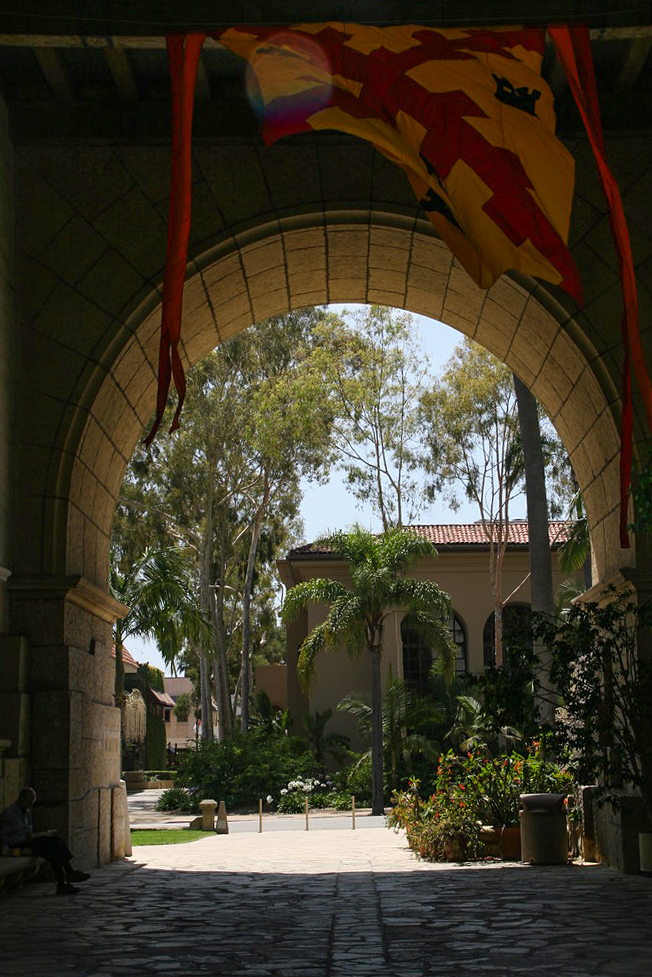
The Santa Barbara library, viewed from the county courthouse. Is this where the dead local paper’s archives will go? How about future archives of all the local news organs?
That ride began with the Santa Barbara News Press Controversy in 2006 and ended when Ampersand, the company McCaw created to hold the paper’s bag of assets (which did not include its landmark building downtown, which McCaw kept), filed for Chapter 7 bankruptcy in late July of last year. Here are stories about the death of the paper in three local news journals that have done a great job of taking up the slack left when the News-Press began to collapse, plus one in the LA Times:
From what I’ve read so far (and I’d love to be wrong) none of those news reports touch on the subject of the News-Press‘ archives, which conceivably reach back across the century and a half it was published. There can’t be a better first draft of history for Santa Barbara than that one. If it’s gone, the loss is incalculable. (August 18 2023)
The only mention of archives was in the closing sentences of that piece:
The purchase of the website included the Santa Barbara News-Press trademark, which would be important to the groups looking at the physical archive of back issues, photographs, and clippings by topic. Romo, who was once a paper boy for the daily, acknowledged that his group was supportive of the archive remaining local, too.
I don’t know what that means, and I haven’t checked. But I am sure that the archives ought to be managed by the community as a common pool resource.
Match rules governing use of common goods to local needs and conditions.
Ensure that those affected by the rules can participate in modifying the rules.
Make sure the rule-making rights of community members are respected by outside authorities.
Develop a system, carried out by community members, for monitoring members’ behavior.
Use graduated sanctions for rule violators.
Provide accessible, low-cost means for dispute resolution.
Build responsibility for governing the common resource in nested tiers from the lowest level up to the entire interconnected system.
Journalists, especially those who report news, are not herding animals. They tend to be competitive and territorial by both nature and purpose. So the collection of news entities I wrote about in We Need Wide News and We Need Whole News will almost certainly not cohere into a commons such as Lin (her nickname) Ostrom addresses in that list.
But they should cohere around archives—not only because that’s the right thing to do, but because they need those archives. We all do.
So I hope Santa Barbara’s many journals, journalists, friends, supporters, and interested local institutions get together around this challenge. Build a commons around those archives, whatever and wherever they happen to be.
Meanwhile here in Bloomington, my other hometown, we are pushing forward with The Online Local Chronicle that Dave Askins wrote about in the previous installment in this series. We might call that a commons interest here.
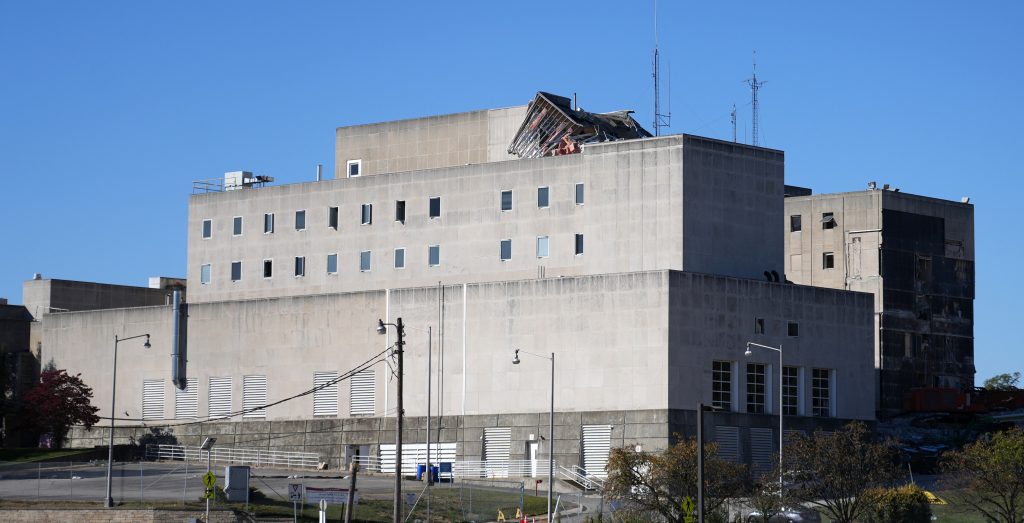
Bloomington Hospital on October 15, 2022, right after demolition began.
After we came to Bloomington in the summer of 2021, we rented an apartment by Prospect Hill, a quiet dome of old houses just west of downtown. There we were surprised to hear, nearly every night, as many police and ambulance sirens as we’d heard in our Manhattan apartment. Helicopters too. Soon we realized why: the city’s hospital was right across 2nd Street, a couple blocks away. In 2022, the beautiful new IU Health Bloomington Hospital opened up on the far side of town, and the sounds of sirens were replaced by the sounds of heavy machinery slowly tearing the old place down.
Being a photographer and a news junkie, I thought it would be a good idea to shoot the place often, to compile a chronicle of demolition and replacement, as I had done for the transition of Hollywood Park to SoFi Stadium in Inglewood, California. But I was too busy doing other things, and all I got was that photo above, which I think Dave Askins would categorize as a small contribution to topical history.
Dave is a highly productive local journalist, and—by grace of providence for a lifelong student of journalism such as me—the deepest and most original thinker I know on the topic of what local news needs in our time—and going forward. I’ve shared some of Dave’s other ideas (and work) in the News Commons series, but this time I’m turning a whole post over to him. Dig:::::
In the same way that every little place in America used to have a printed newspaper, every little place in America could have an online local chronicle.
Broadly speaking, an online local chronicle is a collection of facts organized mostly in chronological order. The “pages” of the chronicle can be thought of as subsets of a community’s universal timeline of events. These online local chronicles could become the backbone of local news operations.
First a word about what a local chronicle is not. It is not an online encyclopedia about the little place. It’s not a comprehensive history of the place in any conventional sense. Why should it not try to be those things? Because those things are too hard to think about building from scratch. Where would you even start?
It is at least conceivable that an online local chronicle could be built from scratch because you start by adding new facts that are newsworthy today. A new fact added to the chronicle is a touchstone, about which anyone can reasonably ask: What came just before that?
A working journalist in a little place with an online local chronicle will be in a good position to do two things: (1) add new facts to the local chronicle (2) help define sets of old facts that would be useful to include in the online local chronicle.
A journalist who is reporting the news for a little place would think not just about writing a report of new facts for readers today. They would keep this question in mind: What collection of old facts, if they were included in the local chronicle, would have made this news report easier to write?
Here’s a concrete example. A recent news report written for The B Square Bulletin included a mention of a planned new jail for Monroe County. It included a final sentence meant to give readers, who might be new to that particular topic, a sense of the basic reason why anyone was thinking about building a new jail: “A consultant’s report from two and a half years ago concluded that the current jail is failing to provide constitutional levels of care.”
About that sentence, a reader left the following comment on the website: “I know it’s the last sentence in an otherwise informative article, but at the risk of nit-picking that sentence seems inadequate to the task of explaining the context of the notion of a new jail and the role of the federal court and the ACLU.”
What this reader did was to identify a set of old facts that should be a collection (a page) in Bloomington’s local chronicle.
It’s one thing to identify a need to add a specific collection of facts to the local chronicle. It’s quite another to figure out who might do that. Working journalists might have time to add a new fact or two. But to expect working journalists to add all the old sets of facts would, I think, be too tall an order.
The idea would be to recruit volunteers to do the work of adding old facts to the online local chronicle. They could be drawn from various segments of the community—including groups that have an interest in seeing the old facts about a particular topic not just preserved, but used by working journalists to help report new facts.
I think many community efforts to build a comprehensive community encyclopedia have foundered, because the motivation to make a contribution to the effort is mostly philosophical: History is generally good to preserve.
The motivation for helping to build the online local chronicle is not some general sense of good purpose. Rather it is to help working journalists provide useful facts for anyone who in the community who is trying to make a decision.
That includes elected leaders. They might want to know what the reasons were at the time for building the current jail at the spot where it is now.
Decision makers include voters, who might be trying to decide which candidate to support.
Decision makers also include rank-and-file residents—who might be trying to decide where to go out for dinner and want to know what the history of health inspections for a particular restaurant are.
For the online local chronicle I have set up for Bloomington, there are very few pages so far. They are meant to illustrate the general concept:
The Tessereact, a structure that allows travel in time through a deep library, from the movie “Interstellar.”
Let’s say you’re a public official. Or an engineer. Or a journalist researching a matter of importance, such as a new reservoir or a zoning change. What do you need?
In a word, facts. This should go without saying, but it bears saying because lots of facts are hard to find. They get lost. They decay. Worse, in their absence you get hearsay. Conjecture. Gossip. Mis and Dis information. Facts can also get distorted or excluded when they don’t fit a story. This is both a feature and a bug of storytelling. I reviewed this problem in Stories vs. Facts.
So how do we keep facts from decaying? How do we make them useful and accurate when future decisions require them?
Two ways.
One is by treating news as history. You do this by flowing news into well0-curated archives that remain accessible for the duration.
The other is to gather and produce facts that don’t make news but might someday—and flow those into curated archives as well.
In both cases, we are talking about facts that decision-makers may need to do their work, whether or not their work produces news.
So let’s start with history.
Timothy Snyder defines history as “what’s possible.” In his Yale lectures on The Making of Modern Ukraine, he also says history is discontinuity. By that, he means we give the most significance to moments of change, to times of transition. Elections. Wars. Disasters. Championships. And we tend to ignore what’s not making news in the meantime. We also tend to ignore the kind of news that just burbles along, not sounding especially historical, but is interesting to readers, watchers, and listeners—and might be relevant again. This is most of what gets reported by the obsessives who still produce local news. But how much of that stuff gets saved? And where?
Here in Bloomington, Indiana, the big industries for more than a century were limestone, furniture, and radio and television manufacture. Specifically,
The limestone industry is still large and likely to stay that way until demand for premium limestone goes away (my guess is a few centuries from now).
The furniture industry came and went in about seven decades, but at its peak Showers Brothers Furniture produced a lion’s share of the affordable furniture sold in the U.S.
In the Forties and Fifties, so many radios and TVs were made here that Bloominngton for a time called itself “the color TV capitol of the world.”
If you haven’t seen Breaking Away yet, please do. Besides being one of the greatest coming-of-age stories ever told, it’s an excellent look at Bloomington’s small-town/big university charms, plus its limestone industry and the people who worked in it, back when the quarries and the cutting plants were still right in town. (They’re still around, but out amidst the farmlands.)
In Showers Brothers Furniture Company: The Shared Fortunes of a Family, a City and a University (Quarry Books, 2012), Carol Krause gives a sense of how huge a business Showers Brothers was at the time:
Shipments averaged seventy rail carloads per month. The sawmill daily cut 25,000 feet of lumber at that time and secured its lumber by purchasing large tracts of land and then logging them. This is undoubtedly part of the reason that so much of the land around Monroe and surrounding counties had been completely clear-cut early by the twentieth century.” (p. 121)
Her source for that was the April 26, 1904 issue of Bloomington Courier, then one of two papers competing to serve a town of about seven thousand people. But countless other bits of history are forever gone. In her notes about sources, Krause writes,
The business records of the Showets company have unfortunately been lost, and only a handful of the annual furniture catalogs survive, despite decades of publication. We no longer have the training materials that the company distributed to its salesme, and we have virtually no remaining business correspondence. As for family papers, we possess only the handwritten memoir of James Showers, the spiritual daybook of his mother, Elizabeth, and a small handful of family photographs. There is also no comprehensive Bomington history that sums up the major events or characters in the company’s history. Owing to the lack of records, this work relies largely upon accounts published in newspapers of the period. this record is fragmentary during the early years and we cannot consider any of it fully accurate or complete, because of the political partiality of the newspaper publishers. Nevertheless, newppaper records are the single largest remaining source of information available about the Showers family and its company, so this book reflects countless hours spent at the microfilm machines at the public library, perusing the headlines of bygone times. (p. xv)
Bloomington is fortunate to have an unusually thick collection of factual resources in the Monroe County library system and history center. Without those, Carol Krause probably wouldn’t have written her book at all. (Alas, she passed in 2014. Here is a Herald-Times obituary.)
The best sources I’ve found for Bloomington’s history as a broadcasting town are Bloomingpedia and Wikipedia. From the former:
In 1940 RCA moved a major manufacturing plant from Camden, NJ to Bloomington. The 1.5 million square foot RCA plant, although originally planned to build radios, was converted to televisions when that technology became viable, and when the first television came off the line on September 6, 1949, “TV Day” was declared in Bloomington. The plant was located on south Rogers Street, and produced more than 65 million televisions over the next 50 years. The factory employed over 8,000 workers at its peak, roughly 2% of the entire Bloomington workforce, and also provided many jobs for industries servicing the plant. Sarkes Tarzian, Inc. was among these. For a while, Bloomington called itself the “Color Television Capital of the World”.
Labor unrest began to swirl in the 1960’s. In 1964 5000 workers walked off the job over the protest of both management and union leaders. After a week, a new contract was approved and the workers returned to the assembly lines; but in October of 1966 the workers stuck again, claiming the company was in violation of the union contract, and several violent scuffles were reported. In 1967 a third, rather disorganized strike also took place.
In 1968, over 2000 people were laid off; mostly the young female workers that were considered to be most skilled at the delicate work of assembling televisions on the line.
RCA was bought by General Electric in 1986, then immediately sold to the French company Thomson SA, and rumors of the plant closing immediately began. On April 1, 1998, the last television rolled off the line and Thomson moved the plant to Juarez, Mexico, where RCA had had a small plant as early as 1968.
The Sarkes Tarzian company was an important manufacturer of radio and television equipment, television tuners, and components. Its FM radio receivers helped to popularize the broadcast medium. Sarkes Tarzian manufactured studio color TV cameras in the mid-1960s.[16] The manufacturing operations were spun off in the 1970s and today the company still exists as a broadcaster, owning several television and radio stations. Gray Television has owned a partial stake in Sarkes Tarzian, Inc., since the early 2000s.
Those are all great sources, but the holes are bigger than the hills.
We also have a new situation on our hands, now that we are completing what Jeff Jarvis calls The Gutenberg Parenthesis: the age of print. How do we best accumulate and curate useful facts in our still-new digital age?
Back in 2001, my son Allen astutely noted that the World Wide Web was splitting between what he called the Static Web and the Live Web. Here is what I wrote about the former in the October 2005 edition of Linux Journal:
There’s a split in the Web. It’s been there from the beginning, like an elm grown from a seed that carried the promise of a trunk that forks twenty feet up toward the sky.
The main trunk is the static Web. We understand and describe the static Web in terms of real estate. It has “sites” with “addresses” and “locations” in “domains” we “develop” with the help of “architects”, “designers” and “builders”. Like homes and office buildings, our sites have “visitors” unless, of course, they are “under construction”.
One layer down, we describe the Net in terms of shipping. “Transport” protocols govern the “routing” of “packets” between end points where unpacked data resides in “storage”. Back when we still spoke of the Net as an “information highway”, we used “information” to label the goods we stored on our hard drives and Web sites. Today “information” has become passé. Instead we call it “content”.
Publishers, broadcasters and educators are now all in the business of “delivering content”. Many Web sites are now organized by “content management systems”.
The word content connotes substance. It’s a material that can be made, shaped, bought, sold, shipped, stored and combined with other material. “Content” is less human than “information” and less technical than “data”, and more handy than either. Like “solution” or the blank tiles in Scrabble, you can use it anywhere, though it adds no other value.
I’ve often written about the problems that arise when we reduce human expression to cargo, but that’s not where I’m going this time. Instead I’m making the simple point that large portions of the Web are either static or conveniently understood in static terms that reduce everything within it to a form that is easily managed, easily searched, easily understood: sites, transport, content.
At the time I thought—we all thought—that the Live Web was blogs. But then social media came along, mostly in the forms of Twitter and Facebook. After Technorati (which I had a hand in creating) began to index the Live Web of RSS feeds, Google also began to index the whole Web in real time, and soon began to supply the world with live information such as traffic densities on maps in apps running on hand-held phones connected to the Internet full time.
As I shared in Deep News., Dave Askins of the B Square Bulletinwould like us to create a “digital file repository”—” a place where anyone—journalists, public officials, and residents of all stripes—can upload digital files, so that others can have access to those files now and until the end of time. It can also serve as a backup for files that the city has made public on its website, but could remove at any time.”
“Removing content from our site is not a decision we take lightly. Our teams analyze many data points to determine whether there are pages on CNET that are not currently serving a meaningful audience. This is an industry-wide best practice for large sites like ours that are primarily driven by SEO traffic,” said Taylor Canada, CNET’s senior director of marketing and communications. “In an ideal world, we would leave all of our content on our site in perpetuity. Unfortunately, we are penalized by the modern internet for leaving all previously published content live on our site.”
This is the exact opposite of deep news. It’s about as shallow as can be.
Not that Google is much deeper. I have a number of pages here that contain a unique word—kind of an Easter egg—that Google used to find if I searched for it. Now Google doesn’t. Why? whatever the reason, it is clear that Google is optimized for now rather than then.
So we need to start creating deep and archival ways that serve meaning across time.
I have a lot more to say about this, but want to get what I have so far up on the blog, where others can help improve the post. Meanwhile a bonus link: