Vue lecture

Il y a de nouveaux articles disponibles, cliquez pour rafraîchir la page.
🔲 ⭐

swift-justhtml

swift-justhtml

First there was Emil Stenström's JustHTML in Python, then my justjshtml in JavaScript, then Anil Madhavapeddy's html5rw in OCaml, and now Kyle Howells has built a vibespiled dependency-free HTML5 parser for Swift using the same coding agent tricks against the html5lib-tests test suite.

Kyle ran some benchmarks to compare the different implementations:

  • Rust (html5ever) total parse time: 303 ms
  • Swift total parse time: 1313 ms
  • JavaScript total parse time: 1035 ms
  • Python total parse time: 4189 ms

Tags: html5, ai, generative-ai, llms, ai-assisted-programming, vibe-coding, swift

🔲 ⭐

JustHTML is a fascinating example of vibe engineering in action

I recently came across JustHTML, a new Python library for parsing HTML released by Emil Stenström. It's a very interesting piece of software, both as a useful library and as a case study in sophisticated AI-assisted programming.

First impressions of JustHTML

I didn't initially know that JustHTML had been written with AI assistance at all. The README caught my eye due to some attractive characteristics:

  • It's pure Python. I like libraries that are pure Python (no C extensions or similar) because it makes them easy to use in less conventional Python environments, including Pyodide.
  • "Passes all 9,200+ tests in the official html5lib-tests suite (used by browser vendors)" - this instantly caught my attention! HTML5 is a big, complicated but meticulously written specification.
  • 100% test coverage. That's not something you see every day.
  • CSS selector queries as a feature. I built a Python library for this many years ago and I'm always interested in seeing new implementations of that pattern.
  • html5lib has been inconsistently maintained over the last few years, leaving me interested in potential alternatives.
  • It's only 3,000 lines of implementation code (and another ~11,000 of tests.)

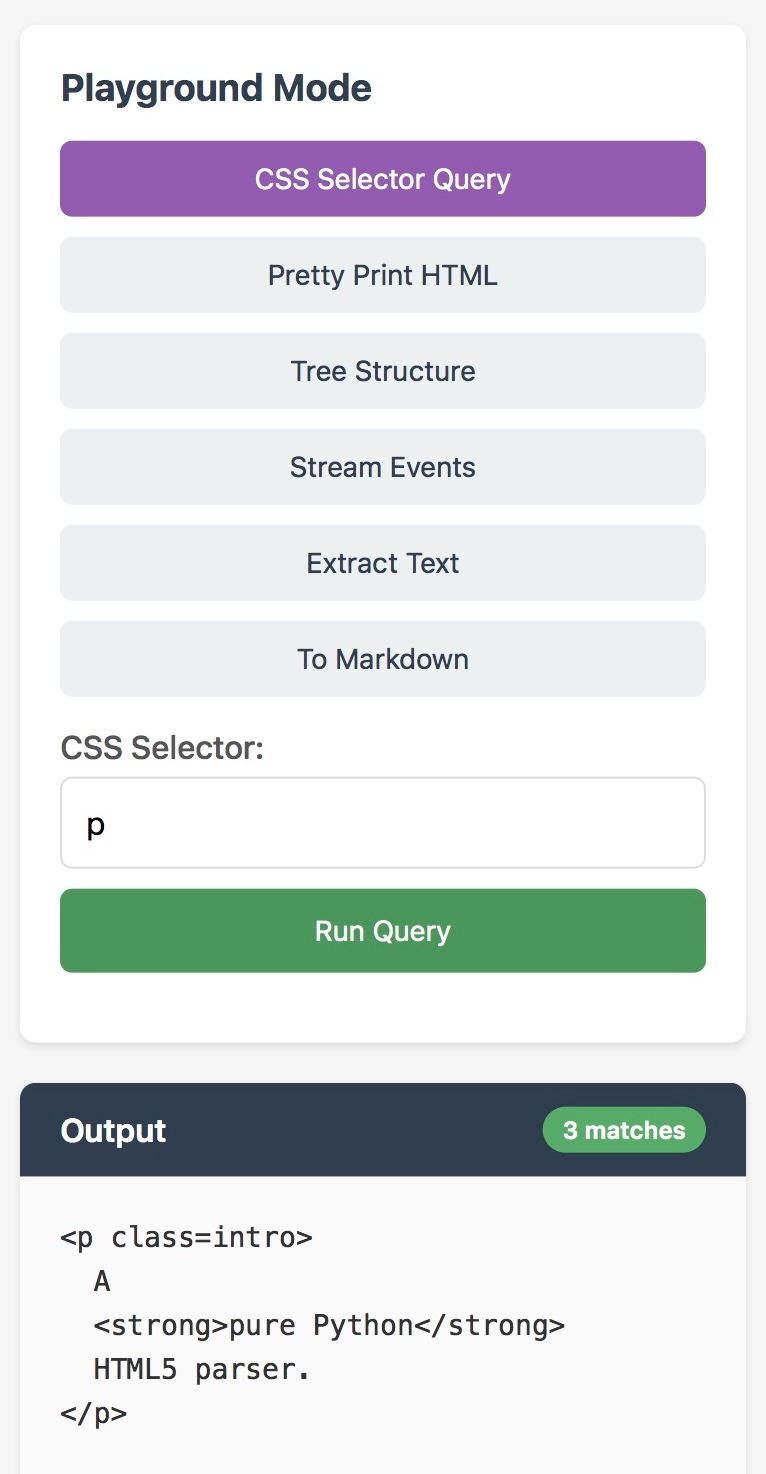
I was out and about without a laptop so I decided to put JustHTML through its paces on my phone. I prompted Claude Code for web on my phone and had it build this Pyodide-powered HTML tool for trying it out:

Screenshot of a web app interface titled "Playground Mode" with buttons labeled "CSS Selector Query" (purple, selected), "Pretty Print HTML", "Tree Structure", "Stream Events", "Extract Text", and "To Markdown" (all gray). Below is a text field labeled "CSS Selector:" containing "p" and a green "Run Query" button. An "Output" section with dark background shows 3 matches in a green badge and displays HTML code

This was enough for me to convince myself that the core functionality worked as advertised. It's a neat piece of code!

Turns out it was almost all built by LLMs

At this point I went looking for some more background information on the library and found Emil's blog entry about it: How I wrote JustHTML using coding agents:

Writing a full HTML5 parser is not a short one-shot problem. I have been working on this project for a couple of months on off-hours.

Tooling: I used plain VS Code with Github Copilot in Agent mode. I enabled automatic approval of all commands, and then added a blacklist of commands that I always wanted to approve manually. I wrote an agent instruction that told it to keep working, and don't stop to ask questions. Worked well!

Emil used several different models - an advantage of working in VS Code Agent mode rather than a provider-locked coding agent like Claude Code or Codex CLI. Claude Sonnet 3.7, Gemini 3 Pro and Claude Opus all get a mention.

Vibe engineering, not vibe coding

What's most interesting about Emil's 17 step account covering those several months of work is how much software engineering was involved, independent of typing out the actual code.

I wrote about vibe engineering a while ago as an alternative to vibe coding.

Vibe coding is when you have an LLM knock out code without any semblance of code review - great for prototypes and toy projects, definitely not an approach to use for serious libraries or production code.

I proposed "vibe engineering" as the grown up version of vibe coding, where expert programmers use coding agents in a professional and responsible way to produce high quality, reliable results.

You should absolutely read Emil's account in full. A few highlights:

  1. He hooked in the 9,200 test html5lib-tests conformance suite almost from the start. There's no better way to construct a new HTML5 parser than using the test suite that the browsers themselves use.
  2. He picked the core API design himself - a TagHandler base class with handle_start() etc. methods - and told the model to implement that.
  3. He added a comparative benchmark to track performance compared to existing libraries like html5lib, then experimented with a Rust optimization based on those initial numbers.
  4. He threw the original code away and started from scratch as a rough port of Servo's excellent html5ever Rust library.
  5. He built a custom profiler and new benchmark and let Gemini 3 Pro loose on it, finally achieving micro-optimizations to beat the existing Pure Python libraries.
  6. He used coverage to identify and remove unnecessary code.
  7. He had his agent build a custom fuzzer to generate vast numbers of invalid HTML documents and harden the parser against them.

This represents a lot of sophisticated development practices, tapping into Emil's deep experience as a software engineer. As described, this feels to me more like a lead architect role than a hands-on coder.

It perfectly fits what I was thinking about when I described vibe engineering.

Setting the coding agent up with the html5lib-tests suite is also a great example of designing an agentic loop.

"The agent did the typing"

Emil concluded his article like this:

JustHTML is about 3,000 lines of Python with 8,500+ tests passing. I couldn't have written it this quickly without the agent.

But "quickly" doesn't mean "without thinking." I spent a lot of time reviewing code, making design decisions, and steering the agent in the right direction. The agent did the typing; I did the thinking.

That's probably the right division of labor.

I couldn't agree more. Coding agents replace the part of my job that involves typing the code into a computer. I find what's left to be a much more valuable use of my time.

Tags: html, python, ai, generative-ai, llms, ai-assisted-programming, vibe-coding, coding-agents

☑️ ⭐

GPT-5.2

OpenAI reportedly declared a "code red" on the 1st of December in response to increasingly credible competition from the likes of Google's Gemini 3. It's less than two weeks later and they just announced GPT-5.2, calling it "the most capable model series yet for professional knowledge work".

Key characteristics of GPT-5.2

The new model comes in two variants: GPT-5.2 and GPT-5.2 Pro. There's no Mini variant yet.

GPT-5.2 is available via their UI in both "instant" and "thinking" modes, presumably still corresponding to the API concept of different reasoning effort levels.

The knowledge cut-off date for both variants is now August 31st 2025. This is significant - GPT 5.1 and 5 were both Sep 30, 2024 and GPT-5 mini was May 31, 2024.

Both of the 5.2 models have a 400,000 token context window and 128,000 max output tokens - no different from 5.1 or 5.

Pricing wise 5.2 is a rare increase - it's 1.4x the cost of GPT 5.1, at $1.75/million input and $14/million output. GPT-5.2 Pro is $21.00/million input and a hefty $168.00/million output, putting it up there with their previous most expensive models o1 Pro and GPT-4.5.

So far the main benchmark results we have are self-reported by OpenAI. The most interesting ones are a 70.9% score on their GDPval "Knowledge work tasks" benchmark (GPT-5 got 38.8%) and a 52.9% on ARC-AGI-2 (up from 17.6% for GPT-5.1 Thinking).

The ARC Prize Twitter account provided this interesting note on the efficiency gains for GPT-5.2 Pro

A year ago, we verified a preview of an unreleased version of @OpenAI o3 (High) that scored 88% on ARC-AGI-1 at est. $4.5k/task

Today, we’ve verified a new GPT-5.2 Pro (X-High) SOTA score of 90.5% at $11.64/task

This represents a ~390X efficiency improvement in one year

GPT-5.2 can be accessed in OpenAI's Codex CLI tool like this:

codex -m gpt-5.2

There are three new API models:

  • gpt-5.2 - I think this is what you get if you select "GPT-5.2 Thinking" in ChatGPT but I'm a little confused.
  • gpt-5.2-chat-latest - the model used by ChatGPT for "GPT-5.2 Instant" mode. It's priced the same as GPT-5.2 but has a reduced 128,000 context window with 16,384 max output tokens.
  • gpt-5.2-pro

OpenAI have published a new GPT-5.2 Prompting Guide. An interesting note from that document is that compaction can now be run with a new dedicated server-side API:

For long-running, tool-heavy workflows that exceed the standard context window, GPT-5.2 with Reasoning supports response compaction via the /responses/compact endpoint. Compaction performs a loss-aware compression pass over prior conversation state, returning encrypted, opaque items that preserve task-relevant information while dramatically reducing token footprint. This allows the model to continue reasoning across extended workflows without hitting context limits.

It's better at vision

One note from the announcement that caught my eye:

GPT‑5.2 Thinking is our strongest vision model yet, cutting error rates roughly in half on chart reasoning and software interface understanding.

I had disappointing results from GPT-5 on an OCR task a while ago. I tried it against GPT-5.2 and it did much better:

llm -m gpt-5.2 ocr -a https://static.simonwillison.net/static/2025/ft.jpeg

Here's the result from that, which cost 1,520 input and 1,022 for a total of 1.6968 cents.

Rendering some pelicans

For my classic "Generate an SVG of a pelican riding a bicycle" test:

llm -m gpt-5.2 "Generate an SVG of a pelican riding a bicycle"

Described by GPT-5.2: Cartoon-style illustration: A white, duck-like bird with a small black eye, oversized orange beak (with a pale blue highlight along the lower edge), and a pink neckerchief rides a blue-framed bicycle in side view; the bike has two large black wheels with gray spokes, a blue front fork, visible black crank/pedal area, and thin black handlebar lines, with gray motion streaks and a soft gray shadow under the bike on a light-gray road; background is a pale blue sky with a simple yellow sun at upper left and two rounded white clouds (one near upper center-left and one near upper right).

And for the more advanced alternative test, which tests instruction following in a little more depth:

llm -m gpt-5.2 "Generate an SVG of a California brown pelican riding a bicycle. The bicycle
must have spokes and a correctly shaped bicycle frame. The pelican must have its
characteristic large pouch, and there should be a clear indication of feathers.
The pelican must be clearly pedaling the bicycle. The image should show the full
breeding plumage of the California brown pelican."
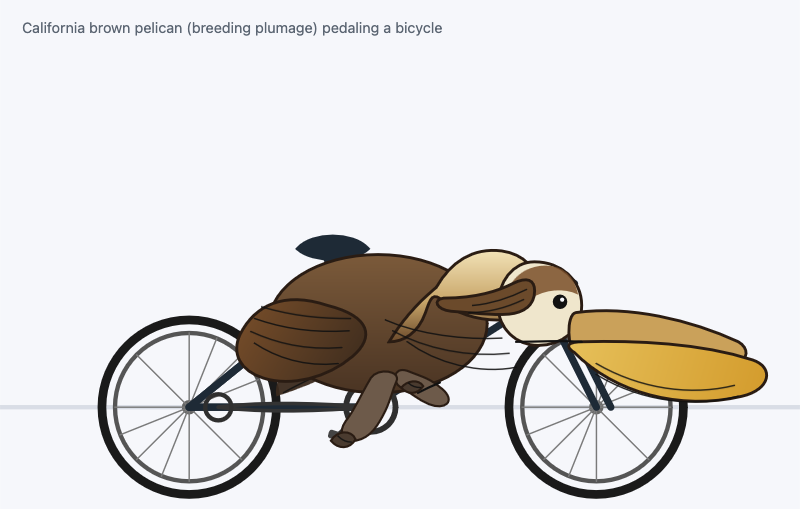
Digital illustration on a light gray/white background with a thin horizontal baseline: a stylized California brown pelican in breeding plumage is drawn side-on, leaning forward and pedaling a bicycle; the pelican has a dark brown body with layered wing lines, a pale cream head with a darker brown cap and neck shading, a small black eye, and an oversized long golden-yellow bill extending far past the front wheel; one brown leg reaches down to a pedal while the other is tucked back; the bike is shown in profile with two large spoked wheels (black tires, white rims), a dark frame, crank and chainring near the rear wheel, a black saddle above the rear, and the front fork aligned under the pelican’s head; text at the top reads "California brown pelican (breeding plumage) pedaling a bicycle".

Update 14th December 2025: I used GPT-5.2 running in Codex CLI to port a complex Python library to JavaScript. It ran without interference for nearly four hours and completed a complex task exactly to my specification.

Tags: ai, openai, generative-ai, llms, llm, pelican-riding-a-bicycle, llm-release, gpt-5

❌