Despite some hype by Apple fans in the media (especially Bloomberg’s Mark Gurman), Apple’s iPad event was more of the same — you might even say it was a dud. The iPad Air has a bigger screen, the iPad Pro has a chip that isn’t even in a Mac yet (telling any prospective Mac buyer to hold off even longer), and the vision of the iPad as a laptop replacement continues as a delusion among only the company’s top management.
The biggest thing to come out of the event wasn’t even one of the products, but an ad that was supposed to introduce the new iPad Pro to the world. In the video, a hydraulic press crushes the tools and products of human creativity, including everything from a trombone and piano to a sculpture and set of paints. The camera lingers on the objects to indulge in the moment of destruction. Everything must be obliterated for the press to rise again and show a gleaming black rectangle.
The idea of the ad is clear: all those creative tools can now be found in a ridiculously expensive device that just got a little thinner. But the execution shows how detached Apple leadership and PR has become that they couldn’t see the scandal in front of their eyes. At a time when generative AI is threatening to replace artists with poor imitations of their own work, people are particularly sensitive to the topic.
Apple has long positioned itself as a friend to artists, but as it signals it will be going hard on generative AI next month, the ad suggested the company has turned its back on that key constituency — and its decision makers couldn’t even see it. As the scandal broke, I could only think of a clip of Hayao Miyazaki that’s been making the rounds again the past couple years, where after seeing a terrible AI demo, he declares it “an insult to life itself.” Apple’s now succeeded in doing the same.
There’s plenty more about Apple in the roundup this week, particularly some stories about its union busting and poor treatment of workers. Beyond that, there are more recommended reads, labor updates, and other news you might have missed in this edition!
Over on Tech Won’t Save Us, I spoke with Ed Niedermeyer to dig into all the news coming out of Tesla lately: the cancellation of the Model 2, the doubling down on robotaxis, and the mass layoffs. It’s an important conversation where Ed explains the structural factors that made Tesla look like it was doing much better than it actually was these past couple years.
I was in Linz, Austria this week to speak at the Art Meets Radical Openness festival. I believe there will be a video of it at some point, so I’ll share it when I have it. If you’re in Copenhagen, I’ll be speaking there on May 22 and 23, then in Berlin on May 27.
The TikTok discourse is rearing its head again and I’m already exhausted by it, but at least it’s an opportunity to look once again at US hypocrisy, as I explained in the newsletter this week. I wasn’t expecting to write up a long post about TikTok and how the expansion of US tech also helped the US increase its own geopolitical clout, so you can also read the more personal post I wrote about physical media and why we shouldn’t want it to be eradicated by the shift to streaming.
In this week’s issue, I dig into some updates on the data center front after writing about it last month. I’m happy to see more media organizations shedding light on the material cost of AI. You can also scroll to the end for some more information on the photo of the big stone head crushing a Tesla — it’s a nice story!
Over on Tech Won’t Save Us, I caught up with Ed Zitron to dig into the many, many ways Silicon Valley is failing us and why people are right to be angry about it. The innovation has stalled, and instead they’re just making everything worse as they try to make as much money as possible.
Anyway, enjoy the roundup and have a great week!
— Paris
🎓
Are you a student and want to get the full Disconnect experience? Send Paris an email at info@disconnect.blog (or just reply to this issue) to get a discount on a paid subscription.
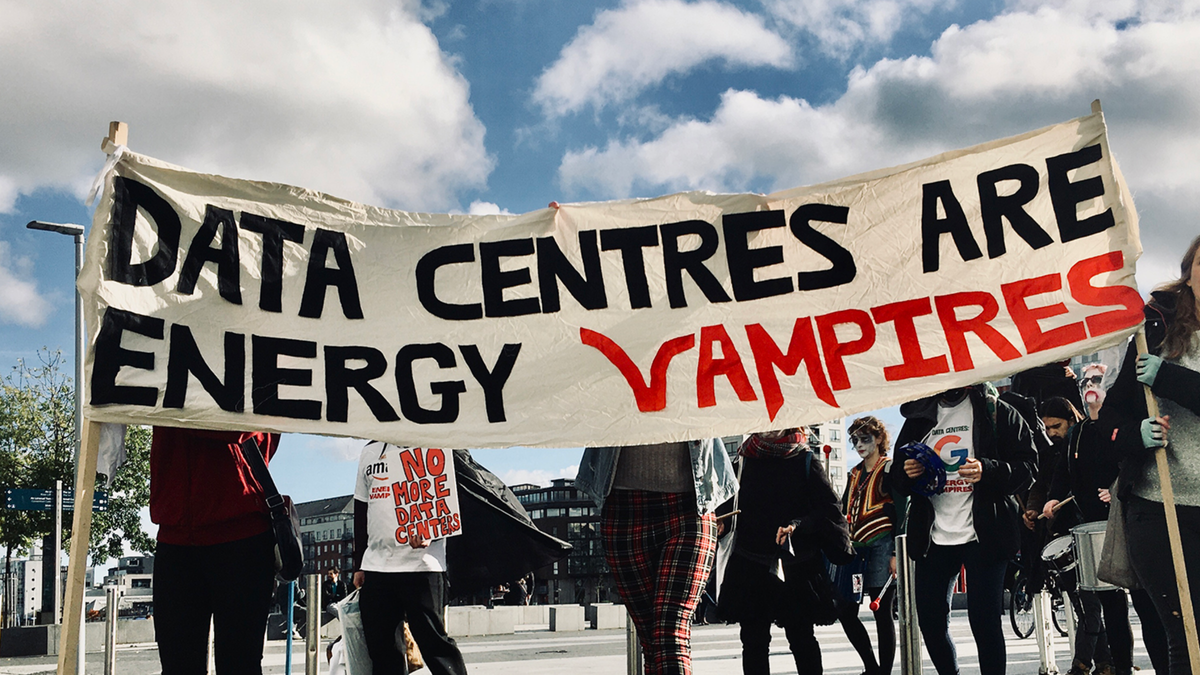
I’m not claiming any direct influence, but I’ve definitely noticed the media’s attention on that aspect of the AI story has picked up. Just in the media I follow, I’ve seen the Financial Times, the New Yorker, The Atlantic, and Bloomberg publish notable stories about the water and energy use of data centers, along with their growing environmental toll. I’m sure they’re not the only ones, and it’s important they’re doing this work because the fight isn’t over.
In my piece, I noted a number of countries where opposition to data centers is growing. After it was published, the New Zealand magazine North & South, whose story I referenced in the article, even reached out about republishing it in their April issue. Around that same time, experts in the Nordic countries were also gathering in Stockholm to discuss the problem posed by these major data center developments in their countries.
“If China remains the place of cheap labor for Silicon Valley innovations, the Nordic countries are today the source of cheap land and cheap renewable electricity for machines needed to produce the new business of Sillicon Valley around data processing and AI,” wrote Linköpings University associate professor Julia Velkova. In her roundup of the meeting, she explained how the high energy demands of Microsoft in Malmö, Sweden meant a bread factory had to be built elsewhere, while Amazon Web Services is responsible for crowding out businesses in the Swedish town of Sörmland. Meanwhile, they’re also building new fossil fuel infrastructure, like AWS’s planned 600 MW diesel generator in Katrineholm, and as in the Chilean case, the companies are not open about their business practices and do not communicate with researchers or the public.
Anthropologist Steven Gonzalez Monserrate has a new report out illustrating why this is so important. “The Cloud now has a greater carbon footprint than the airline industry,” he writes. “A single data center can consume the equivalent electricity of 50,000 homes.” He discusses the energy and water use of data centers, along with the some of the community impacts from noise pollution and the broader issue of e-waste from all the computer hardware that filters in and out of those warehouses of computing. As I argued in my piece last month, understanding the material impact of data centers forces us to consider whether it makes to be using this much computer in the first place.
Recommended reads
Historian Margaret O’Mara has a new piece in Project Syndicate comparing the AI boom in Silicon Valley to what was happening 30 years ago as the dot-com explosion shook off the dread of a recession. While not predicting where things might go, she notes one key difference: “Whereas the internet era fundamentally disrupted the technology industry, the AI boom is making Big Tech stronger than ever.”
Apple and Tesla are struggling in China. In Rest of World, Russell Brandom explains it’s pretty simple why: they underestimated their Chinese competitors. Huawei has become “the hip brand for young people,” displacing Apple, while Nio has “developed a cult following that’s remarkably similar to Tesla’s rabid U.S. fan base.”
Interesting numbers from a new report on AI trust: Only 35% of Americans trust AI companies, down from 50% five years ago. Plus, those surveyed in France, Canada, Ireland, UK, U.S., Germany, Australia, the Netherlands, and Sweden “reject the growing use of AI by a three-to-one margin.”
Labor updates
IATSE, the union representing film industry craft workers, and Hollywood studios are negotiating specific issues of interest to cinematographers, editors, and other crafts next week.
The European Union has adopted a heavily watered down version of the Platform Work Directive that likely won’t make a significant difference for gig workers.
Uber is creating a yellow union in Australia to try to halt progress toward better wages and working conditions for drivers.
I’m almost happy there aren’t many labor updates this week, because recently they’ve often been layoff roundups.
In other news
A new report in AdWeek suggests publishers could see “potential declines ranging from 20% to 60%” in organic search traffic as Google rolls out generative AI tools.
Last year, two men with reported ties to the Indian government assassinated a Canadian citizen on Canadian soil who had ties to a Sikh separatist group. YouTube just removed a report by Canada’s public broadcaster the CBC about the killing after it was demanded by the Indian government.
India is moving forward with AI regulations ahead of parliamentary elections next month after a right-wing backlash to Google’s Gemini (rightfully) identifying prime minister Narendra Modi as a fascist.
Bloomberg did a quick breakdown of the US, EU, and Chinese approaches to AI regulation.
Elon Musk canceled Don Lemon’s show on X/Twitter before it even released its first episode because Musk didn’t like the questions Lemon asked him in an interview.
Musk shared a video accusing Haitians of engaging in cannibalism this week that was later taken down for violating X/Twitter’s (very lax) rules.
Tesla, Netflix, and Salesforce are among the major US companies that paid more to their CEOs between 2018 and 2022 than they paid in taxes.
Tesla isn’t likely to have another big growth phase until at least 2027, according to an Evercore analyst.
Tesla is also headed back to court next week over a case where Autopilot was responsible for the death of Apple engineer Walter Huang in 2018. Lawyers on the plaintiffs’ side have emails showing Tesla knew people weren’t paying attention to the road while using the system.
You’ve already seen the image at the top of the article, but why did artist Chavis Mármol crush a Tesla under a replica of a giant Olmec head? In a video posted to Instagram by the hotel that commissioned the world, he describes wanting to contrast the “mother culture” against one of the most controversial companies and businessmen in the world.
“The Olmec head imposes itself before the technological object, it bursts and crushes it and in the end it is glorified before this object,” says Mármol, “which no matter how technological or how much it is an object of desire, in the end it is just that, just a product of a capitalist system, when in reality what matters is what we came from, what we are, and what we have been generation after generation.”
In a later post, he admitted another goal: “What I was looking for doing with this piece was to troll Elon Musk and his new car plant in Mexico.”